USAID DEC
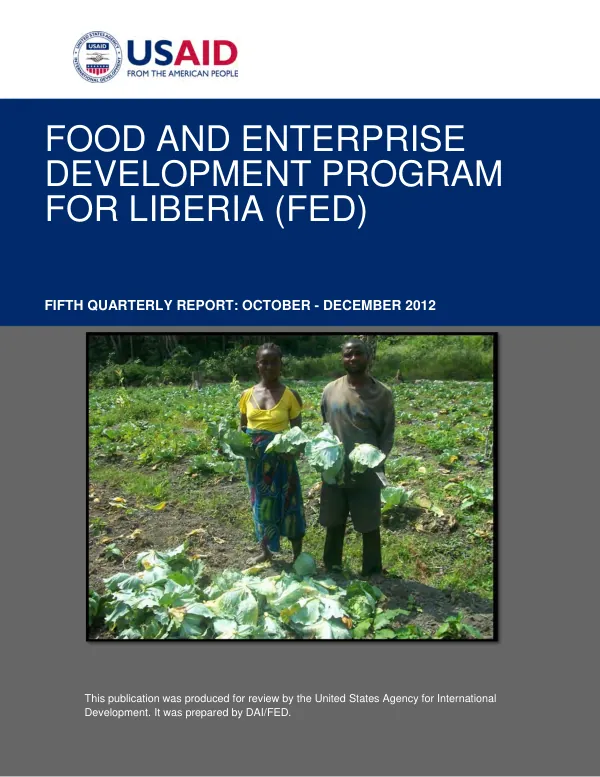
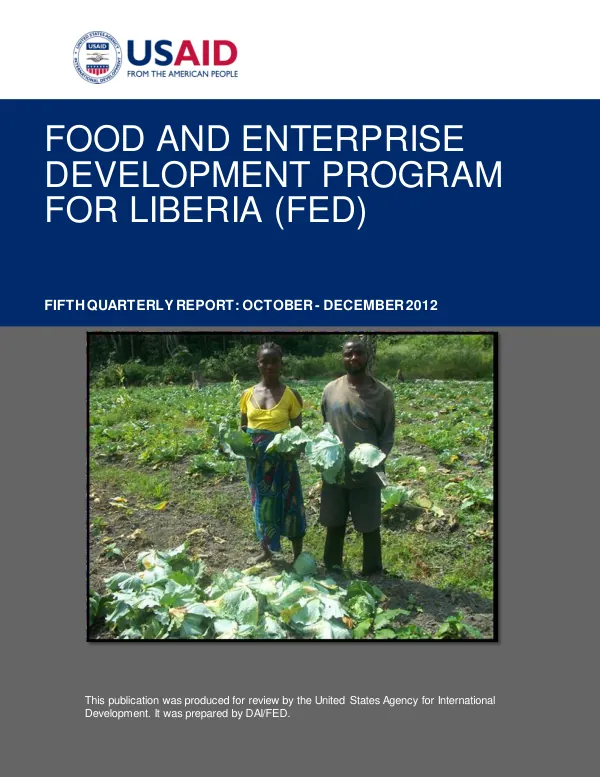
Food and Enterprise Development (FED) Program for Liberia Fifth Quarterly Report: October – December 2012
Sign inCATHOLIC RELIEF SERVICES ORGANIZATION
Food and Enterprise Development (FED) Program for Liberia Fifth Quarterly Report: October – December 2012
The Food and Enterprise Development (FED) Program for Liberia is a USAID-funded initiative aimed at improving agricultural productivity and stimulating private enterprise in Liberia.
2012 · 73 pages
Sign in to readA free account is required to download.
Abstract
The program operates in three main components: Increased Agricultural Productivity, Stimulate Private Enterprise, and Build Local Human Capacity. Increased Agricultural Productivity is the first component of the FED program. This component focuses on improving agricultural productivity through various interventions, including input supply, agriculture extension, and mechanization. In the fifth quarter, seedling producers achieved significant milestones, with 12,000 seedlings produced and sold to farmers in Margibi and Bong Counties. Additionally, agro-dealers in these counties received training on good agricultural practices, and agro-inputs were displayed by Wienco, a local company. Task 1.4, Agriculture Extension, involved training extension agents in Margibi and Bong Counties on best practices in agriculture. The training aimed to improve the agents' ability to provide technical assistance to farmers. Task 1.5, Increased Productions and Profitability of Quality Rice, focused on improving rice production and profitability through the use of improved rice varieties and good agricultural practices. Task 1.6, Increased Productions and Profitability of Quality Cassava, aimed to improve cassava production and profitability through the use of improved cassava varieties and good agricultural practices. Mechanization is another key area of focus in the Increased Agricultural Productivity component. The program aimed to improve farmers' access to mechanized farming equipment, such as tractors and plows, to increase their productivity and efficiency. Task 1.8, Goat Interventions, involved the distribution of goats to farmers in Margibi and Bong Counties to improve their livelihoods and increase their income. The second component of the FED program is Stimulate Private Enterprise. This component focuses on stimulating private enterprise in the agricultural sector through various activities, including profiling commercial buyers and lead producers, providing targeted technical support, and increasing enterprise registration and local government engagement. Activity 2.3.A.i, Profile Commercial Buyers and Activity 2.3.A.ii.a – Profile and Select Lead Producers, FBOs, and Enterprises, involved profiling commercial buyers and lead producers, FBOs, and enterprises in the agricultural sector. Activity 2.3.A.ii.e – Targeted Technical Support, provided targeted technical support to selected lead producers, FBOs, and enterprises. The third component of the FED program is Build Local Human Capacity. This component focuses on building the capacity of local institutions and individuals to manage and implement agricultural projects. Task 3.1, Creating Centers of Excellence, involved the establishment of centers of excellence in agriculture at the Lofa County Community College and the Grand Bassa County Community College. The centers provided training and technical assistance to farmers and agricultural extension agents. Monitoring and evaluation are critical components of the FED program. The program used various indicators to measure its progress and impact. The indicator status table for October-December 2012 showed significant progress in various areas, including increased agricultural productivity, improved market access, and increased enterprise registration. The MDF activities summary for October-December 2012 highlighted the program's achievements in various areas, including input supply, agriculture extension, and mechanization. The FED program also engaged in various project management and administration activities, including environmental compliance monitoring and reporting. The program's environmental compliance monitoring and reporting activities aimed to ensure that the program's activities did not harm the environment and that the program's environmental impacts were mitigated.
Related documents