USAID DEC
Food and Enterprise Development (FED) Program for Liberia Monthly Report: November 2012
Sign inDAI
Food and Enterprise Development (FED) Program for Liberia Monthly Report: November 2012
The Food and Enterprise Development (FED) Program for Liberia is a USAID-funded initiative that began in September 2011.
2012 · 48 pages
Sign in to readA free account is required to download.
Abstract
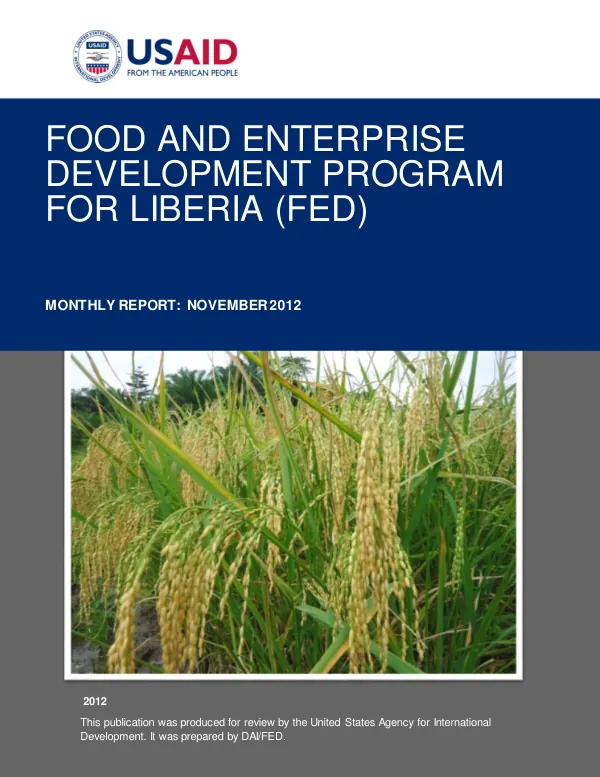
The program aims to help the government of Liberia achieve food security by building an indigenous incentive structure that assists a range of agricultural stakeholders to adopt commercial approaches and actively incorporates women and youth. FED's activities focus on improving technologies for productivity and profitability, expanding and modernizing input supply and extension systems, commercial production, marketing, and processing, enterprise services, and workforce and human capacity development. The program works with the Ministry of Agriculture (MoA) and the private sector to link communities to extension services, agricultural inputs, improved technologies, processing services, market information, transportation, credit, and appropriate education, training, and business development services. The geographic reach of FED includes various counties in Liberia, with a focus on increasing agricultural productivity and stimulating private enterprise. The program has identified several key areas for intervention, including input supply system interventions, increased production and profitability of quality rice and cassava, peri-urban vegetable production, and mechanization. In November 2012, FED's activities included task 1.1 input supply system interventions, which aimed to improve the availability and accessibility of agricultural inputs. Task 1.2 focused on increasing production and profitability of quality rice, while task 1.3 targeted increased production and profitability of quality cassava. Task 1.4 focused on peri-urban vegetable production, including mechanization, crop protection, cover crops, nursery construction, vegetable seedling production training, and vegetable dryer production training. FED also implemented component two, which aimed to stimulate private enterprise. This component included activities such as profiling commercial buyers and lead producers, providing targeted technical support, and increasing enterprise registration and local government engagement. Additionally, FED implemented component three, which focused on building local human capacity through the creation of centers of excellence, internship programs, and staff workshops. Monitoring and evaluation activities were also conducted in November 2012, including field travel, overall county findings, M&E successes and challenges, rice survey, and special reports/studies/surveys. The indicator status table and successes and challenges encountered during the month were also reported. Activities planned for December 2012 included market development fund, FED activity table, and FED STTAs tracking table. The FED program has made significant progress in increasing agricultural productivity and stimulating private enterprise in Liberia. The program's activities have improved the availability and accessibility of agricultural inputs, increased production and profitability of quality rice and cassava, and stimulated private enterprise through the creation of centers of excellence and internship programs.