USAID DEC
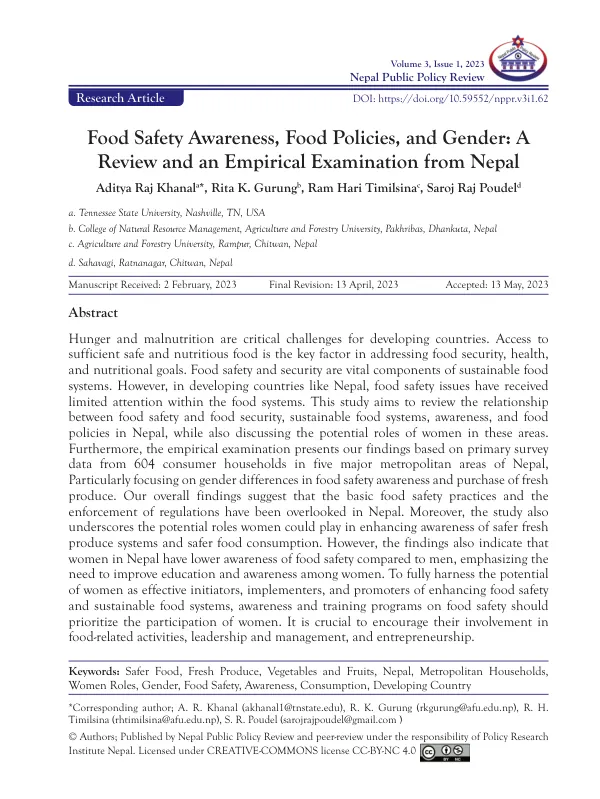
Food Safety Awareness, Food Policies, and Gender: A Review and an Empirical Examination from Nepal
Sign inCORNELL UNIVARSITY INTERNATIONAL
Food Safety Awareness, Food Policies, and Gender: A Review and an Empirical Examination from Nepal
Food safety awareness and food policies play a crucial role in addressing hunger and malnutrition in developing countries.
2023 · 26 pages
Sign in to readA free account is required to download.
Abstract
Access to sufficient, safe, and nutritious food is essential for addressing food security, health, and nutritional goals. Food safety encompasses the aspects of handling, preparation, storage, and consumption of food, preventing contamination throughout the process and food chains, and reducing foodborne illnesses. In developing countries like Nepal, food safety issues have received limited attention within the food systems. However, Nepal has slowly dropped its score on the Global Hunger Index from a serious to moderate level. There is still much work to be done in addressing food insecurity and ensuring a safer food supply and consumption in Nepal. The efforts on food safety in Nepal are emerging but are at the initial stages, mainly focusing on identifying issues and challenges and documenting policies. Women play a central role in the food system and are integral components in the cultivation of food crops, food production, food consumption, and related activities. According to the United Nations, women make up at least 43 percent of the agricultural workforce in developing countries, and as much as 70 percent in some countries. Therefore, women could be instrumental in the fight against malnutrition and in making food systems more sustainable. The study aims to review the relationship between food safety and food security, sustainable food systems, awareness, and food policies in Nepal, while also discussing the potential roles of women in these areas. The empirical examination presents findings based on primary survey data from 604 consumer households in five major metropolitan areas of Nepal, focusing on gender differences in food safety awareness and purchase of fresh produce. The study conducted a comprehensive review of the existing literature related to food safety, food security, and gender roles in food systems, focusing on developing country perspectives and the Nepalese context. The review findings are presented under different subheadings in the result and discussion section. Additionally, the study used empirical survey data generated from a research project implemented in Nepal to understand the baseline and drivers of food safety among consumers and producers of fresh produce systems. The study administered stratified random sampling with randomly selected wards and Toles within the selected metropolitan area. A sample frame was devised in each metropolitan area in collaboration with local government authorities and officials, and in-person interviews were conducted based on a structured questionnaire using survey enumerators. The study examined the awareness level of food safety in fresh produce shopping and consumption, analyzing responses from a primary survey conducted in five major metropolitan areas of Nepal. The findings suggest that the basic food safety practices and the enforcement of regulations have been overlooked in Nepal. The study also underscores the potential roles women could play in enhancing awareness of safer fresh produce systems and safer food consumption. However, the findings also indicate that women in Nepal have lower awareness of food safety compared to men, emphasizing the need to improve education and awareness among women. To fully harness the potential of women as effective initiators, implementers, and promoters of enhancing food safety and sustainable food systems, awareness and training programs on food safety should prioritize the participation of women.
Related documents
Documents in this collection
 2023
2023USAID DEC
FY2023 Semi-Annual Report Feed the Future Innovation Lab for Food Safety
Open record 2017
2017USAID DEC