USAID DEC
Household food production is positively associated with dietary diversity and intake of nutrient-dense foods for older preschool children in poorer families: Results from a nationally-representative survey in Nepal
Sign inINTERNATIONAL FOOD AND POLICY RESEARCH INSTITUTE
Household food production is positively associated with dietary diversity and intake of nutrient-dense foods for older preschool children in poorer families: Results from a nationally-representative survey in Nepal
Household food production is positively associated with dietary diversity and intake of nutrient-dense foods for older preschool children in poorer families in Nepal.
2017 · 24 pages
Sign in to readA free account is required to download.
Abstract
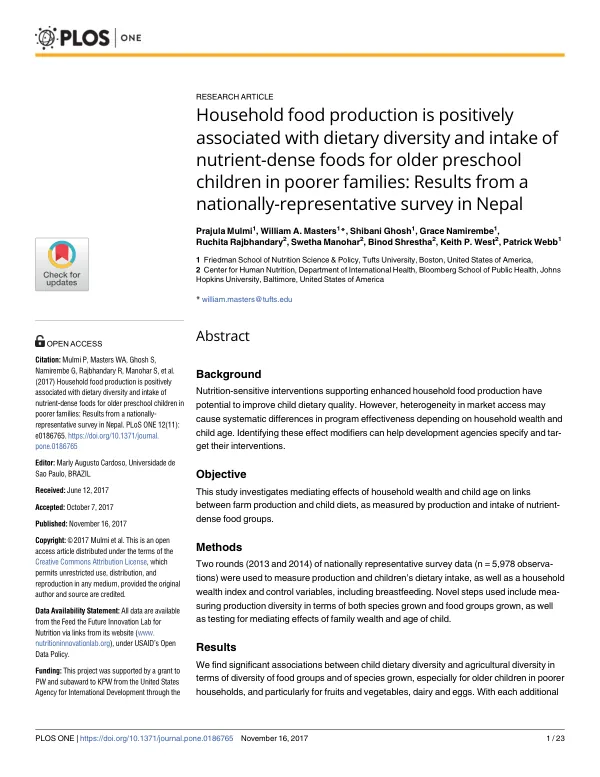
The study, conducted in 2013 and 2014, used nationally representative survey data to measure production and intake of various food groups, as well as household wealth and control variables. The results show significant associations between child dietary diversity and agricultural diversity, particularly for older children in poorer households. The study found that for every additional food group produced, the log-odds of meeting a minimum dietary diversity score increased by 0.25 (p = 0.01) for children aged 24-59 months. This effect size was similar for younger children aged 18-23 months, but only in the poorest two quintiles of household wealth. For infants aged 6-18 months, no association was found between production and intake. The study also found that household food production was associated with dietary diversity and intake of nutrient-dense foods, particularly for fruits and vegetables, milk, and eggs. The results suggest that household food production can be an effective strategy for improving child nutrition, particularly in poorer households. The study's findings have implications for the design of nutrition-sensitive interventions that aim to improve child dietary diversity and intake of nutrient-dense foods. The results suggest that such interventions should prioritize support for household food production, particularly in poorer households. Additionally, the study's findings highlight the importance of considering the heterogeneity in market access and household wealth when designing such interventions. The study used a nationally representative survey of 5,978 observations, collected in two rounds in 2013 and 2014. The survey measured production and intake of various food groups, as well as household wealth and control variables. The study's methodology allowed for careful consideration of heterogeneity in household wealth and child age as potential confounders in the relationships between agricultural production and child diets. The study's results are consistent with previous research on the relationship between agricultural production and child diets. The study's findings also highlight the importance of considering the heterogeneity in market access and household wealth when designing nutrition-sensitive interventions. The study's results have implications for the design of such interventions, particularly in the context of Nepal's national nutrition plan to improve child dietary diversity and intake of nutrient-dense foods. The study's findings also have implications for the design of interventions that aim to improve child nutrition in other low- and middle-income countries. The results suggest that such interventions should prioritize support for household food production, particularly in poorer households. Additionally, the study's findings highlight the importance of considering the heterogeneity in market access and household wealth when designing such interventions. The study's methodology allowed for careful consideration of heterogeneity in household wealth and child age as potential confounders in the relationships between agricultural production and child diets. The study's results are consistent with previous research on the relationship between agricultural production and child diets. The study's findings also highlight the importance of considering the heterogeneity in market access and household wealth when designing nutrition-sensitive interventions. The study's findings are consistent with previous research on the relationship between agricultural production and child diets. The study's results also highlight the importance of considering the heterogeneity in market access and household wealth when designing