USAID. MISSION TO COSTA RICA
Forest conservation and management (BOSCOSA)
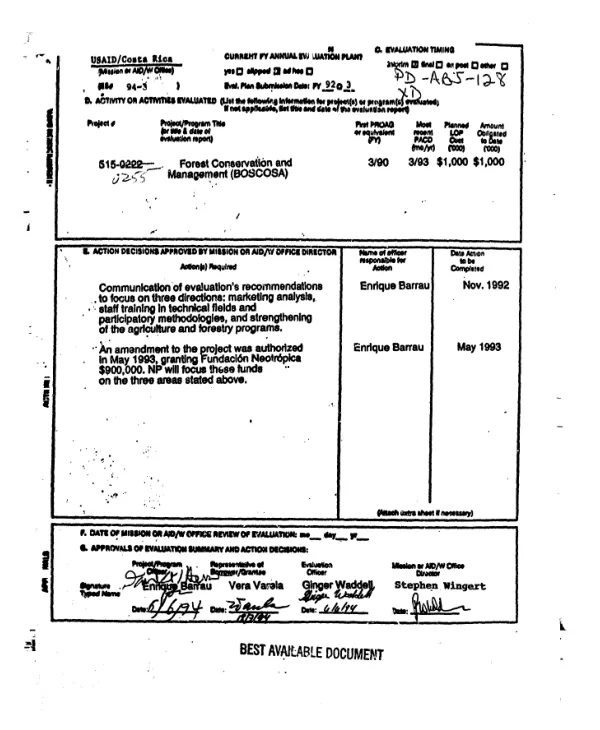
Summarizes final evaluation (PD-ABF-158) of a project to promote sustainable forest management on the Osa Peninsula of Costa Rica (BOSCOSA project).
1994
Sign in to readA free account is required to download.
Abstract
The evaluation covered the period 3/90-6/92 (vs. a 3/93 PACD). The project was implemented by Fundacion Neotropica through partnerships with grassroots organizations. Fundacion Neotropica has done a commendable job in launching the project and maintaining its momentum in the face of difficult circumstances. Despite several challenging obstacles, the project accomplished much in a short time and demonstrates great potential in natural resource management and development techniques that can be replicated elsewhere. Legal and policy work being carried out with assistance from CEDARENA is of utmost importance and should be maintained, even expanded. The most significant impacts were in the areas of social and ecological sustainability. In regard to social sustainability, BOSCOSA helped to change local attitudes towards forest conservation; catalyzed the development of grassroots organizations and increased cooperation among governmental agencies; and increased human resource development and employment. Ecologically, the project improved land use on 160 of 290 ha and stabilized land use around the Corcovado Park; as a result, fewer forests are at risk of being cleared for agricultural use. Economic and political impacts of the project were not significant. Continued USAID support will permit BOSCOSA to move in three general directions: marketing analysis, staff training in technical fields and participatory methodologies, and improved agricultural and forestry programs. Operational organization should be modified to reflect these priorities, and economic programs should be designed to pay off within 3 years. Also, counterpart assistance in financing core project costs will help to ensure financial independence and institutional continuity after the termination of USAID assistance. In May 1993, USAID granted Fundacion Neotropica an additional $900,000 for activities in the three areas recommended by the evaluators.