DEUTSCHE GESELLSCHAFT FÜR INTERNATIONALE ZUSAMMENARBEIT GMBH
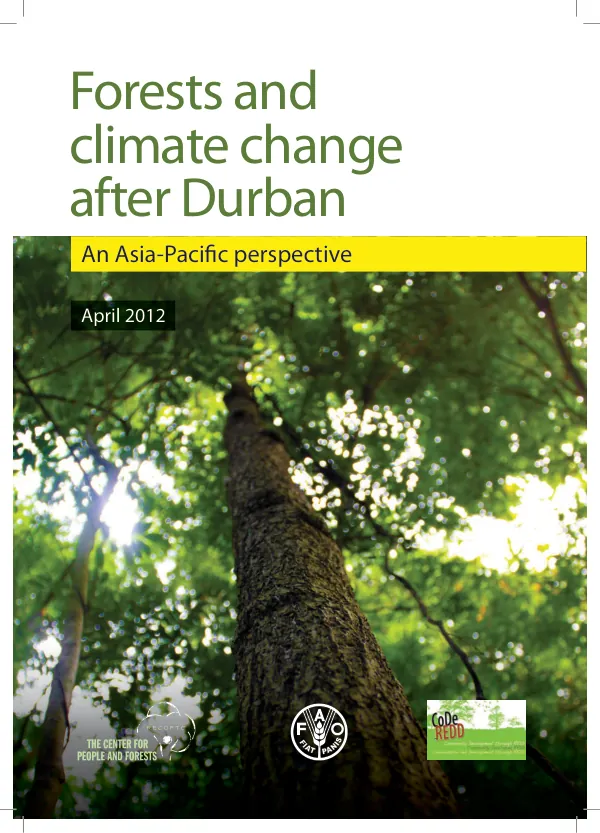
Forests and climate change after Durban An Asia-Pacific perspective
Forests and climate change after Durban: An Asia-Pacific perspective.
2012 · 28 pages
Sign in to readA free account is required to download.
Abstract
The REDD+ text emerging from Durban brings greater clarity to the Forest Reference Emissions Levels (RELs)/Reference Levels (RLs), social and environmental safeguards, and Measurement, Reporting, and Verification (MRV). However, many questions remain unresolved regarding the sources of finance and mechanisms for benefit sharing. The Subsidiary Body for Scientific and Technological Advice (SBSTA) has postponed a decision on developing an 'information system' for reporting national REDD+ safeguard performance until Parties have more experience of REDD+ implementation. Safeguards are now explicitly linked to REDD+ finance in the Long Term Cooperative Action (LCA) text, which is an important step forward. There is an unresolved debate on the sources of financing for REDD+, although the door has been left open for market-based funding. Public funds for REDD+ are still considered necessary by all Parties, particularly during the Readiness phase, underlining reliance on donor support for the strengthening of forest governance, safeguard enforcement, and MRV systems. The Durban decisions offer little guidance on how REDD+ finance will reach local stakeholders. This presents difficulties for countries, such as Cambodia, that have established pilot REDD+ projects and must demonstrate how benefits can be delivered before building a case for extending the model to other areas. Finance discussions are now more open and less contentious than in previous Conferences of the Parties (COPs). This is expected to continue and should help ensure greater progress at the COP 18 in Qatar. The creation of the Durban Platform for Enhanced Action has launched a new stage in the negotiations, opening up opportunities for constructive dialogue between industrialized and developing countries. However, this may effectively mean that the principle of 'common but differentiated responsibilities' is weakened. It remains to be seen whether this is a constructive step from the perspective of Asia-Pacific countries, despite the laudable stalemate-breaking actions of China and India. The issue of historic equity between Parties must not be forgotten. The Asia-Pacific region needs to achieve regional priorities in balancing adaptation and mitigation, as well as finding an appropriate role for REDD+, and a regionally coherent approach. The region must also address the unresolved debate on the sources of financing for REDD+ and ensure that REDD+ finance reaches local stakeholders. The REDD+ dialogue leading up to Durban has been constructive for the region, but there are still many challenges to be addressed. The region must work together to ensure that REDD+ is implemented in a way that benefits local communities and the environment. The Durban Platform for Enhanced Action provides an opportunity for the region to move forward, but it also presents challenges that must be addressed. The creation of the Durban Platform for Enhanced Action has launched a new stage in the negotiations, opening up opportunities for constructive dialogue between industrialized and developing countries. However, this may effectively mean that the principle of 'common but differentiated responsibilities' is weakened. It remains to be seen whether this is a constructive step from the perspective of Asia-Pacific countries, despite the laudable stalemate-breaking actions of China and India.