USAID DEC
Formulaci6n de Proyectos de Desarrollo Agricola
The agricultural development initiative in Latin America has been heavily reliant on external financing for the economic and social development of the region.
2010 · 11 pages
Sign in to readA free account is required to download.
Abstract
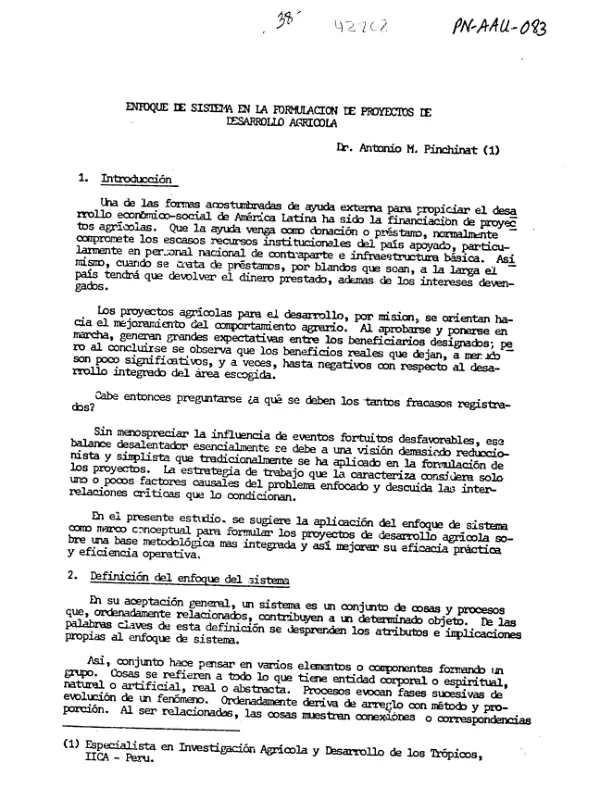
Regardless of whether the aid comes in the form of a donation or a loan, it typically promotes the limited institutional resources of the supported country. In the long run, the country will have to repay the loan, in addition to the accrued interest. The agricultural projects for development, by mission, aim to improve the agricultural management. Upon approval and implementation, they generate high expectations among the designated beneficiaries; however, upon completion, the real benefits they leave are often minimal, insignificant, or even negative compared to the integrated development of the selected area. It is essential to question why the numerous failures are registered. While not downplaying the influence of unfavorable fortuitous events, the discouraging balance is essentially due to a too-restrictive and simplistic vision that has traditionally been applied in the formulation of projects. The work strategy that characterizes this approach considers only one or a few causal factors of the focused problem and disregards the critical relationships that condition it. In the present study, the application of the systemic conceptual approach is suggested for formulating agricultural development projects on a more integrated and methodological basis, thus improving their practical effectiveness and operational efficiency. A system, in its general acceptance, is a set of things and processes that, ordered and related, contribute to a determined object. From this definition, the attributes and implications proper to the systemic approach are derived. A set implies several elements or components forming a group. Things refer to what has a corporal or natural or spiritual, artificial, real, or abstract entity. Processes can be the evolution of a phenomenon, its successive phases. Ordered and derived from arrangement and proportion, the things show connections or correspondences when related. If they contribute, it is understood that each thing brings its share of effect. Determined is the result of definition and selection. The object is the end or intent to which an action is directed. From a practical point of view, natural systems are open, meaning they relate to the environment, resulting in input and output flows. The established relationships between the sets, for analytical purposes, indicate the operational scope of each system. In summary, the systemic approach is characterized by implying: a) sets of identified components, b) interrelations (interaction and interdependence) between the components of each set and between sets, c) inputs of one set to another, d) output of one set to another, and e) limits of the sets. Functionally visualized, the approach separates three parts of the process (Figure No. 1): a) input of inputs, b) transformation of inputs into a determined product, and c) output of the product, which (at least theoretically) retroalimentates the source of inputs. For convenience in the functional analysis of systems (Figure No. 2), two environments are distinguished for each structure: a) the internal environment, which refers to the specifically focused system, and b) the external environment, which includes both the source of inputs and the receptor of the product, grouped in a single, peripheral system (environment). The determination of the limits depends on various conditions, with the following being critical: a) the reasons that lead to the analysis and the degree of resolution desired, b) the type of interaction between the considered components or the most relevant ones for the proper functioning of the system under study, c) the degree and level of control that can be exercised over the inputs and outputs, and d) the analytical instruments and resources available for the study. Conceptually, the systemic approach proceeds from the whole to the components and emphasizes the interrelations both within and between sets to understand their integral functioning. In effect, it rescues the basic principles of organization. When applied to forms that interest life, it is situated in an ecological perspective. Typically, agricultural projects for development are essentially based on the technical improvement of certain bio-physical and socio-economic components in a specific agricultural zone. The agricultural zones can be considered individually as subsystems of the agricultural sector, defined as agroecosystems, characterized by their components, the interrelations between the components, the input and output flows, and the functional limits of the environment. The agroecosystems can be further decomposed into production subsystems, such as agricultural, livestock, or forestal, individual or combined, called agrosystems. Continuing with the analysis, one would arrive at the level of the plant or animal, which are considered as base subsystems of the agricultural system.
Related documents