USAID DEC
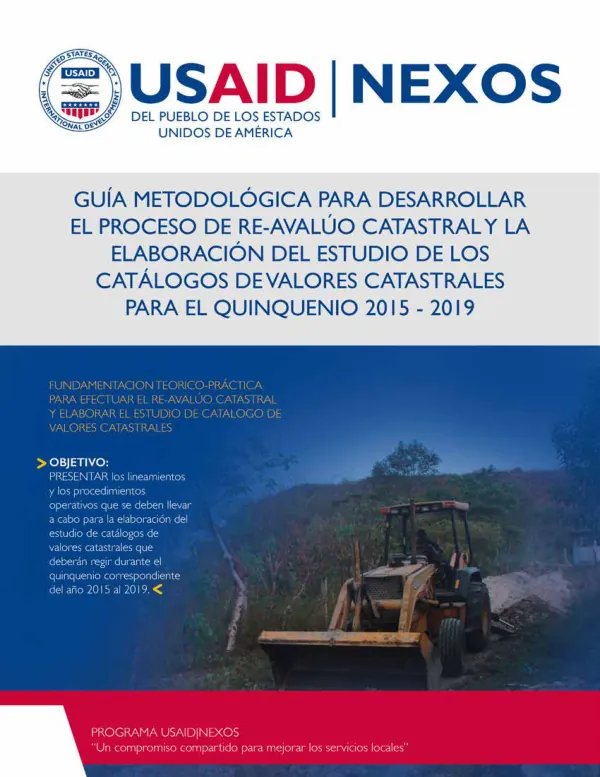
Fundamentación Teórico-Práctica para Efectuar el Re-Avalúo Catastral y Elaborar el Estudio de Catalogo de Valores Catastrales
Sign inUSAID
Fundamentación Teórico-Práctica para Efectuar el Re-Avalúo Catastral y Elaborar el Estudio de Catalogo de Valores Catastrales
The re-valuation of property values in Honduras is a process that involves the determination of new values for properties, which will be used for taxation purposes.
2015 · 20 pages
Sign in to readA free account is required to download.
Abstract
This process is governed by the Ley de Municipalidades, which establishes the framework for the re-valuation of property values. The Ley de Municipalidades, Article 76, as amended by Decreto Legislativo 124-95, requires that the determination of property values for the year 1995 be made in consultation with various sectors of society and the economy. This consultation must take place within a period of 90 days from the entry into force of the decree. For subsequent years, the consultation must be held within 90 days prior to the approval of the municipal budget. The Corporación Municipal, as the highest authority in the municipality, is responsible for convening assemblies of representatives from local organizations, including communal, social, gremial, sindical, and ecological organizations, to discuss and resolve issues affecting the community. These assemblies are held at least five times a year, and failure to comply with this requirement can result in responsibility for the members of the Corporación Municipal. The process of re-valuation of property values involves several stages, including the collection of data, the analysis of market trends, and the determination of new values for properties. The new values will be used for taxation purposes and will be reflected in the municipal budget. The re-valuation of property values is a complex process that requires the involvement of various stakeholders, including the Corporación Municipal, local organizations, and the public. The process must be carried out in accordance with the Ley de Municipalidades and the Reglamento de la Ley de Municipalidades. The Ley de Municipalidades, Article 25, as amended by Decreto 48-91, establishes the Corporación Municipal as the highest authority in the municipality, with the power to convene assemblies of representatives from local organizations. The Corporación Municipal is responsible for ensuring that the re-valuation of property values is carried out in a transparent and participatory manner. The re-valuation of property values is a critical component of the municipal budget, as it determines the amount of taxes that will be collected from property owners. The new values will be used to calculate the taxes owed by property owners, and will be reflected in the municipal budget. The process of re-valuation of property values is governed by the Ley de Municipalidades and the Reglamento de la Ley de Municipalidades. The Corporación Municipal is responsible for ensuring that the process is carried out in accordance with these laws, and that the new values are determined in a transparent and participatory manner. The Ley de Municipalidades, Article 3, as amended by Decreto 983, establishes the Dirección General de Catastro as the authority responsible for the re-valuation of property values. The Dirección General de Catastro is responsible for ensuring that the process is carried out in accordance with the Ley de Municipalidades and the Reglamento de la Ley de Municipalidades. The Ley de Municipalidades, Article 4, as amended by Decreto 124-95, establishes the requirement for the Corporación Municipal to convene assemblies of representatives from local organizations to discuss and resolve issues affecting the community. The Corporación Municipal is responsible for ensuring that these assemblies are held at least five times a year, and that the process is carried out in accordance with the Ley de Municipalidades and the Reglamento de la Ley de Municipalidades. The process of re-valuation of property values is governed by the Ley de Municipalidades and the