AVENIR HEALTH
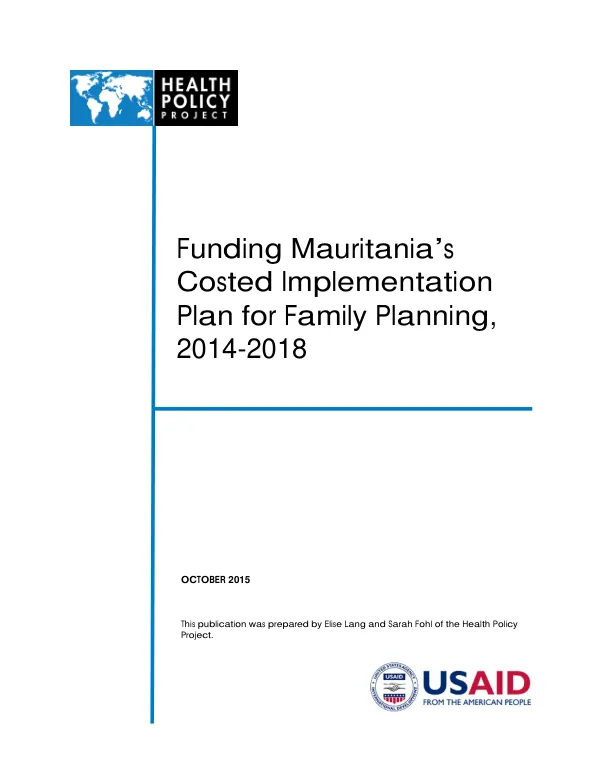
Funding Mauritania’s Costed Implementation Plan for Family Planning, 2014-2018
Mauritania has made recent commitments to improve access to family planning, with a concrete Costed Implementation Plan (CIP) in 2014.
2015 · 17 pages
Sign in to readA free account is required to download.
Abstract
The CIP outlines specific activities and associated costs necessary to achieve national family planning goals. Despite surplus funding in some program areas, there are many activities that are underfunded each year of the plan. This lack of long-term commitment and general uncertainty could prevent Mauritania from reaching its long-term family planning goal of increasing the contraceptive prevalence rate to 18.5% in 2018. Mauritania's Ministry of Islamic Affairs and Religious Education introduced family planning into the national health policy landscape through recognition of family planning as a method of "birth spacing" in 1997. Later policies reinforced this commitment to family planning, including the 2005 Youth and Adolescent Reproductive Health Strategy and the 2009 revision of the Policies, Norms, and Standards for Reproductive Health. A significant challenge to improving access to family planning in Mauritania will be the ability to address the health workforce gap by increasing the number of health workers, particularly those servicing rural areas. The estimated annual costs for each thematic area, as seen in the CIP, are outlined in Table 1. The estimated annual costs for each thematic area are as follows: Contraceptive Commodities (US$162,014 in 2014, increasing to US$249,518 in 2018), Demand Creation (US$1,001,288 in 2014, decreasing to US$511,741 in 2018), Service Delivery and Access (US$1,268,527 in 2014, decreasing to US$563,672 in 2018), Contraceptive Security (US$161,223 in 2014, increasing to US$15,984 in 2018), Policy and Enabling Environment (US$120,759 in 2014, increasing to US$31,306 in 2018), and Monitoring and Evaluation and Coordination (US$570,965 in 2014, decreasing to US$483,082 in 2018). In July 2015, the USAID-funded Health Policy Project conducted a financial gap analysis of Mauritania's CIP to compare the annual funding available from the government and partners for family planning compared to the CIP budget. The CIP Gap Analysis Tool, developed by Futures Group, was used to estimate additional resources needed to fully implement each thematic area identified in the CIP. The government and development and implementing partners provided information on their planned FP activities between 2014 and 2020. All funded thematic areas were then assigned the appropriate funds (without any associated overhead costs added), and compared to the costs of the CIP thematic areas. The results of this analysis show that the projected cost to implement Mauritania's CIP is estimated at US$10.8 million, but the government and partners have currently allocated only US$8.2 million. This leaves a US$2.5 million or 23 percent funding gap for the CIP from 2014 to 2018. Figure 1 compares the CIP costs per year compared to the funds allocated per year. The funding gap analysis can assist the government to identify thematic areas with high financial coverage and those that need additional resource mobilization. Mauritania's participation in the 2011 Ouagadougou Conference signaled an increased commitment to family planning through improved and enhanced access to services. In the same year, the Ministry of Health established a budget line item for contraceptive commodities, although no funds have yet been allocated and contraceptive products are not integrated into the formal drug distribution system. Mauritania's costed implementation plan for family planning, 2014-2018, outlines priority activities to improve access to family planning and increase the contraceptive prevalence rate (CPR) from 11% to 18.5% by 2018. The CIP is organized around six thematic areas: Contraceptive Commodities, Demand Creation, Service Delivery and Access, Contraceptive Security, Policy and Enabling Environment, and Monitoring and Evaluation and Coordination.