AVENIR HEALTH
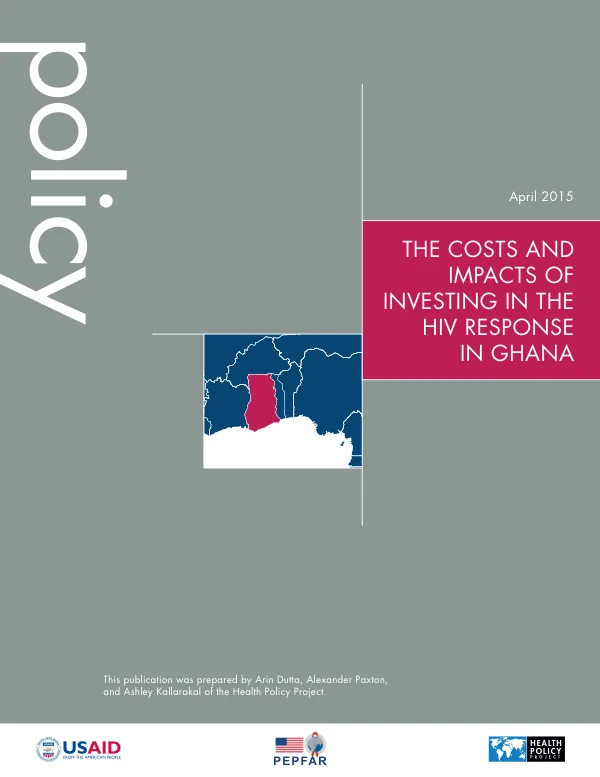
The Costs and Impacts of Investing in the HIV Response in Ghana
The HIV epidemic in Ghana is characterized by a disproportionately higher prevalence among key population groups, such as men who have sex with men (MSM) and female sex workers (FSWs).
2015 · 42 pages
Sign in to readA free account is required to download.
Abstract
At the end of 2013, an estimated 189,930-206,280 adults and 34,560-36,250 children were living with HIV in Ghana. The country's epidemic continues to evolve, with the need for effective HIV prevention strategies. The National HIV and AIDS Strategic Plan: 2011-2015 outlines key interventions to address the epidemic, including antiretroviral treatment, prevention of mother-to-child transmission, HIV testing and counseling, prevention in key populations, and other prevention interventions in the general population. The plan aims to reduce the number of new HIV infections and AIDS-related deaths. A focused analysis was conducted by the Health Policy Project (HPP) in partnership with the Ghana AIDS Commission (GAC) to examine the future effectiveness of HIV prevention in Ghana. The analysis used the Goals model, a mathematical model integrated into the Spectrum Policy Modeling System, to estimate the impact of different levels of uncertain future HIV funding on the scale-up and health impact of key HIV interventions. Four scenarios were examined, each corresponding to different levels of uncertain future HIV funding in Ghana. Scenario 1, the Baseline scenario, extended the reported 2013 coverages of specific interventions through 2020 without any increase. Scenario 2, New Funding Model targets (NFM), reflected the coverage targets that can be achieved within the limits of the resources allocated for Ghana's application to the Global Fund's New Funding Model mechanism. Scenario 3, the NFM targets plus above allocation, allowed additional program coverage as enabled by domestic and other sources plus financing from the Global Fund above the currently allocated NFM limit for the country. Scenario 4, the National Strategic Plan (NSP) scenario, reflected the continuation of high levels of coverage for a limited period. The analysis estimated the total cost of the HIV program in Ghana for 2014-2020, given the direct service delivery costs under each of the four scenarios, and applied additional estimated costs for the management of the HIV response. The estimated impact over the same period was in terms of the number of new HIV infections and AIDS-related deaths averted. Incremental cost-effectiveness ratios (ICERs) were computed as a metric to compare the costs and outcomes of different scenarios. The results of the analysis showed that the scale-up and health impact of key HIV interventions would be affected by the level of uncertain future HIV funding in Ghana. The Baseline scenario would result in a limited scale-up of interventions, while the NFM targets scenario would achieve higher coverage levels. The NFM targets plus above allocation scenario would allow for even higher coverage levels, and the NSP scenario would maintain high levels of coverage for a limited period. The analysis highlights the importance of effective HIV prevention strategies in Ghana, particularly in key population groups. The results suggest that investing in HIV prevention interventions can have a significant impact on reducing the number of new HIV infections and AIDS-related deaths. The analysis also emphasizes the need for sustained funding and support to maintain high levels of coverage and achieve the goals of the National HIV and AIDS Strategic Plan.
Related documents
Documents in this collection
 2015
2015USAID DEC
Making Strategic Choices: Prioritizing HIV Interventions in a Resource-Limited Setting Options for Ghana’s Next HIV National Strategic Plan
Open record 2014
2014USAID DEC