AVENIR HEALTH
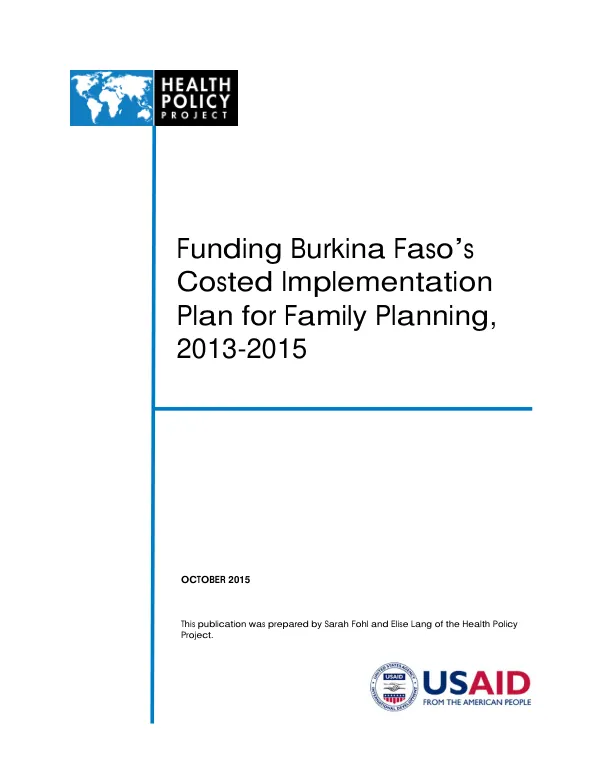
Funding Burkina Faso’s Costed Implementation Plan for Family Planning, 2013-2015
Burkina Faso has made recent commitments to improve access to family planning, with a concrete Costed Implementation Plan (CIP) in 2013.
2015 · 14 pages
Sign in to readA free account is required to download.
Abstract
The CIP outlines specific activities and associated costs necessary to achieve a national family planning goal. The funding for this plan is strong and shows a short-term commitment to family planning in Burkina Faso, allowing thousands of women the opportunity to access family planning services. Gradual improvements are being seen in the environment for family planning in Burkina Faso, including a Reproductive Health Law in 2005 granting individuals and couples the right to reproductive health and equitable access to care. More recently, the government offered to host the "Francophone West Africa Conference-Population, Development, and Family Planning: The Urgency to Act" in 2011. The former President of Burkina Faso, Blaise Compaoré, pledged strong support for family planning, and the Costed Implementation Plan for Family Planning (2013-2015) was developed shortly thereafter. The CIP highlights activities in five thematic areas needed to extend and improve family planning services and education: contraceptive commodities, demand creation, service delivery and access, contraceptive security, and monitoring and evaluation and coordination. The objective of the plan is to increase contraceptive prevalence among married women by 10 percentage points from 15% in 2010 to 25% in 2015 in only 3 years of programming. The CIP costs are summarized below by thematic area. Contraceptive commodities costs totaled $8,854,639 over the three-year period, with $2,500,923 allocated in 2013, $3,005,692 in 2014, and $3,348,024 in 2015. Demand creation costs totaled $5,931,002 over the three-year period, with $2,299,097 allocated in 2013, $1,774,681 in 2014, and $1,857,223 in 2015. In June 2015, the USAID-funded Health Policy Project conducted a financial gap analysis of Burkina Faso's CIP to compare the annual funding available from the government and partners for family planning compared to the CIP budget. The CIP Gap Analysis Tool, developed by Futures Group, was used to estimate additional resources needed to fully implement each thematic area identified in the CIP. The government and development and implementing partners provided information on their planned FP activities between 2015 and 2020. The results of this analysis indicated that the government and partners have allocated $41 million to family planning from 2013 to 2015. There appear to be few financial gaps and an overall excess of funds equal to 67% of the total CIP budget or $16.5 million. According to PMA2020, the contraceptive prevalence rate among all women remains at 15% (2014). The methodology of this study did not examine the exact activities that were implemented; therefore, it is possible the activities listed in the CIP do not align with the activities that were funded and therefore did not have the same expected impact. The CIP Gap Analysis Tool was used to estimate additional resources needed to fully implement each thematic area identified in the CIP. The results of this analysis can assist the government to identify thematic areas with high financial coverage and those that need additional resource mobilization. More information on the CIP Gap Analysis Tool is available at www.healthpolicyproject.com.