USAID
Future of Marketing Highlighted at Forums
The agricultural market in Iraq is undergoing significant changes as the country's agricultural sector grows and evolves.
2011 · 1 pages
Sign in to readA free account is required to download.
Abstract
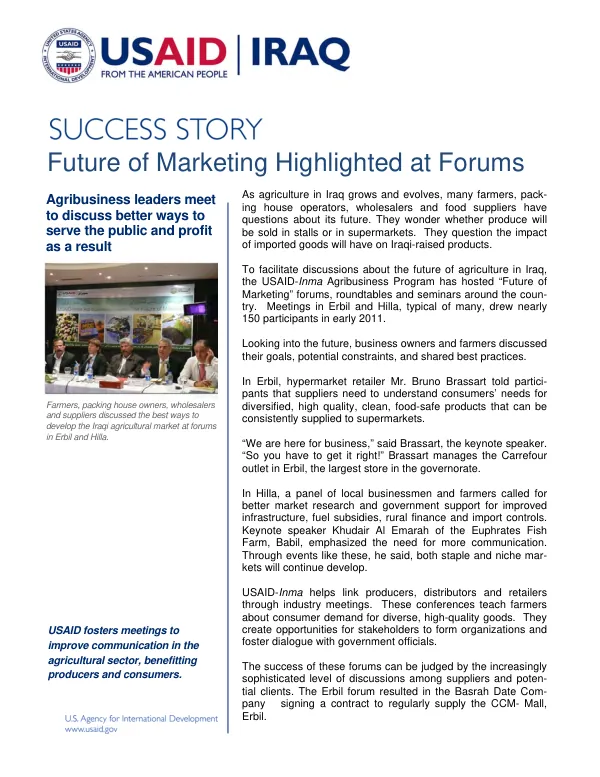
Farmers, packing house operators, wholesalers, and food suppliers are seeking to understand the future of agriculture in Iraq and how they can adapt to changing market conditions. One of the key challenges facing the sector is the impact of imported goods on Iraqi-raised products. To facilitate discussions about the future of agriculture in Iraq, the USAID-Inma Agribusiness Program has hosted a series of "Future of Marketing" forums, roundtables, and seminars around the country. These events have brought together nearly 150 participants, including business owners and farmers, to discuss their goals, potential constraints, and share best practices. The meetings have been held in various locations, including Erbil and Hilla, and have provided a platform for stakeholders to share their experiences and learn from each other. At the Erbil forum, keynote speaker Mr. Bruno Brassart emphasized the need for suppliers to understand consumers' needs for diversified, high-quality, clean, and food-safe products that can be consistently supplied to supermarkets. Brassart, who manages the Carrefour outlet in Erbil, the largest store in the governorate, stressed the importance of getting it right for business. In Hilla, a panel of local businessmen and farmers called for better market research and government support for improved infrastructure, fuel subsidies, rural finance, and import controls. Keynote speaker Khudair Al Emarah of the Euphrates Fish Farm, Babil, emphasized the need for more communication between stakeholders. He noted that through events like these, both staple and niche markets will continue to develop. The success of these forums can be judged by the increasingly sophisticated level of discussions among suppliers and potential clients. The Erbil forum resulted in the Basrah Date Company signing a contract to regularly supply the CCM-Mall, Erbil. The USAID-Inma Agribusiness Program plays a crucial role in facilitating these meetings and improving communication in the agricultural sector. By linking producers, distributors, and retailers through industry meetings, the program teaches farmers about consumer demand for diverse, high-quality goods and creates opportunities for stakeholders to form organizations and foster dialogue with government officials.
Related documents