UNIVERSIT6 DE PURDUE
Policy Brief: Field Crop Production in Nineveh
The Nineveh Plains region of Iraq has long been a significant contributor to the country's field crop production, with fertile soil and a rich agricultural history.
2022 · 3 pages
Sign in to readA free account is required to download.
Abstract
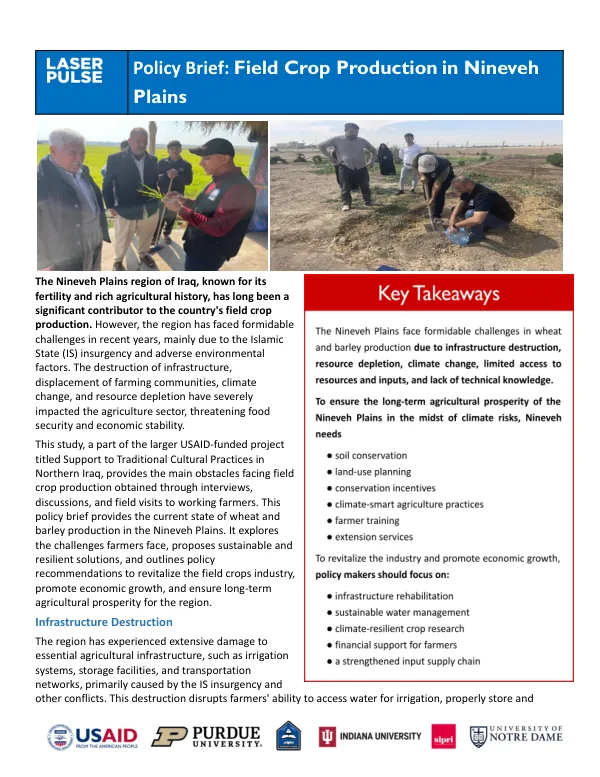
However, the region has faced formidable challenges in recent years, primarily due to the Islamic State (IS) insurgency and adverse environmental factors. The destruction of infrastructure, displacement of farming communities, climate change, and resource depletion have severely impacted the agriculture sector, threatening food security and economic stability. Infrastructure destruction has been a major obstacle to field crop production in the Nineveh Plains. Essential agricultural infrastructure, such as irrigation systems, storage facilities, and transportation networks, has been extensively damaged, primarily caused by the IS insurgency and other conflicts. This destruction disrupts farmers' ability to access water for irrigation, properly store and preserve crops, and efficiently transport produce to markets, leading to substantial losses and reduced profitability. The Iraqi government is recommended to prioritize reconstructing and repairing the Nineveh Plain's agricultural infrastructure by allocating resources and collaborating with international organizations and other donors. Additionally, the government should provide financial assistance and incentives to farmers to encourage infrastructure restoration, particularly for the repair and maintenance of irrigation systems and storage facilities. Capacity building programs should also be implemented to provide farmers and agricultural workers with technical training and capacity-building programs to manage and maintain agricultural infrastructure crucial for irrigation, post-harvest handling, and storage. Resource depletion and environmental issues have also been significant challenges in the Nineveh region. Water scarcity and soil degradation have been exacerbated by the mismanagement of natural resources, unsustainable agricultural practices, and the aftermath of conflicts. The government is recommended to promote water-efficient irrigation techniques and soil conservation practices, including crop rotation, mulching, and cover cropping, to protect soil from erosion and degradation. Environmental awareness campaigns and extension services should also be supported to raise awareness among farmers about the importance of sustainable agricultural practices and environmental conservation. Climate change has led to increased uncertainty and vulnerability in agricultural operations in the Nineveh Plains. The region is experiencing shifts in temperature patterns, changes in rainfall distribution, and increased extreme weather events, such as drought. These climate-related challenges disrupt the delicate balance required for successful wheat and barley cultivation, affecting planting schedules, water availability, pest and disease dynamics, and overall crop growth. The government is recommended to implement policies and strategies for efficient water resource management in wheat and barley production, including the development and maintenance of irrigation infrastructure, the promotion of water-saving technologies, and the establishment of water pricing mechanisms. Limited access to resources and inputs has also hindered the farmers' ability to achieve optimal yields and agricultural productivity in the Nineveh Plains. The region's farmers face challenges in obtaining quality seeds, fertilizers, pesticides, machinery, and other essential agricultural inputs required for efficient crop cultivation. The government is recommended to provide financial assistance and subsidies to farmers to purchase essential agricultural inputs, establish credit facilities and loan programs tailored to the needs of farmers, and improve the efficiency and accessibility of input supply chains in the Nineveh Plains.
Related documents