USAID DEC
FY 2013 Semi-annual Report: Conservation and Adaptation in Asia’s High Mountain Landscapes and Communities
Sign inCOOPERATIVE FOR ASSISTANCE AND RELIEF EVERYWHERE INTERNATIONAL
FY 2013 Semi-annual Report: Conservation and Adaptation in Asia’s High Mountain Landscapes and Communities
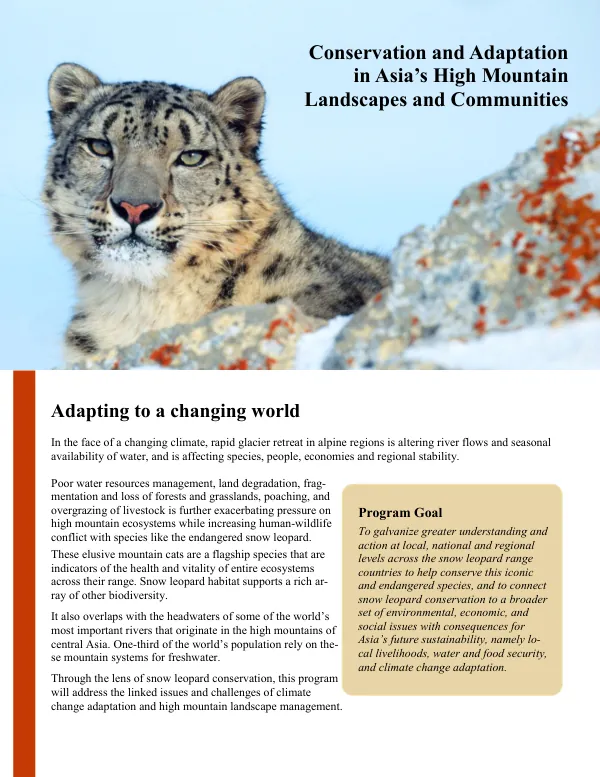
The Asia High Mountains Project, led by the World Wildlife Fund, aims to promote climate-smart management of high mountain landscapes and snow leopard habitat for sustainable development in specific sites.
2015 · 57 pages
Sign in to readA free account is required to download.
Abstract
The project focuses on strengthening local natural resource institutions' governance and capacity, as well as promoting sustainable natural resource management and use. In Nepal, the Community Based Forestry Supporters' Network (COFSUN) and CARE conducted monitoring of field activities in the Kangchenjunga Conservation Area (KCA) to ensure quality. The joint monitoring team reported that most activities were effective in raising awareness of Community Forest Users' Group (CFUG), Mothers' Group (MG), and Natural Resource Management Group (NRMG) members on biodiversity conservation and natural resource management practices. In Bhutan, WWF provided support to Wangchuck Centennial Park (WCP) to celebrate International Snow Leopard Day on October 23, 2014. The event was attended by approximately 500 students from four primary schools. Additionally, WWF established partnerships with the Ugyen Wangchuck Institute for Conservation and the Environment (UWICE) and the Watershed Management Division (WMD) for conducting climate adaptation and integrated river basin management (IRBM) activities. In Sikkim, India, WWF hired an associate researcher to prepare a climate vulnerability assessment for the Upper Teesta River basin in the AHM Project region. The residents of Lachen Village decided to impose a monthly trash collection fee to support and promote AHM Project-sponsored efforts to segregate community trash for re-use and recycling. In Kyrgyzstan, two International Snow Leopard Day celebrations were held in AHM Project communities, and a climate vulnerability assessment for the AHM Project region was completed. A Local Development Fund (LDF) was launched in Engilchek Village to provide small loans for the development of sustainable, environmentally-friendly alternative income-generating activities. In Mongolia, a pasture management database for the Altai-Sayan Ecoregion was compiled, and the 105,200 ha Bayan Nuruu Reserve Pasture was formally established in Khovd Aimag with AHM Project support. A knowledge, attitude, and practice (KAP) survey on climate change in the Altai-Sayan Ecoregion was completed, and further snow leopard camera trap surveys with citizen scientist participation were conducted. In Pakistan, WWF developed a conservation and development plan for the Laspur Valley, Chitral through a participatory process. Work continued on preparation of a climate vulnerability assessment and adaptation strategy for the AHM Project areas of Chitral and Gilgit-Baltistan. WWF also began the process of organizing watershed management surveys that will serve as the basis for site selection for integrated river basin management (IRBM) demonstration activities. Regional highlights during this reporting period included the holding of a 5-day, mid-project AHM learning and sharing meeting in Kathmandu, which featured three days of climate change and adaptation training sessions. A partnership was established with the Columbia University Center for Climate Systems Research, which is providing AHM Project countries with project site-specific climate data analyses for use in developing future climate scenarios for each site. The formal release of two AHM-funded climate change reports, titled Climate Vulnerability in Asia's High Mountains and Guardians of the Headwaters: Snow Leopards, Water Provision, and Climate Vulnerability, as well as the release of the Snow Leopard Network's revised Snow Leopard Survival Strategy (SLSS), were also notable regional highlights.