LAND O'LAKES, INC. - INTERNATIONAL DEVELOPMENT
FY 2019 Quarter 3 Progress Report: April 1st to June 30th, 2019
The Resilient Agricultural Markets Activity – Beira Corridor (RAMA-BC) is a five-year USAID Feed the Future initiative that began in 2017 and aims to support local producers in raising agricultural productivity, profitability, and resilience.
2019 · 29 pages
Sign in to readA free account is required to download.
Abstract
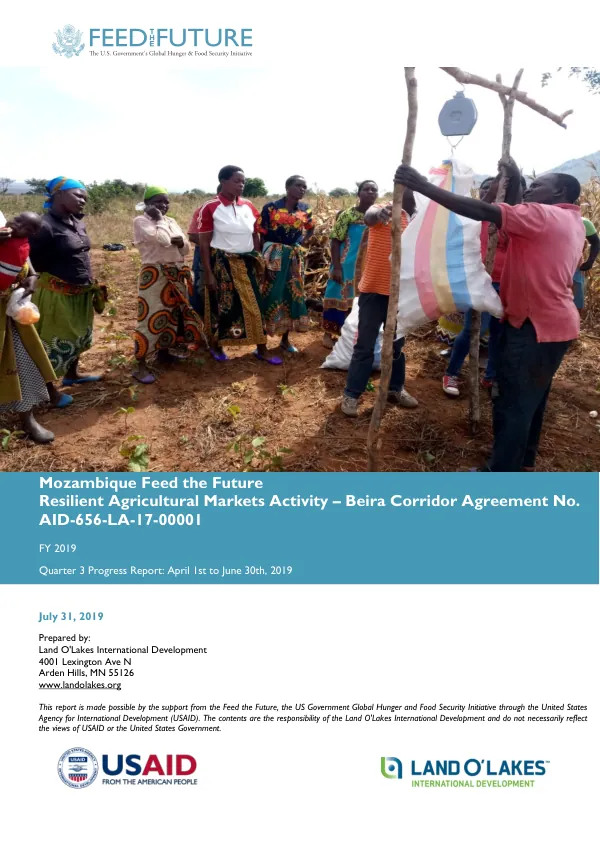
The project operates in the 9 Feed the Future districts in Manica and Tete provinces, targeting key agricultural stakeholders along the soy, pigeon pea, sesame, common bean, and cowpea value chains. RAMA-BC consists of four components: Behavior Change Communication, Model Family Farms, Sustainable Extension Services, and Strengthened Market Systems. The project's overall objective is to equitably increase the agricultural productivity and climate resilience of farmers through increased adoption of resilient agricultural technologies and practices. During the quarter ending June 30, 2019, key activities included yield measurements of maize at 27 Resilient Agriculture Model Family Farms (MFFs) and 19 traditional agriculture sites. The measurements showed an overall yield increase of 85%. One farmer in Mpenha, Angonia, harvested an equivalent maize yield of 5.6 tonnes/ha from his improved plot. Additionally, nearly half of the MFFs in the 2018/19 season were established by the Mozambican private sector and civil society. Seven Observation Units (OUs) were also established within agricultural colleges, a research station, and the private sector, where trials studying the integrated pest management (IPM) 'push-pull' approach of utilizing green manure/cover crops (gm/ccs) to suppress Fall Army Worm (FAW) are being evaluated. Field days on MFFs and OUs were held to demonstrate the effect of Resilient Agriculture to nearly 1,700 people from partners and surrounding communities. Input suppliers showcased and marketed their seeds, and yield and profit analyses were conducted to show the progress in productivity from improved soil fertility. Farmers were also shown how to do solar treatment of seed to prevent weevil infestation in storage. Drought-resistant jack bean, previously used by RAMA-BC as a maize intercrop, has been sown as a sequential rotation in MFFs for soy, common bean, and cowpea. Phoenix Seed Company has established 6ha of jackbean production to sell to its clientele. Closeout of the remaining 4 subrecipient seed companies/agrodealers has also been completed, incorporating project subawards that focus on a dual approach to seed production and distribution. The project's geographic coverage includes the 9 FTF districts in the Beira Corridor Zone of Influence, including Gondola, Chimoio, Manica, Barué, Sussundenga, Vanduzi, Macate, Angonia, and Tsangano. The project's implementation is led by Land O'Lakes International Development, with the support of various partners, including the Mozambican private sector and civil society.