USAID DEC
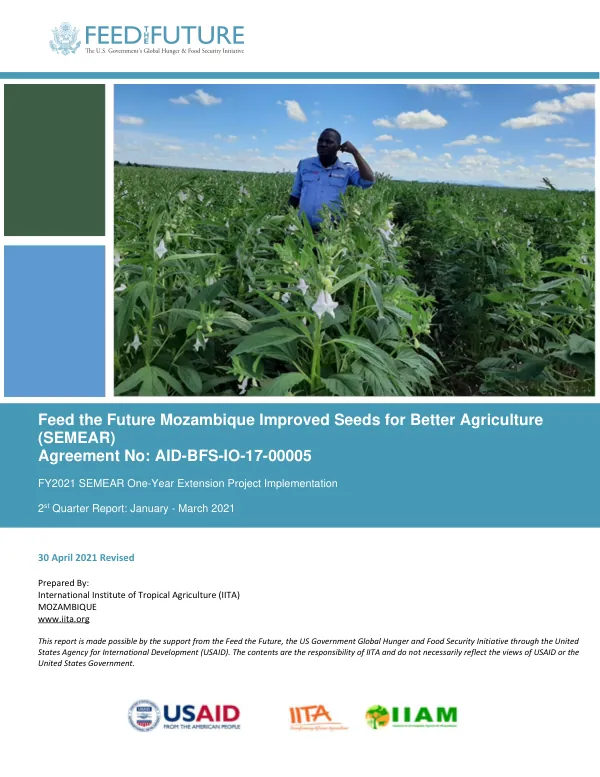
FY2021 SEMEAR One-Year Extension Project Implementation 2nd Quarter Report: January - March 2021
Sign inINTERNATIONAL INSTITUTE OF TROPICAL AGRICULTURE
FY2021 SEMEAR One-Year Extension Project Implementation 2nd Quarter Report: January - March 2021
The Feed the Future Mozambique Improved Seeds for Better Agriculture (SEMEAR) project is a six-year initiative implemented by the International Institute of Tropical Agriculture (IITA) in Mozambique.
2021 · 37 pages
Sign in to readA free account is required to download.
Abstract
The project aims to improve agricultural productivity and food security in the Feed the Future Zone of Influence (FTF ZOI) by increasing the production and supply of quality seeds of improved varieties and best management practices. The project's geographic focus is on four provinces in Mozambique: Nampula, Zambézia, Manica, and Tete. The project's objectives are to build on the production and supply of breeder, pre-basic, basic, certified seed, and Quality Declared Seeds (QDS) of common bean, cowpea, groundnut, pigeon pea, sesame, and soybean in the FTF ZOI. Additionally, the project aims to strengthen the national seed system in planning, coordination, and production of Early Generation Seeds (EGS) through capacity development. During the second quarter of FY21, the project focused on capacity development to increase EGS production and strengthen the national seed system. The main activities conducted during this period included planting of EGS, collaboration with seed producers to establish demonstration plots on varieties and good crop management practices, training of project technical staff and SDAE, seed producers, and farmers, and other awareness creation activities. SEMEAR planted 15.4 ha breeder/pre-basic and 112.5 ha basic seed fields of common bean, cowpea, groundnut, pigeon pea, sesame, and soybean. The project supported partners, including seed companies, individual seed producers, farmers' associations, and NGOs, to produce certified and QDS through the sale of basic seeds, training sessions, and technical support on seed production. Most of the basic seeds were sold in the first quarter of FY21, with an additional 1.13 ton sold in the second quarter, making a total of 22.35 tons of basic seed sold to seed companies, agro-dealers, farmers associations, and community-based seed producers to produce certified seed. The basic seed sold is expected to plant 1,157 ha of certified seed fields. SEMEAR partners planted a total of 2,068 ha for certified seed or QDS by the end of the second quarter, and it is estimated to produce 1,950 tons of seeds at the end of the season. The project also organized two technical training workshops on planning, management, and production of EGS, which were attended by project technical staff, SDAE, seed producers, and farmers. These workshops aimed to enhance the capacity of stakeholders to produce high-quality EGS. The project's progress during the second quarter of FY21 demonstrates its commitment to improving agricultural productivity and food security in Mozambique. The project's focus on capacity development, seed production, and awareness creation activities is expected to lead to increased production and supply of quality seeds of improved varieties and best management practices in the FTF ZOI.