USAID DEC
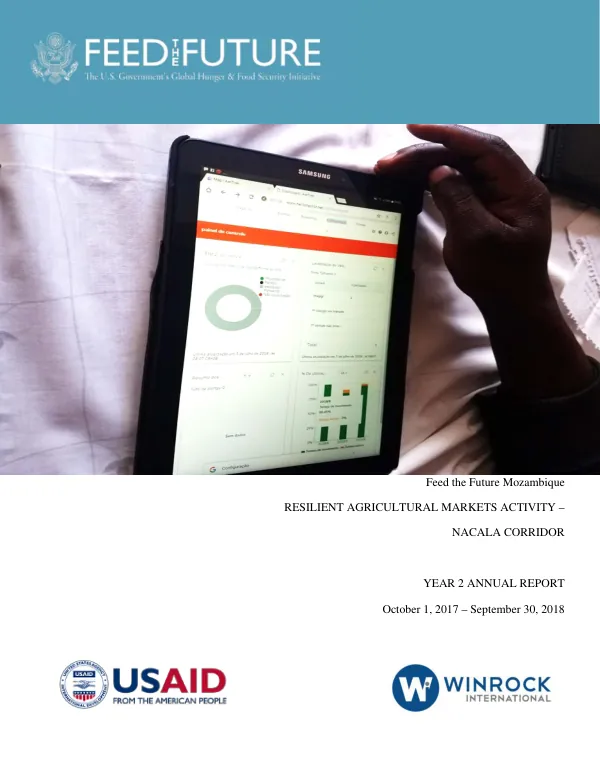
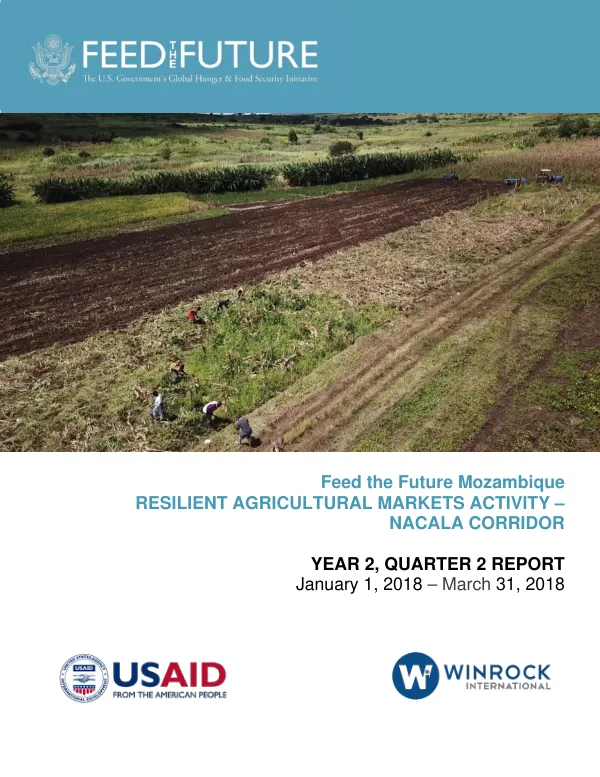
Feed the Future Mozambique Resilient Agricultural Markets Activity – Nacala Corridor Year 2, Quarter 2 Report
Sign inCULTURAL PRACTICES ORGANIZATION
Feed the Future Mozambique Resilient Agricultural Markets Activity – Nacala Corridor Year 2, Quarter 2 Report
The Feed the Future Mozambique Resilient Agricultural Markets Activity - Nacala Corridor is a 5-year project with a starting date of December 12, 2016, and a total funding of $15,999,978.
2018 · 31 pages
Sign in to readA free account is required to download.
Abstract
The project's geographic focus is the Nacala Corridor in Mozambique, and its primary objective is to identify, evaluate, pilot, and scale-up impactful technologies that build resilience among smallholder farmers in the region. The project emphasizes the development of critical thinking abilities among smallholder farmers to equip them to make informed decisions in changing conditions. It also engages with women as decision-makers and drivers of production, and household nutrition. RAMA - Nacala Corridor maximizes resources through partnerships with the private sector, the Government of Mozambique, and donor-funded programs, and supports the dissemination and commercialization of technologies and critical information through existing networks and value chain stakeholders. During the reporting period, five partnerships with fixed amount award agreements (FAA) were approved and launched. Three partnerships, with CPS Angoche, DREAMERS, and Hello Tractor, aim to extend access and adoption of mechanized land preparation services by smallholder farmers. These partnerships' first activities included field days to raise awareness of mechanization benefits and requirements of hiring land preparation services, installation of data collection mechanisms on tractors to capture data to improve business operations and service delivery, and sales of promotional land preparation packages including plowing, disking, and mechanized planting at a reduced price. One partnership was signed with CTI, a Minnesota-based NGO that has developed small-scale groundnut stripping and shelling technology now fabricated and commercially available in Malawi. The milestones within the fixed amount award include demonstrating CTI's smallholder-focused post-harvest processing equipment and identifying profitable entrepreneur-based service models for access and adoption. The final agreement was signed with iDE, an American NGO, which builds upon iDE's recent work with agrodealers and community-based input retailers (ADAs) in the corridor. RAMA - Nacala Corridor launched its third request for assistance (RFA) in this quarter, soliciting partnerships and concepts in support of on-demand information solutions for smallholder farmers. The RFA intended to identify opportunities to co-invest in broadening access, deepening content, and/or developing economic viability of interactive information platforms and systems providing smallholder farmers with agronomic, climate and weather, and market information. In February, a volunteer expert conducted consultations to identify relevant stakeholders in irrigation and water management in the Nacala Corridor and catalog agricultural-related water management and irrigation technologies and practices being promoted and commercialized. Key conclusions were shared in a workshop aimed at facilitating the establishment of an irrigation and water management community of practice to better coordinate and share ongoing related activities. The volunteer assisted RAMA – Nacala Corridor to identify specific activities to develop locally available small-scale commercial and multi-user system design expertise, and to pilot small-scale multi-user water delivery entrepreneurs during the coming dry season. The program also engaged Cultural Practice, an implementing organization of the Feed the Future Integrating Gender and Nutrition within Agricultural Extension Services program (INGENAES), to provide two trainings in Nampula for private sector and extension services to improve strategies for increasing both access and adoption of technologies by different farmer segments, including women and youth. For both trainings, Cultural Practice adapted the basics of the INGENAES technology assessment tools and introduced strategies and frameworks for conducting their work in a more gender-responsive manner for higher technology access and adoption.