FHI 360
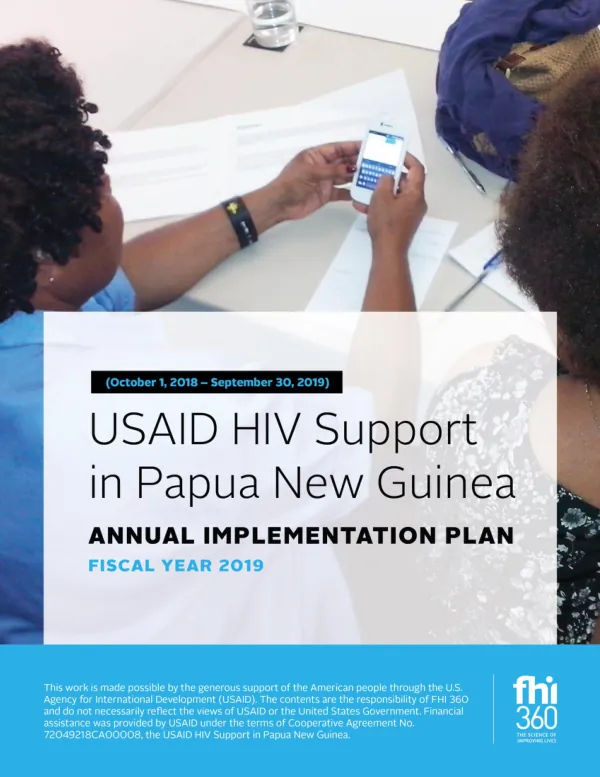
FY 2021 Annual Implementation Plan for USAID HIV Support in Papua New Guinea
The USAID HIV Support in Papua New Guinea project aims to support the Government of Papua New Guinea in achieving HIV epidemic control in the National Capital District (NCD) by 2023.
2021 · 51 pages
Sign in to readA free account is required to download.
Abstract
The project, funded by USAID and PEPFAR, focuses on key populations and the general population in NCD, where HIV prevalence is high. The project's vision is to establish a strong and resilient national health system that delivers integrated, high-quality HIV, sexually transmitted infection (STI), and gender-based violence (GBV) services. The project has three strategic objectives: to support the Government's work in rolling out Test and Start and viral load testing, to provide technical assistance for sustainable HIV, STI, and GBV prevention and service delivery models for key populations, and to support improved data collection and use at the national and provincial levels. The project's geographic focus is on the National Capital District, with a revised plan to prioritize key interventions that contribute to achieving epidemic control in NCD. To achieve epidemic control, the project will focus on increasing efficient HIV case-finding, ensuring linkage and initiation on HIV treatment for all identified people living with HIV (PLHIV), improving retention on HIV treatment, ensuring high viral suppression among those on treatment, and reducing the impact of GBV on HIV transmission and care and treatment. The project will implement differentiated service delivery models, including multi-month dispensing and active case management and follow-up, to improve retention on treatment. The project will also support the development of sustainable HIV, STI, and GBV prevention and service delivery models for key populations, including female sex workers, men who have sex with men, and transgender individuals. The project will work with the Government of Papua New Guinea, civil society organizations, and other stakeholders to achieve these objectives. The project's budget for FY 2021 is $13.2 million, with additional funding from PEPFAR's "Accelerate and Scale the Asia Program" (ASAP) to support direct service delivery activities and address critical programmatic gaps. The project's implementation plan includes a range of activities, including training for healthcare workers, community outreach and engagement, and data collection and analysis. The project's geographic focus is on the National Capital District, with a revised plan to prioritize key interventions that contribute to achieving epidemic control in NCD. The project's implementation will be monitored and evaluated through regular reporting and data analysis, with a focus on achieving the project's strategic objectives and contributing to the achievement of the 95-95-95 goals. The project's vision is that, by 2023, a strong and resilient national health system will support the delivery of integrated, high-quality HIV, STI, and GBV services that incorporate institutionalized models, best practices, tools, and strategies. The project's implementation will contribute to the achievement of this vision and support the Government of Papua New Guinea in its efforts to control the HIV epidemic in NCD.