USAID
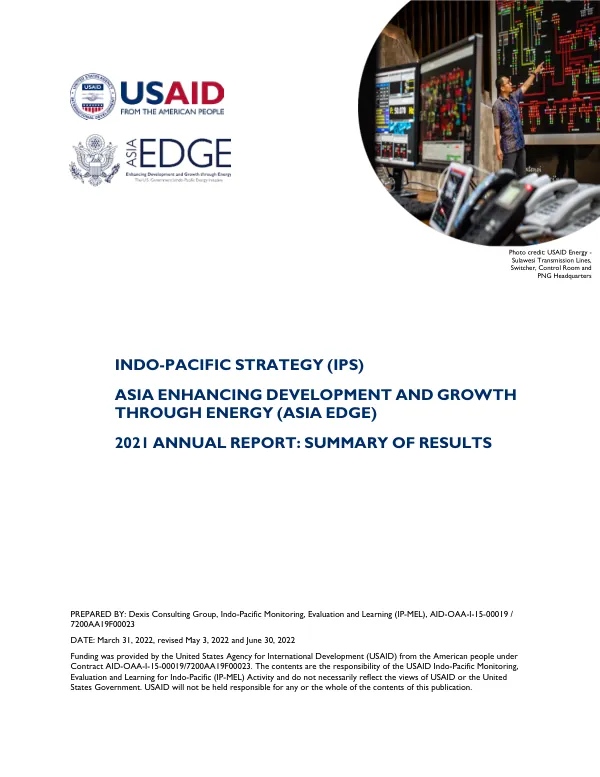
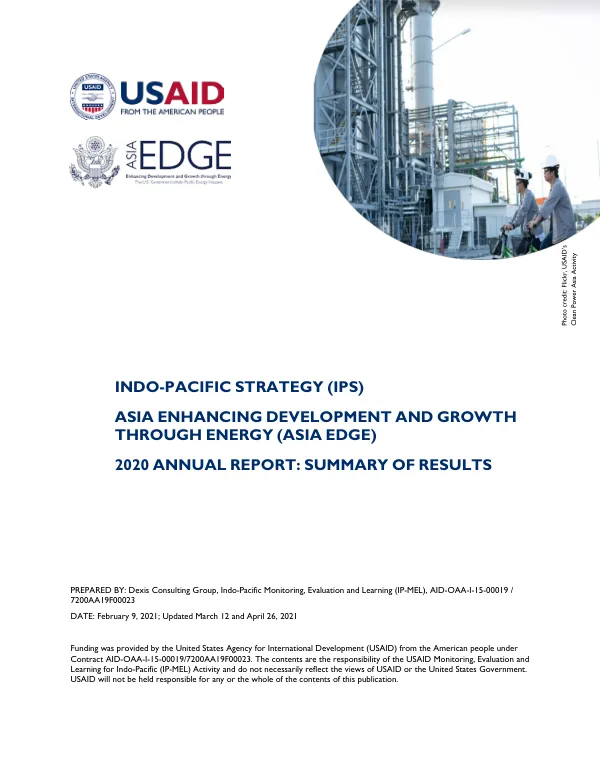
FY 2021 Results: Asia EDGE
Asia EDGE is a whole-of-government initiative launched in July 2018 to grow sustainable and secure energy markets throughout the Indo-Pacific region.
2021 · 8 pages
Sign in to readA free account is required to download.
Abstract
The initiative is part of the Indo-Pacific Strategy and aims to transform the energy sector to accelerate energy security and sustainability in the region. USAID plays a leading role in the initiative, helping its Indo-Pacific partners expand energy access, promote energy diversification and trade, and strengthen energy security across the region. The overall goal of Asia EDGE is supported by four interconnecting Outcomes, related Intermediate Outcomes, and three Cross-cutting Outcomes. In FY 2021, Asia EDGE transitioned to the Clean EDGE Asia Initiative to incorporate Administration and 2022 IPS Strategy priorities. The initiative focuses on improving the performance of energy utilities, deploying advanced energy systems, and promoting transparent and best-value energy procurement practices. In FY 2021, USAID/India and the U.S. International Development Finance Corporation established a $41 million credit guarantee program to help finance Indian micro, small, and medium enterprise (MSME) investments in renewable energy solutions, including rooftop solar. The loan guarantee program was announced in March 2021, and two Indian non-banking financial partners have already issued 47 loans worth $2.2 million through this guarantee. The USAID/South Asia Regional Initiative for Energy Integration (SARI-EI) Activity mobilized $602 million in clean energy investment through policy work on the Kholongchhu hydroelectric project between the Indian and Bhutanese governments. USAID/India's energy programming supported the reduction of an estimated 29 million tons of greenhouse gas (GHG) emissions, deployed 1.19 gigawatts of renewable energy, and saved 687,655 megawatt hours of electricity through energy efficiency measures. USAID/RDMA's Clean Power Asia (CPA) Activity contributed to the achievement of the Asia EDGE Goal by mobilizing nearly eight billion dollars in renewable energy investments and delivering ten gigawatts of renewable energy projects over the life of the Activity. Most of the results culminated in FY 2021, when USAID CPA mobilized $5.9 billion in renewable energy investments and supported 8.2 gigawatts in renewable energy generation that successfully achieved commercial operations. In FY 2021, USAID/India pioneered the RE Procurement Optimization and Smart Estimation (REPOSE) software to enable distribution utilities to forecast demand and plan renewable energy resources more efficiently. Using REPOSE, USAID increased renewable energy uptake by up to five times for Jharkhand and Assam states and reduced costs by 8-10 percent. REPOSE was subsequently introduced into five additional Indian states. The Government of Nepal instituted a lifeline tariff in FY 2021 that provided electricity at a minimum charge for low-income customers who use less than 20 units (kilowatt hours) a month. Through Urja Nepal, USAID/Nepal assisted the Nepal Electricity Authority (NEA) to assess the impact of the lifeline tariff on the NEA's revenue goals. To enhance productive uses of increased availability of electricity during off-peak hours, USAID supported efforts to identify new domestic market opportunities, such as electric cooking and electric vehicles, that also reduce air pollution and greenhouse gas emissions. In Lao PDR, USAID/RDMA's Clean Power Asia (CPA) Activity supported the development of renewable energy zones and the country's first solar power auction. Provincial authorities in Lao PDR proposed five sites with a total potential auction capacity of 45 megawatts. Site visits yielded preliminary results for the working committee to move toward land acquisition and clearance, marking the first steps in the implementation phase and finalization of the auction announcement package. USAID/Bangladesh's Reinforcing Advanced Energy Systems Activity developed a Wind Energy One-stop Service (OSS) Guide serving as a central repository of wind power project development information to assist the Government of Bangladesh and private sector stakeholders with navigating the complex project development process in Bangladesh. This OSS Document was well received by the GOB agencies and contributed to the country's first ever Onshore Wind Power Projects Installation Guideline. Overall, the Asia EDGE initiative made significant progress in FY 2021, achieving key results in improving the performance of energy utilities, deploying advanced energy systems, and promoting transparent and best-value energy procurement practices.