USAID DEC
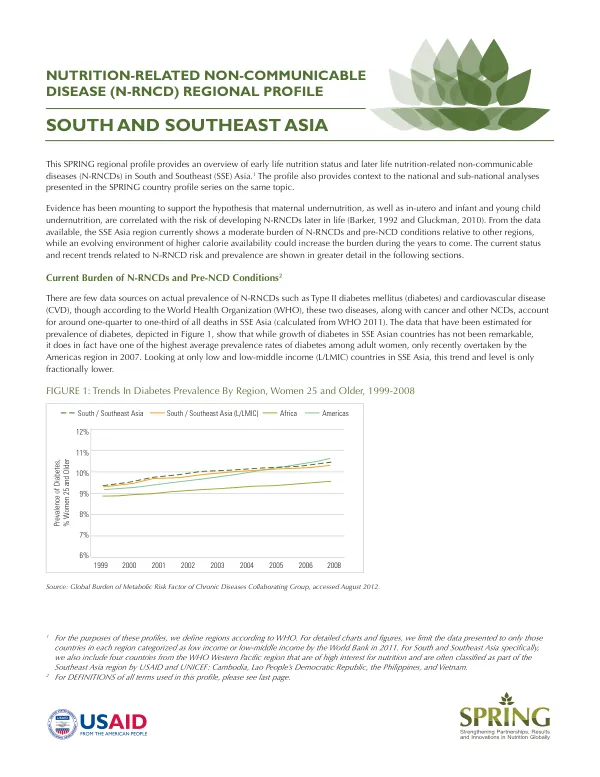
NUTRITION-RELATED NON-COMMUNICABLE DISEASE (N-RNCD) REGIONAL PROFILE SOUTH AND SOUTHEAST ASIA
Sign inUSAID
NUTRITION-RELATED NON-COMMUNICABLE DISEASE (N-RNCD) REGIONAL PROFILE SOUTH AND SOUTHEAST ASIA
The region of South and Southeast Asia (SSE Asia) has a moderate burden of nutrition-related non-communicable diseases (N-RNCDs) and pre-NCD conditions.
2012 · 5 pages
Sign in to readA free account is required to download.
Abstract
The prevalence of N-RNCDs such as Type II diabetes mellitus and cardiovascular disease is significant, with these two diseases accounting for around one-quarter to one-third of all deaths in SSE Asia. The region also has a high burden of pre-NCD conditions, including hypertension and raised cholesterol. According to the World Health Organization (WHO), the mean prevalence of hypertension and raised cholesterol for women in SSE Asia is 35% and 42%, respectively. The prevalence of these conditions varies by income group, with lower-income countries having higher rates. However, when broken down by selected countries in SSE Asia, the relationship between pre-NCD rates and wealth is no longer evident. The region also has a significant burden of overweight and obesity, with a mean prevalence of overweight women ranging from 5% in Timor-Leste to 29% in the Philippines. SSE Asia has the lowest mean prevalence of overweight women among all world regions, but this may be related to biological differences across ethnicities. Considering this, the prevalence of increased risk for N-RNCDs nearly doubles when using the increased risk BMI cutoff of 23. The potential for growth in future N-RNCD burden is significant, particularly in children. SSE Asia has significantly lower prevalence of overweight children compared to other regions, but the total burden is larger due to population size. The prevalence of overweight children is growing, while stunting is dropping quickly. National averages for overweight in children for the low- and low-middle-income countries in SSE Asia show that while many countries have quite low rates of child overweight, a selection of countries has rates that are close to or equal to the rates seen in the United States. The region's calorie availability has increased over the last decade, with an average gain of 180 calories per capita. However, there are several exceptions, with some countries gaining little or no calories at the national level. Trends for women's BMI are shown to be somewhat similar over the same time period, but there are several exceptions. The rapid growth in calorie availability and the existing burden of low birth weight and stunting could create a rapid growth in N-RNCDs beyond the age of five years. The region's burden of N-RNCDs and pre-NCD conditions is significant, and the potential for growth in future N-RNCD burden is substantial. The region's calorie availability has increased over the last decade, and the existing burden of low birth weight and stunting could create a rapid growth in N-RNCDs beyond the age of five years.