ECO CONSULTING GROUP
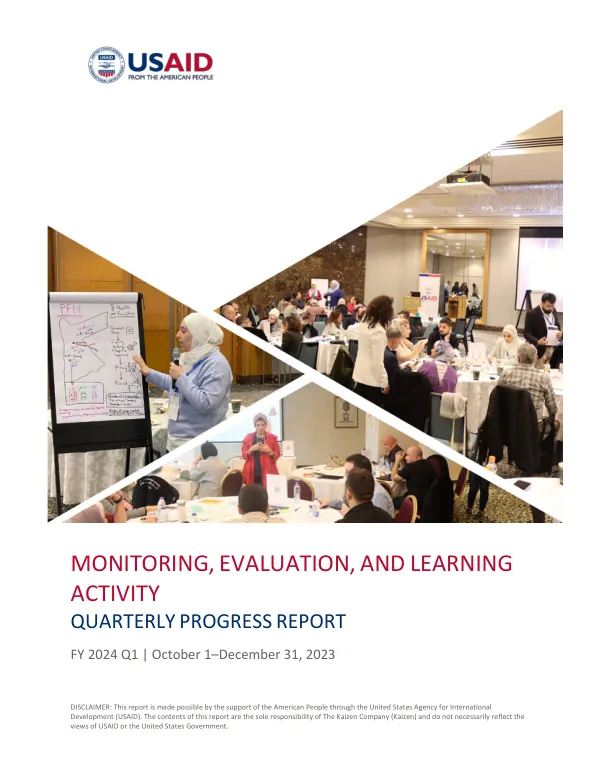
FY 2024 Q1 Monitoring, Evaluation, and Learning Activity Quarterly Progress Report
The Monitoring, Evaluation, and Learning Activity (MELA) in Jordan is a comprehensive initiative aimed at enhancing the monitoring, evaluation, and learning capacity of the United States Agency for International Development (USAID) and its implementing partners.
2024 · 107 pages
Sign in to readA free account is required to download.
Abstract
The activity, which began in February 2020 and is set to conclude in February 2025, is implemented by The Kaizen Company (Kaizen) and has a geographic focus on Jordan. The primary objective of MELA is to provide high-quality monitoring, evaluation, and learning services to USAID and its implementing partners, with a focus on improving performance management, accountability, and evidence-based decision-making. To achieve this objective, MELA has established a robust framework for monitoring, evaluation, and learning, which includes the development of a comprehensive monitoring and evaluation plan, the implementation of regular monitoring and evaluation activities, and the provision of technical assistance to USAID and its implementing partners. One of the key achievements of MELA in the first quarter of FY 2024 (October 1–December 31, 2023) was the completion of a comprehensive study on Gender Equality and Social Inclusion (GESI) in Jordan. The study, which was conducted in collaboration with USAID's implementing partners, aimed to identify the common gaps, opportunities, and recommendations across their GESI analyses. The study's findings highlighted key challenges in measuring and reporting on Gender Equality and Women's Empowerment indicators, as well as the extent to which USAID/Jordan's indicators align with the Government of Jordan's national priorities and reform strategies. The study team's design included a comprehensive desk review of all IP gender analyses and reported indicators, as well as key informant interviews with gender and MEL specialists from each IP. Following the analysis and triangulation of primary and secondary sources, the study team held a validation workshop with the Gender Community of Practice to present their initial findings and seek peer validation and feedback. The workshop produced many of the findings, while informing additional avenues to be further explored in subsequent data collection. The culmination of this assignment resulted in four robust learning products, each accompanied by tools designed to inform and enhance USAID/Jordan's GESI work. These products and tools emerged as invaluable resources, providing strategic insights, fostering collaboration, and addressing the challenges identified during the study. Kenana Amin, USAID's Senior Gender Advisor, praised the study team's exceptional organization and the participatory nature of their approach, highlighting the tangible utility of the learning products and tools in supporting the Mission to integrate best practices of gender-related programming across the differing sectors and USAID activities. In addition to the GESI study, MELA has also made significant progress in other areas, including the development of a comprehensive monitoring and evaluation plan, the implementation of regular monitoring and evaluation activities, and the provision of technical assistance to USAID and its implementing partners. The activity has also established a robust framework for knowledge management, which includes the development of a knowledge management portal and the provision of training and technical assistance to USAID and its implementing partners. Overall, the first quarter of FY 2024 has been a productive period for MELA, with significant progress made in a number of key areas. The activity continues to provide high-quality monitoring, evaluation, and learning services to USAID and its implementing partners, with a focus on improving performance management, accountability, and evidence-based decision-making.