MERCY CORPS INTERNATIONAL
FY14 Q2 Report: January - March 2014
The Southeast Economic Recovery and Protection Project (SERAP) was initiated in June 2013 to address the growing protection and relief needs of conflict-affected communities in southeastern Central African Republic (CAR).
2014 · 10 pages
Sign in to readA free account is required to download.
Abstract
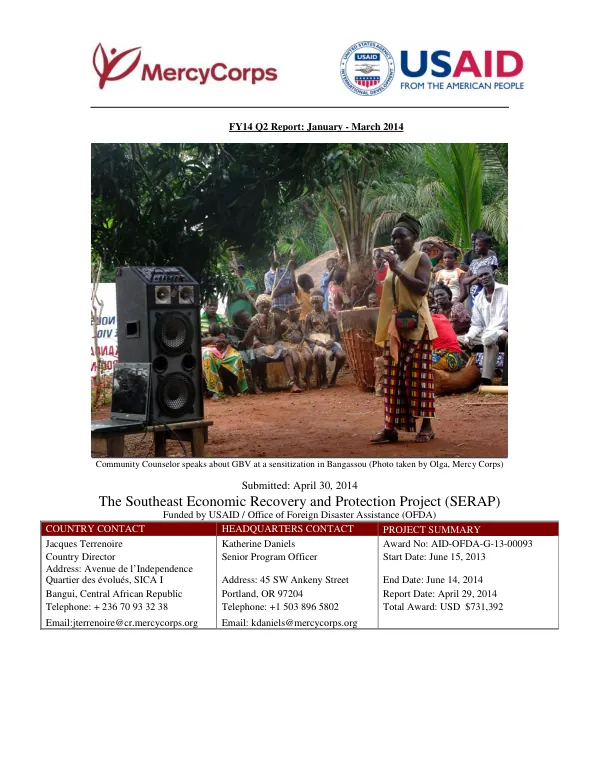
The program aims to increase food security, enhance community resilience, and strengthen the protective environment through community-based mechanisms for children, women, and men affected by conflict in the Mbomou prefecture. During the reporting period, the project achieved significant milestones. Thirty-six resilience groups received training on literacy, life skills, and financial literacy, with some groups also receiving vocational training or Village Savings and Loan (VSLA) training. Village leaders were trained on Gender-Based Violence (GBV) and the importance of medical and psychosocial referrals, particularly in cases of child rape. Agricultural groups were provided with land for farming and received training on parcel division and farming techniques. The project also continued to support play therapy groups and clubs in Bangassou and Rafai, with a total of 36 groups and 30 children each. Thirty-six play therapy micro-project proposals were submitted, approved, and procurement began. Ongoing mobilization of 41 protection committees and other community networks for effective protection monitoring and community sensitization on GBV was also conducted. The two Listening Centers handled 88 cases, with 23 of them being children. The centers provided critical support to survivors of GBV, including medical and psychosocial referrals. The project's efforts to educate local leadership on GBV and child rights, as well as the referral system and the importance of seeking medical attention, are expected to have a significant impact on reducing GBV incidents. The project's geographic focus is on the Mbomou prefecture, with a particular emphasis on the towns of Rafai, Agoumar, Selim, Dembia, Geurikindo, and surrounding villages. The project aims to reach 33,381 vulnerable people, including 3,000 internally displaced persons (IDPs) in LRA-affected communities, with access to protection services, including prevention and response to GBV. The project's expected results include: * 33,381 vulnerable people, including 3,000 IDPs in LRA-affected communities, continuing to have access to protection services, including prevention and response to GBV. * 3,500 vulnerable people, including 2,000 IDPs in LRA-affected communities, having restored assets to promote livelihoods and economic recovery. * 2,000 vulnerable people, including 1,250 IDPs in LRA-affected communities, having improved agriculture livelihoods and income generation opportunities. * Surveillance information will be collected to provide timely and rigorous early warning and vulnerability information on emerging and evolving crises situations for 93,457 people living in the Mbomou prefecture, including 10,000 IDPs. The project's security situation improved during the reporting period, with the African-led International Support Mission to Central Africa (MISCA) and the United Nations Integrated Peacebuilding Office in the Central African Republic (BINUCA) contributing to increased security in the region. Despite the relative security, programs continue to be affected by the conflict in Bangui and along the routes out of Bangui, mainly due to the inability to procure materials in the southeast.
Related documents