MERCY CORPS INTERNATIONAL
FY14 Q4 quarterly report KKRD Submitted January 31, 2015
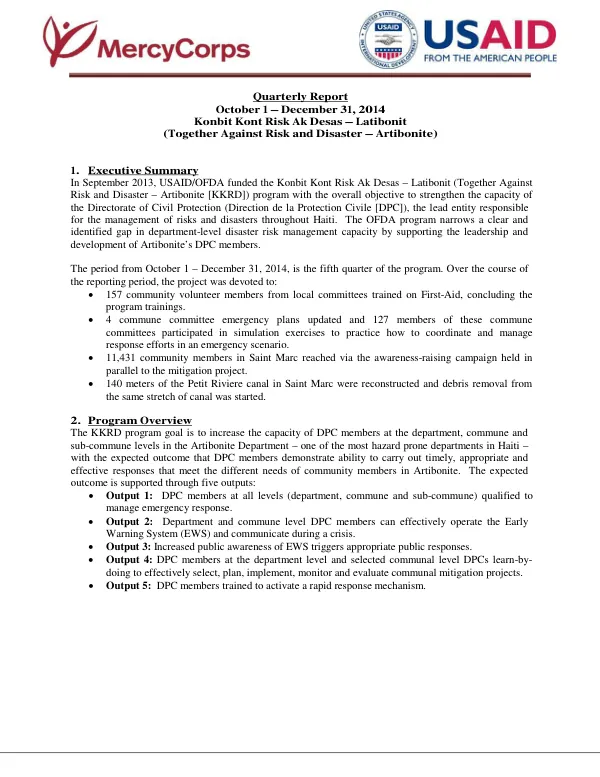
The Konbit Kont Risk Ak Desas – Latibonit (Together Against Risk and Disaster – Artibonite) program, funded by USAID/OFDA, aims to strengthen the capacity of the Directorate of Civil Protection (Direction de la Protection Civile) in the Artibonite Department of Haiti.
2015 · 8 pages
Sign in to readA free account is required to download.
Abstract
The program focuses on disaster risk management and emergency response, with the goal of increasing the capacity of DPC members at the department, commune, and sub-commune levels. During the fourth quarter of 2014, the program continued to implement its activities, with a focus on capacity building and training. A total of 157 community volunteer members from local committees were trained on first aid, with 22% female participation. The training was conducted in five communes, including Gros Morne, Source Chaud, Saint Michel, Liancourt, and Montrouis. The training covered three main objectives: preserving life, preventing further harm or danger of injury, and promoting recovery. In addition to the first aid training, the program also supported the development of emergency response plans and the implementation of mitigation projects. In the Petit Riviere canal in Saint Marc, 140 meters of the canal were reconstructed, and debris removal from the same stretch of canal was started. The project aimed to improve the canal's capacity to handle floodwaters and reduce the risk of flooding in the surrounding communities. The program also focused on building community awareness and mobilization, with a focus on strengthening Early Warning System (EWS) systems. In October 2014, an external consultant was recruited to lead the simulation exercises (SIMEX) process, which included updating commune emergency plans and preparing commune committees. A total of four communes were selected to undergo a SIMEX, including Gros Morne, Ennery, Marchand Dessalines, and Desdunes. The SIMEX process included field workshops to update and validate commune emergency plans, as well as a one-day field workshop to go over the existing plans and identify information to update all sections of the plan. The consultant worked to incorporate the updated information into the emergency plan documents and held a second half-day validation workshop with each committee to present and validate the final updated plans. The program's activities were implemented in collaboration with local authorities and community members, with a focus on building capacity and promoting disaster risk management. The program's expected outcome is that DPC members demonstrate the ability to carry out timely, appropriate, and effective responses to emergencies, and that community members are aware of the Early Warning System and can respond appropriately in the event of a crisis. The program aims to reach an estimated 30,145 people, including members of the department level and commune level DPC, and community members living in communities that benefit from communal mitigation projects. The program's activities are expected to contribute to the reduction of disaster risk and the improvement of emergency response capacity in the Artibonite Department of Haiti.