USAID DEC
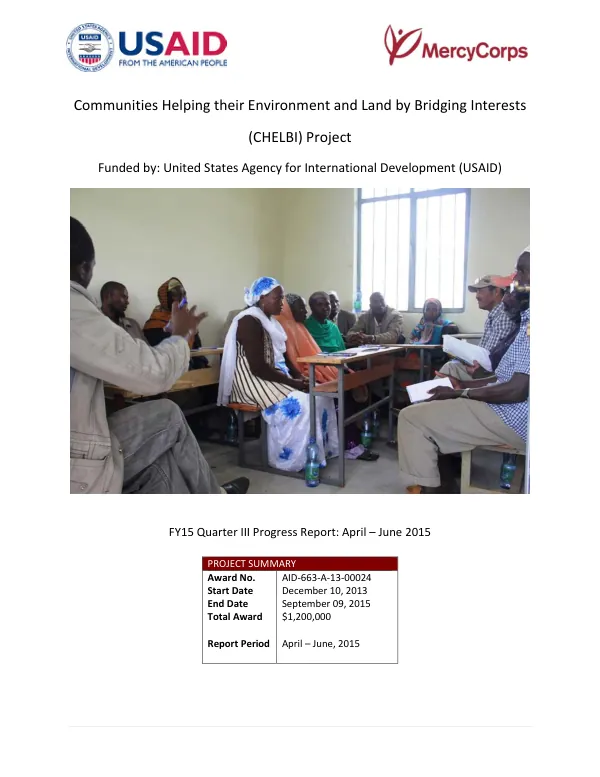
FY15 Quarter III Progress Report: April – June 2015 for the Communities Helping their Environment and Land by Bridging Interests (CHELBI) Project
Sign inMERCY CORPS INTERNATIONAL
FY15 Quarter III Progress Report: April – June 2015 for the Communities Helping their Environment and Land by Bridging Interests (CHELBI) Project
The Communities Helping their Environment and Land by Bridging Interests (CHELBI) Project operates in the Chau Bahir watershed of Southern Ethiopia, where six distinct ethnic groups compete over limited key livelihood resources.
2015 · 11 pages
Sign in to readA free account is required to download.
Abstract
The project aims to reduce violence among agricultural and pastoral communities by promoting sustainable natural resource management, land use planning, and livelihood opportunities. The CHELBI project operates in Konso, Alle, and Burji woredas of the Southern Nations Nationalities and Peoples Regional State (SNNPRS), and Teltele Woredas of Borana Zone in Oromiya Regional State. The project's goal is to promote interdependence among pastoral and agricultural communities through sustainable natural resource management, land use agreements, and livelihood opportunities. The project works towards its goal through three objectives: facilitating people-to-people solutions to land and natural resource competition, developing capacity and linkages among formal and non-formal institutions, and facilitating market linkages for natural resource products and improved technologies. The project focuses on consensus-driven, sustainable management and utilization of key shared resources, land use planning, and rehabilitation processes through people-to-people facilitation approaches. During the reporting period, the project made significant progress in achieving its objectives. Four NRM committees were established in Burji and Alle woredas, and two consultation meetings were facilitated on by-law development processes. A total of 8,105 community members were mobilized for rehabilitation of key natural resource areas, and 253 youth participated in peer-to-peer discussions on environmental protection. The project also supported the establishment of nursery sites, trained women's groups on fuel-efficient cooking stove production, and promoted post-harvest technology at the household level. Additionally, the project organized a conflict management workshop for Gamo Gofa Zone officials and facilitated a visit by the USAID Director General to the CHELBI project. The project's achievements in the reporting period include the establishment of NRM committees, community mobilization for rehabilitation of degraded areas, and peer-to-peer discussions among youth groups on environmental issues. The project's focus on sustainable natural resource management, land use planning, and livelihood opportunities has contributed to reducing violence among agricultural and pastoral communities in the Chau Bahir watershed. The project's success is attributed to its people-to-people facilitation approaches, which have enabled the communities to take ownership of the project's activities and outcomes. The project's focus on building institutional capacity among community-based traditional institutions and local government structures has also contributed to its success. The project's achievements have been recognized by the local communities, who have expressed their appreciation for the project's efforts in promoting sustainable natural resource management and reducing conflict. The project's success has also been acknowledged by the regional and national authorities, who have expressed their commitment to supporting the project's activities and outcomes. The project's future plans include continuing to support the establishment of NRM committees, community mobilization for rehabilitation of degraded areas, and peer-to-peer discussions among youth groups on environmental issues. The project also plans to expand its activities to other areas of the Chau Bahir watershed and to strengthen its partnerships with local communities, institutions, and government agencies. The project's long-term goal is to promote sustainable natural resource management, land use planning, and livelihood opportunities in the Chau Bahir watershed, and to reduce violence among agricultural and pastoral communities. The project's success will depend on its ability to continue to build the capacity of local communities, institutions, and government agencies, and to promote a culture of peace and cooperation among the communities.
Related documents