USAID DEC
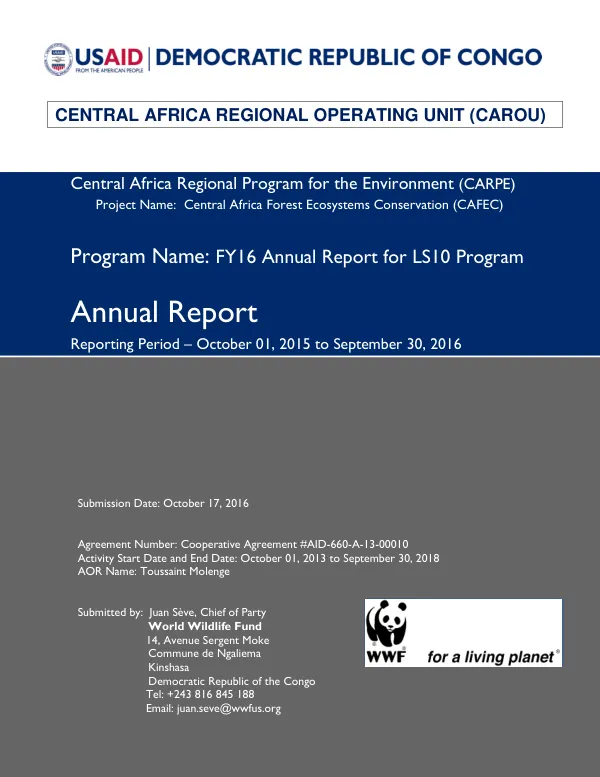
FY16 Annual Report for LS10 Program: Central Africa Forest Ecosystems Conservation (CAFEC) Project
Sign inTHE JANE GOODALL INSTITUTE
FY16 Annual Report for LS10 Program: Central Africa Forest Ecosystems Conservation (CAFEC) Project
The Central Africa Forest Ecosystems Conservation (CAFEC) program is a project implemented by the World Wildlife Fund (WWF) in collaboration with the Institut Congolais pour la Conservation de la Nature (ICCN) and other partners.
2016 · 25 pages
Sign in to readA free account is required to download.
Abstract
The program aims to conserve the exceptional values and biodiversity of the Itombwe Natural Reserve (RNI) in the Democratic Republic of the Congo. The project is centered on the RNI in the southern part of the Maiko Tayna Kahumbe-Biega (MTKB) Landscape, which is a key area for conservation efforts. The main threats to conservation targets in the RNI include illegal commercial hunting, slash-and-burn agriculture, large-scale gold mining, artisanal and small-scale mining, unsustainable wood harvesting, and subsistence hunting. To address these threats, the WWF is implementing a project that contributes to the principal results of the CAFEC program, which are to sustainably managed targeted forest landscapes and to mitigate biodiversity threats in forest landscapes. The project is implementing multiple strategies and activities that are priorities for CAFEC and contribute to the National Framework for REDD+ in the DRC. The project is implemented in close collaboration with the ICCN and other partners, including civil society organizations and local communities. The approach is transparent and collaborative, aiming to mitigate the loss of habitat and improve habitat suitability in the RNI macro-zone. The project is also contributing to the establishment of a protected area that can sustain conservation targets. The project is implementing six strategies, including strengthening protected area management capacity, implementing land-use plans, enhancing law enforcement and prosecution, promoting sustainable agriculture and livelihood alternatives, promoting ecologically sustainable artisanal use of natural resources, and facilitating access to health services. The project has achieved several results, including training 605 people in natural resources management and biodiversity conservation, with 232 of them being pygmies. The project has also trained 157 people in global climate change, with 95 of them being women. The project has detected 127 incidents of poaching, with a rate of 0.11 incidents per km patrol effort. The project has also found no illegally killed elephants, and no charcoal production sites have been encountered. The project has proposed 73,400 hectares of forested area as community forestry areas, which is more than the annual target. The project has also found no incidences of illegal logging in protected areas. The project has conducted an inventory of elephant populations, which found an abundance of 0.28 individuals per km for gorillas and 0.30 individuals per km for chimpanzees. The project has also found an overall increase in the effectiveness of protected area management. The project has also achieved several other results, including improving the management of 721,000 hectares of biological and natural resources, effectively patrolling 30% of critical habitat for elephants and apes, and patrolling a total of 1,121 kilometers. The project has also found no apprehensions made while patrolling, and no patrols informed by intelligence. The project has also found no prosecutions made. The project is contributing to the overall goal of the CAFEC program, which is to maintain the ecological integrity of the humid forest ecosystem of the Congo Basin. The project is also contributing to the development objective of the CAFEC program, which is to conserve biodiversity and natural resources in the Congo Basin.