USAID DEC
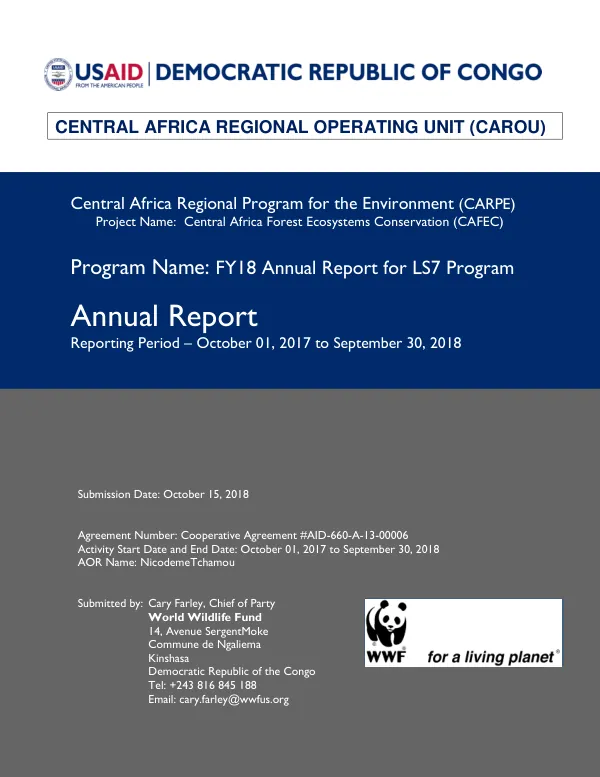
FY18 Annual Report for LS7 Program: Central Africa Forest Ecosystems Conservation (CAFEC)
Sign inWILDLIFE CONSERVATION SOCIETY
FY18 Annual Report for LS7 Program: Central Africa Forest Ecosystems Conservation (CAFEC)
The Central Africa Forest Ecosystems Conservation (CAFEC) program is a collaborative effort between the World Wildlife Fund (WWF) and other key partners, including the Institut Congolais pour la Conservation de la Nature (ICCN) and local authorities.
2018 · 38 pages
Sign in to readA free account is required to download.
Abstract
The program's overall objective is to maintain the ecological integrity of the humid forest ecosystem of the Congo Basin. To achieve this goal, CAFEC has implemented seven strategies across the Lac Tumba Landscape, which includes seven macrozones, two Nature Reserves, three Community-Based Natural Resource Management (CBNRM) zones, and two private concessions. One of the key strategies implemented by CAFEC is the strengthening of protected area management capacity. This has been achieved through the use of assessment learning tools, such as the IMET, and data collection tools, such as the SMART Spatial Monitoring and Reporting Tool. The IMET was used to assess the management level of the RNTN, while the SMART tool improved the efficiency of biological monitoring. A total of 15 guards were trained to collect survey and monitoring data, resulting in 40 discoveries in 3689 and 36% in calendar size of 2x2 km. Another key strategy is the strengthening of land use management plans. To achieve this, CAFEC has worked to put in place appropriate structures to improve governance in this area. A total of 118 Community Land Development Committees (CLDS) were created, with 27 receiving administrative recognition of the Bikoro and Lukolela territories. The appropriation of various activities and/or actions initiated in the field will be easy because the SODEFOR ISSONGO concession is owned by 689 members of the Steering Committees of the 55 CLDs. CAFEC has also implemented strategies to enhance law enforcement and prosecution, promote sustainable livelihood alternatives, and facilitate access to family planning and health services. Training in fish farming techniques was delivered to 69 people, resulting in the installation of 23 fish ponds for 23 agroforestry households. Additionally, 15 community fields were installed to promote the use of best agriculture practices, and 1509 women were trained and supported in the technique of producing improved chikwangue. Furthermore, CAFEC has worked to promote ecologically sustainable artisanal use of natural resources. WWF worked with 64 Tumba Lake Fishermen's Associations to strengthen their statutes and train 186 members in best fishing practices. The program has also facilitated access to family planning and health services in communities where healthcare partners are active. A total of 47836 people were reached by awareness-raising and outreach activities in relation to family planning, with an additional 11466 people reached through the financial contribution of KfW. CAFEC has also implemented strategies to reduce the impact of extractive industry by promoting best management practices. WWF developed 6 fire management plans for six village lands, and the SOGENAC (Lebomo) concession was given its own fire management plan in harmonization with the communities. Additionally, 24 fire units were established and are currently operational throughout the Bolobo district. Finally, CAFEC has promoted tourism and REDD+ financing mechanisms, such as payments for ecosystem services. One of the key accomplishments was the development of an ecotourism strategy for the Nkala Nkoo CBNRM. The program has also signed agreements with corporate partners to provide services such as nurseries, reforestation of fast-growing trees, and fires, reforested sites, and anthropogenic savannah protection. The CAFEC program has made significant contributions to the eight pillars of the DRC's National REDD+ Framework Strategy. The program's activities have been carried out in collaboration with key partners, including the ICCN, RSM, and local authorities. The program's overall objective is to maintain the ecological integrity of the humid forest ecosystem of the Congo Basin, and its strategies have been implemented across the Lac Tumba Landscape.