USAID DEC
FY15 Q4 Report: Advancing Solutions for Peace through Intercommunity Reconciliation and Engagement (ASPIRE)
Sign inCATHOLIC RELIEF SERVICES ORGANIZATION
FY15 Q4 Report: Advancing Solutions for Peace through Intercommunity Reconciliation and Engagement (ASPIRE)
The Advancing Solutions for Peace through Intercommunity Reconciliation and Engagement (ASPIRE) program in Bouar, Central African Republic, aims to enable community leaders and disaffected youth to work together to peacefully manage inter-group tensions and rebuild community cohesion.
2016 · 7 pages
Sign in to readA free account is required to download.
Abstract
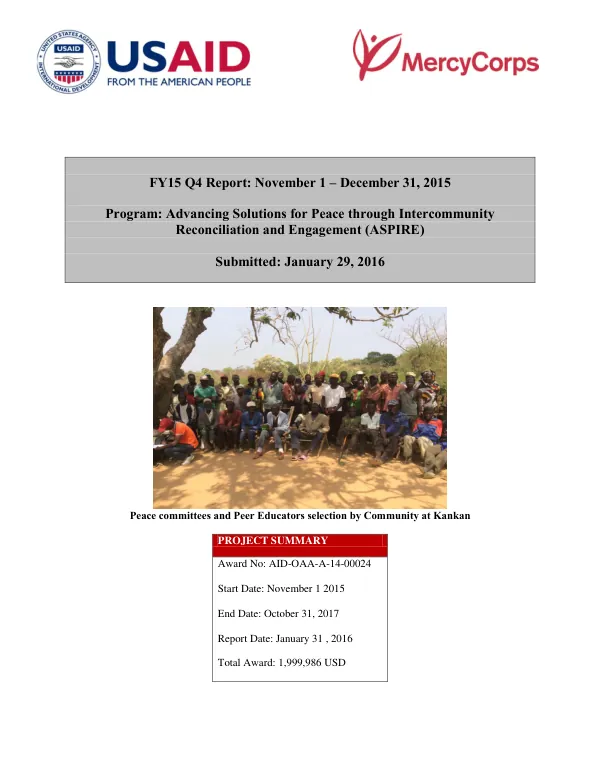
The program, implemented by Mercy Corps, is funded by the United States Agency for International Development (USAID) and has a total award of $1,999,986. During the fourth quarter of 2015, Mercy Corps established a firm foundation for the launch of the ASPIRE program in Bouar. The organization conducted a kick-off meeting with all Mercy Corps departments to present the program and orient each department on their roles and responsibilities. A new program Performance Monitoring Plan and Work Plan were developed and submitted to USAID on December 11, 2015. Mercy Corps also recruited and deployed national staff, including the Program Manager, M&E Assistant, Program Assistant, Program Facilitator, Sub Grant Officer, and Driver Bouar. Mercy Corps organized a total of 20 meetings in Bouar and surrounding villages to present the program and inform communities on their need to be involved. Meetings mobilized around 514 people, including local leaders, disabled persons, youth, women representatives, religious leaders, and other key community actors. The organization also developed and signed a Memorandum of Understanding with the Bouar Inter-Religious Platform (BIRP) describing roles and responsibilities between Mercy Corps and the BIRP. Nine Peace committees were established in Bouar and in five of the six areas of intervention. The Peace committees are comprised of community leaders, women, and youth who meet regularly to review rising tensions and inter-group dispute resolution, and discuss interventions. The selection criteria for Peace Committee members focused on relevant factors such as influence within the community, dynamic and positive personalities with leadership potential, passion for peace-building, and ending conflict. Each Peace Committee represented a cross-section of the community, including youth, local leaders, men, and women, and representatives of parties in conflict. A total of 63 members were selected for the 9 Peace Committees, including 12 Muslim members. The remaining Peace Committee will be put in place during the next reporting period when security has improved in Niem. The Peace Committee members will be trained in mediation, facilitation, dispute resolution, Do No Harm, and multi-stakeholder dialogue processes during the first quarter of 2016. In addition to the Peace Committees, 34 Peer Educators (PEs) were selected through a rigorous selection process. The PEs will be responsible for promoting peaceful resolution of inter-group disputes and inter-group dialogue in their communities. The selection criteria for PEs focused on relevant factors such as influence within the community, dynamic and positive personalities with leadership potential, passion for peace-building, and ending conflict. The PEs will be trained in community awareness on socio-economic project selection, project monitoring, and other relevant skills. The ASPIRE program aims to achieve its objectives through a holistic people-to-people approach that facilitates inclusive, community-led processes to mitigate current and future conflicts, increases economic cooperation across lines of division, and positively changes attitudes towards tolerance and non-violence. The program will be implemented in Bouar and surrounding villages, with a focus on promoting peaceful resolution of inter-group disputes and inter-group dialogue.
Related documents
Documents in this collection
 2014
2014USAID DEC
FY14 Q3 Quarterly Report: Stabilizing Vulnerable Communities in the Central African Republic through the Promotion of Interfaith Dialogue and Economic Cooperation
Open record 2016
2016USAID DEC