USAID DEC
Advancing Solutions for Peace through Intercommunity Reconciliation and Engagement (ASPIRE) FY16 Q4 Report: July - September, 2016
Sign inMERCY CORPS INTERNATIONAL
Advancing Solutions for Peace through Intercommunity Reconciliation and Engagement (ASPIRE) FY16 Q4 Report: July - September, 2016
The ASPIRE program, implemented by Mercy Corps, aims to support faith leaders and unemployed youth in resolving inter-communal tensions and re-establishing peace and social cohesion in the Central African Republic.
2016 · 8 pages
Sign in to readA free account is required to download.
Abstract
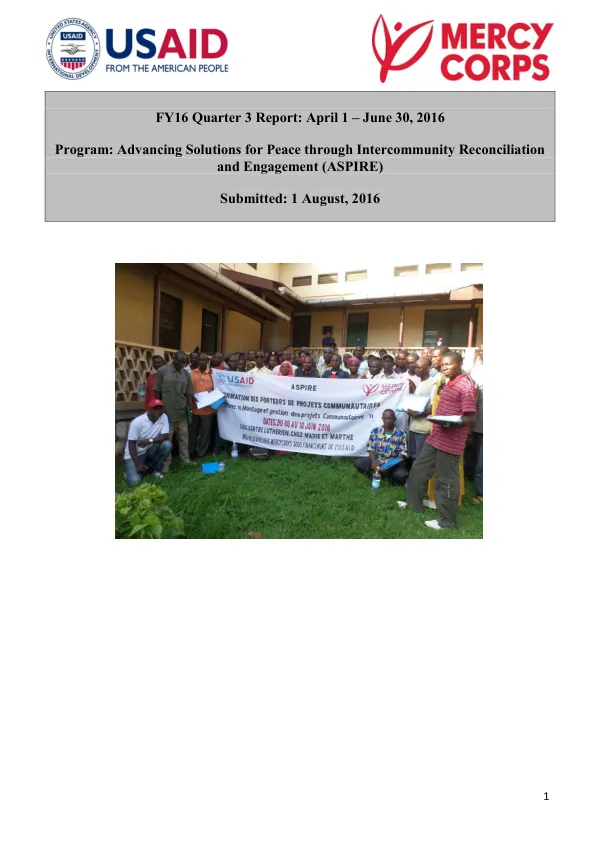
The program has three main objectives: facilitating inclusive peace processes, increasing economic cooperation between divided groups, and promoting tolerance and non-violence. To achieve these objectives, the program focuses on setting up peace committees consisting of community leaders, women, and youth who meet regularly to discuss key issues creating intergroup tensions and suggest next steps to resolve disputes. During the reporting period, five peace committees developed activities allowing for mediation between community groups or families in conflict, and five others conducted awareness-raising around the promotion of social cohesion through radio broadcasts. The peace committees have helped to resolve 10 conflicts, often based on disputes between agro-pastoralists over land and resource use, as well as interpersonal and socioeconomic differences. These conflicts were resolved through constructive dialogue and communication in a relaxed atmosphere where people can talk openly and freely about their grievances. The peace committees have become well known in the intervention zones, with community members requesting their assistance in resolving conflicts. The program also focuses on training peace committees in mediation, facilitation, dispute resolution, Do No Harm, and multi-stakeholder dialogue. From July 28 to August 14, 2016, trainings were conducted for 56 members of the peace committees in Bouar and surroundings, including 20 women and 36 men who have participated in activities to train others and facilitate activities within their communities using the conflict mitigation techniques they have learned. In addition, the program has established an early warning system, which is now operationalized in the intervention area. From August 5 to 10, trainings were conducted in Bouar, and a group was formed to monitor, collect, share, and analyze data as part of the early warning system. A total of 52 people were trained, including 2 women and 50 men composed of program staff, peace committee members, peer educators, and community members. The security context in Bouar and surrounding localities remains relatively calm, but armed groups have become increasingly active in the north of the project zone. The program has documented the resolution of 10 conflicts, including land disputes, conflicts between farmers and herders, and domestic conflicts. The peace committees have helped to resolve these conflicts through constructive dialogue and communication, and have become well known in the intervention zones. The program has also continued to meet with local authorities, UN agency representatives, religious and community leaders, women and youth association representatives, and civil society representatives to present the project and progress achieved since its start in November 2015. In total, Mercy Corps organized or participated in 12 stakeholder or coordination meetings during the reporting period. The program has made significant progress in achieving its objectives, including the establishment of peace committees, training of peace committee members, and the resolution of conflicts. The early warning system is now operationalized, and the program continues to work towards promoting tolerance and non-violence in the Central African Republic.
Related documents
Documents in this collection
 2016
2016USAID DEC
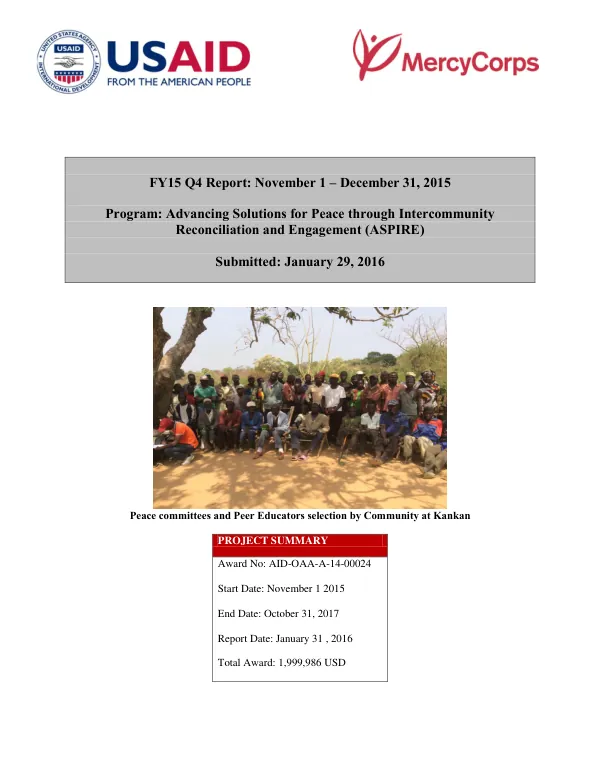
FY15 Q4 Report: Advancing Solutions for Peace through Intercommunity Reconciliation and Engagement (ASPIRE)
Open record 2014
2014USAID DEC
FY14 Q3 Quarterly Report: Stabilizing Vulnerable Communities in the Central African Republic through the Promotion of Interfaith Dialogue and Economic Cooperation
Open record