USAID DEC
FY16 Q3 Quarterly Report: Emergency Assistance to Conflict-Affected Populations-V (EACAP-V)
Sign inMERCY CORPS INTERNATIONAL
FY16 Q3 Quarterly Report: Emergency Assistance to Conflict-Affected Populations-V (EACAP-V)
The EACAP-V program provides essential emergency assistance to conflict-affected populations in North Kivu, Democratic Republic of the Congo through providing water, sanitation and hygiene (WASH) services to about 125,000 people, including 100,000 individuals living in IDP camps.
2016 · 22 pages
Sign in to readA free account is required to download.
Abstract
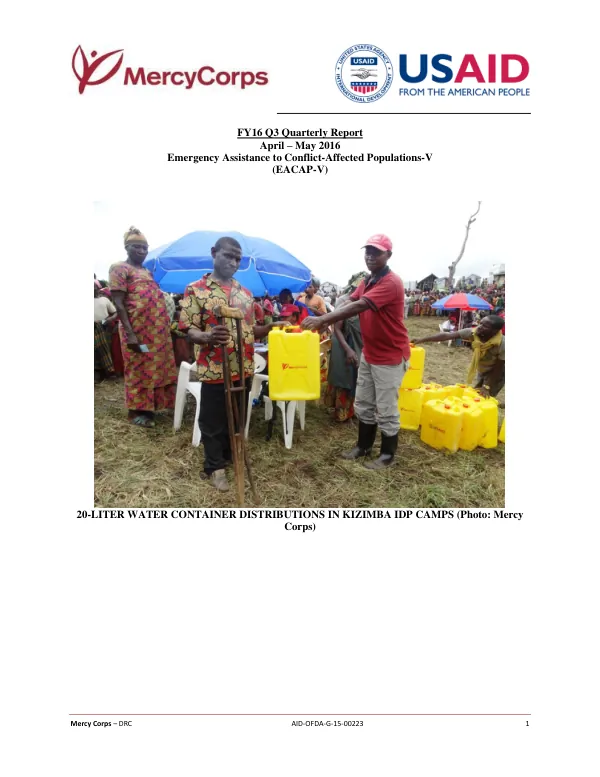
The program addresses the populations' most critical WASH needs, including access to water, sanitation and a clean and safe environment. Throughout the lifetime of the program, EACAP-V surpassed the population target, reaching 158,625 people, including 117,125 individuals living in IDP camps and 41,500 host communities. During the reporting period, there were an estimated 77,766 IDP residing in 13 of the 18 IDP camps targeted by the program in Masisi and Goma territories. Due to their steady population growth, these camps still require extensive external support. The current provision of services in and around the camps is not adequate to meet the needs of the displaced and host populations. Mercy Corps strengthened awareness on the need for self-care and hygiene in the camps around Goma, as part of its exit strategy. The security situation in North Kivu remains tense and volatile in many areas of the province, following increased activity from armed groups, including the Alliance of Democratic Forces (ADF), the Democratic Forces for the Liberation of Rwanda (FDLR) and the Maï Maï-Nyatura. Humanitarian access remains a problem for organizations intervening in the area. Due to the increasingly unstable security situation, three organizations suspended humanitarian operations in Rutshuru during the reporting period. Several others have suspended their activities but are able to respond in the territories of Masisi and Beni. In the Mpati area in Masisi, 45,000 people who were evicted from displacement sites are being deprived of assistance due to the security situation. There was a trickle of returning IDPs reported in the sites of Bweru, Bibwe and Kitso. These sites, and the former Mpati site, were entirely emptied in late March during military operations against armed groups in the area. Despite the low numbers of returnees, the situation remains tense in the area, which is still a major theater of military operations against armed groups. Mercy Corps participated regularly in coordination meetings, such as the WASH Cluster and the Camp Coordination and Management (CCCM) working group in Goma, and in weekly inter-agency meetings in Kitchanga, to ensure that it coordinated its interventions with other key actors to meet the needs of IDP populations in North Kivu. The program continued to work with the humanitarian community to advocate for the rights of displaced populations and against the rapid closure of other camps in North Kivu. The provincial government has already announced the closure of several IDP camps, including Muhanga and Mugunga I, where Mercy Corps operates. During the reporting period, Mercy Corps constructed 180 latrines, rehabilitated 36 and treated and sealed latrines in 13 camps. The WASH team conducted hygiene promotion activities in all 13 camps through an awareness raising campaign, including door-to-door visits and Community Theater, weekly focus group discussions in the camps and the dissemination of hygiene messaging through a local radio station. In two camps, Mungote and Kahe, Mercy Corps supported Relais communautaires (RECOs) who conducted a sensitization campaign on the five critical moments for hand washing and distributed soap to 14 families. In May 2016, Mercy Corps conducted total sanitation in the Muhanga camp after the site was consolidated. The EACAP-V program provided hygiene kits and water containers for women and girls in IDP camps during the no-cost extension period from April 14, 2016 to May 14, 2016. Mercy Corps worked in 13 IDP camps, where it continued to ensure access to clean drinking water and sanitation facilities in accordance with North Kivu WASH Cluster standards. Mercy Corps provided hygiene promotion support to approximately 77,766 IDP and 6,500 members of host communities in the Mweso and Karisimbi Health Zones. Due to high insecurity in the area of Mpati, five IDP camps were inaccessible.