CATHOLIC RELIEF SERVICES ORGANIZATION
DRC SIMAMA Quarterly Report FY 16 Q2
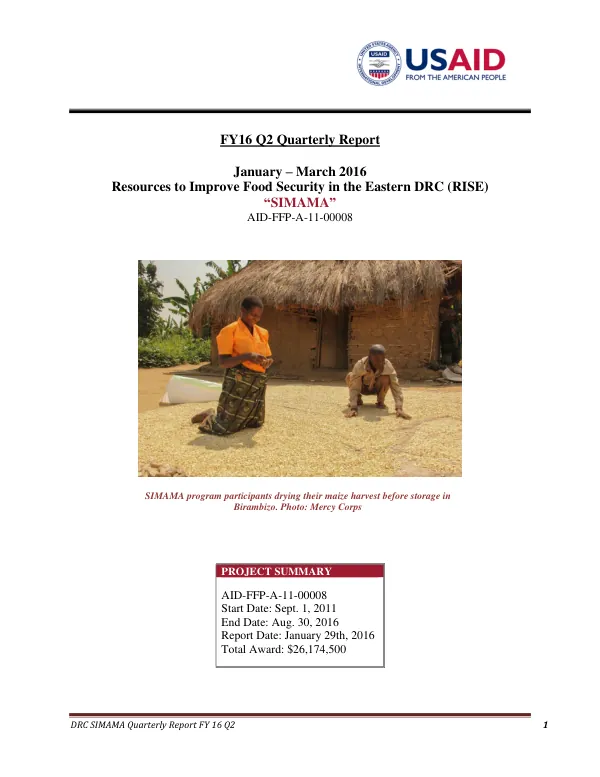
The SIMAMA program, implemented by Mercy Corps in partnership with Catholic Relief Services, aims to ensure that vulnerable households and communities in North Kivu build and sustain their food security.
2016 · 17 pages
Sign in to readA free account is required to download.
Abstract
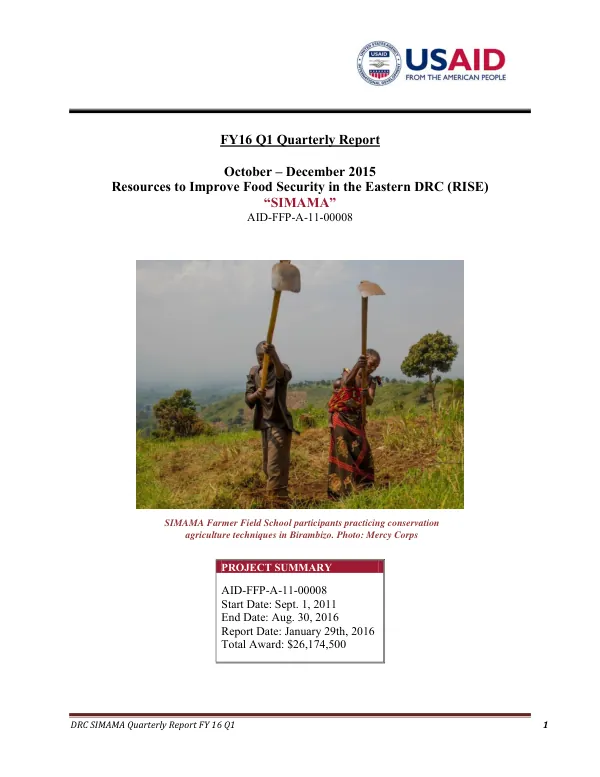
The program focuses on improving agricultural production, controlling and eradicating crop disease, increasing household incomes, and preventing childhood malnutrition. Activities specifically address the challenges that vulnerable households face regarding food availability, access, and utilization. The program's implementation continues as per its Year 5 PREP, with no specific change to report. The period corresponded to the harvest season in the different program areas, characterized by reduced crops due to climatic issues. In respect with SO2 Nutrition, the period was mainly marked with the last distribution of food commodities to PM2A participants. The governance SO3 component strived to move forward with the implementation of the exit strategy through capacity building of local groups partnering with the program. SIMAMA continued the mainstreaming of the program exit strategy initiated within each SO. Two specific workshops took place in Goma and Butembo to refine the strategy elaborated and train staff on the various aspects of the program coming up phasing down. In May 2016, the program will conduct three workshops with local authorities and stakeholders to officially close the program. In March 2016, the first phase of staff contract terminations took place following the phasing down plan that was designed in December 2015 within both Mercy Corps and CRS. The program's agricultural calendar in North Kivu is characterized by a harvest season for crops sown during the October to December period. During the quarter, heavy rains damaged some vegetable crops, notably around the areas of Birambizo and Musienene. The program estimates a 30% loss on cabbage and onion crops. Conversely, in Masereka and Kalunguta health zones, a dearth of rainfall stunted plant growth, mainly potatoes, cassava, and beans, which in the long-term raises concerns for the quality of yields. To support the activities of farmers during this period, SIMAMA and its technical agricultural team intensified their efforts in the following areas: support for Farmer Field Schools (FFS), amplifying the campaign to combat and manage BXW, technical support to Producer/Multipliers (PM) and Common Interest Groups (GIC). To prepare for the withdrawal of the program, many activities were carried out in collaboration with local authorities, including touring agricultural activities with the agronomist of Bwito chefferie (Birambizo) and joint visits of local authorities of Lubero territory to the Musienene and Masereka health zones. Farmer Field Schools - homestead gardens were a key focus area for SIMAMA during the reporting period. The program concentrated its efforts in providing refresher trainings to 187 FFS homestead gardens created in the first quarter of FY16. A total of 2,002 members from 96 FFS (1,437 women and 565 men) in Birambizo and 2,129 members from 91 FFS (1,564 women and 565 men) in Butembo attended training sessions on the selection of good seed, integrated pest management, soil conservation, and the harvest and post-harvest of homestead garden produce. Prevention of crop disease, particularly cassava and banana, was another key area of focus for SIMAMA. Sensitization campaigns on healthy cassava cuttings continued for Producers multipliers, including plant protection monitoring and conforming to standards maintained by the national seeds authority, SENASEM, in the production and multiplication of certified cassava cuttings. In Birambizo, SIMAMA provided technical support to associations that installed 8 ha of healthy cassava cuttings during Q1 FY16 for agricultural production and multiplication. Agriculture commercialization was also a key area of focus for SIMAMA. The program continued to coach 76 Common Interest Groups (CIG) set up in Q3 FY15. The 76 CIG (33 in Butembo and 43 in Birambizo) engaged in the production and marketing of potatoes (7), beans (32), and onions (37). As a result, the Central Cooperative of North Kivu (COOCENKI) trained 1,000 farmers on potato production and marketing.
Related documents