USAID DEC
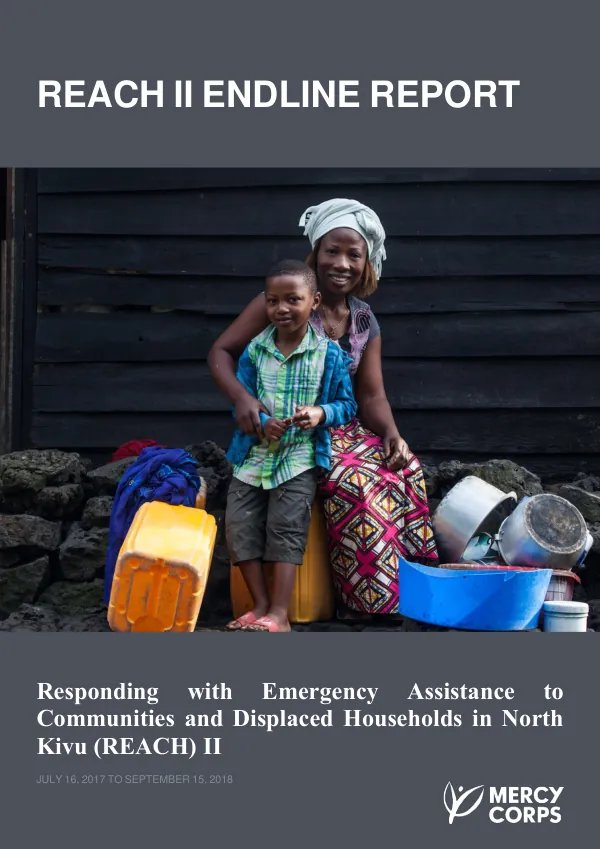
Responding with Emergency Assistance to Communities and Displaced Households in North Kivu (REACH) II
Sign inMERCY CORPS INTERNATIONAL
Responding with Emergency Assistance to Communities and Displaced Households in North Kivu (REACH) II
The REACH II project was implemented in North Kivu, Democratic Republic of the Congo, from July 16, 2017, to September 15, 2018.
2018 · 12 pages
Sign in to readA free account is required to download.
Abstract
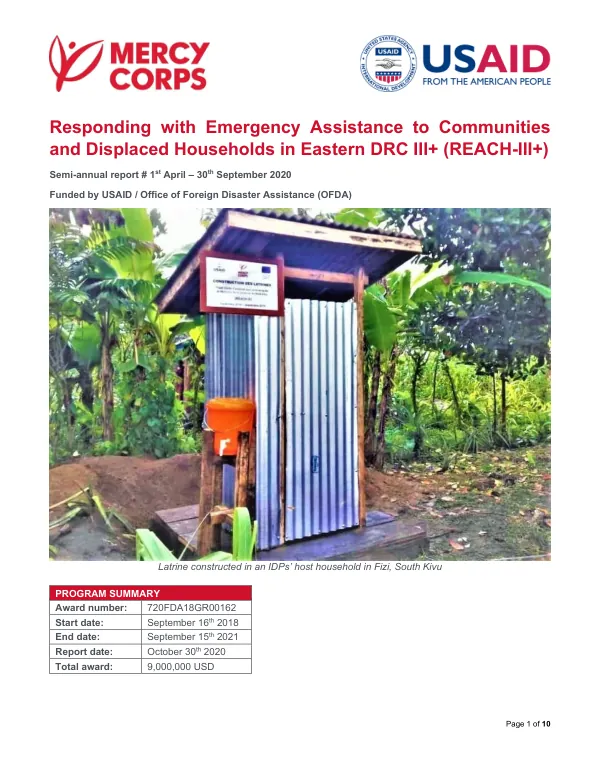
The project aimed to provide emergency water, sanitation, and hygiene (WASH) assistance to 120,000 vulnerable persons, including 100,000 Internally Displaced Persons (IDPs). The project was funded by the Office of U.S. Foreign Disaster Assistance (OFDA) and built on the successes of previous Emergency Assistance to Conflict Affected Populations (EACAP) programs. The REACH II project employed a rolling baseline/endline evaluation strategy to respond to the unpredictable progression of humanitarian rapid responses. The strategy involved conducting multiple baselines at the beginning of each response, two weeks after the conclusion of the response, and at the end of the project. This approach allowed for clear visibility on each rapid response at the moment of deployment and departure of humanitarian actors. The project's objectives were to inform understanding of the immediate intervention context and measure project indicator values at the intervention sites. The indicators and their corresponding baseline and endline values were included in a table for easy reference. The project's methodology involved a two-level cluster study design, with each intervention evaluated at the beginning, two weeks after the conclusion, and at the end of the project. A comprehensive sample size of 850 household respondents was calculated based on an estimated 17 intervention sites, with 50 household respondents per site. The sample size ensured a 95% confidence level, a 5% margin of error, and a design effect of 2 given a population of 120,000 and a 10% non-response rate. Across all baselines, endlines, and global endlines, a total of 1,056 households were surveyed in REACH II intervention sites. The project's infrastructure was evaluated using infrastructure-specific checklists, with 100 percent of latrines, handwashing stations, showers, and water points evaluated during the preliminary endline. The global endline evaluated a sampling of 10 percent of infrastructure points to determine the durability of all activities. The REACH II Monitoring & Evaluation (M&E) team adapted the DRC Kivus WASH Cluster's rapid evaluation quantitative questionnaire to promote high-quality data and alignment with USAID/OFDA indicator measures. The questionnaire was implemented using the electronic platform Open Data Kit (ODK). All endline and global endline evaluations were led by a member of Mercy Corps DRC's Emergency M&E team, in conjunction with a team of three to four enumerators. The project recognized certain limitations, including the inability to determine the target population data for the intervention zone as a whole at the onset of the project. The sample size was determined based on the REACH II team's practical experiences in similar interventions. The project also recognized that the sample size was not powerful enough to detect differences between rolling baseline and rolling endline for any one site alone or to allow comparisons between baseline and the global endline when adjusting for the intervention-to-project-end interval.