WINROCK INTERNATIONAL FOUNDATION
FY2021 Semi-Annual Report: West Africa Farmer-to Farmer Program
The West Africa Farmer-to-Farmer (F2F) Program is a five-year initiative implemented by Winrock International and its partners, Browse and Grass Growers Cooperative (BGGC) and the National Peace Corps Association (NPCA).
2021 · 19 pages
Sign in to readA free account is required to download.
Abstract
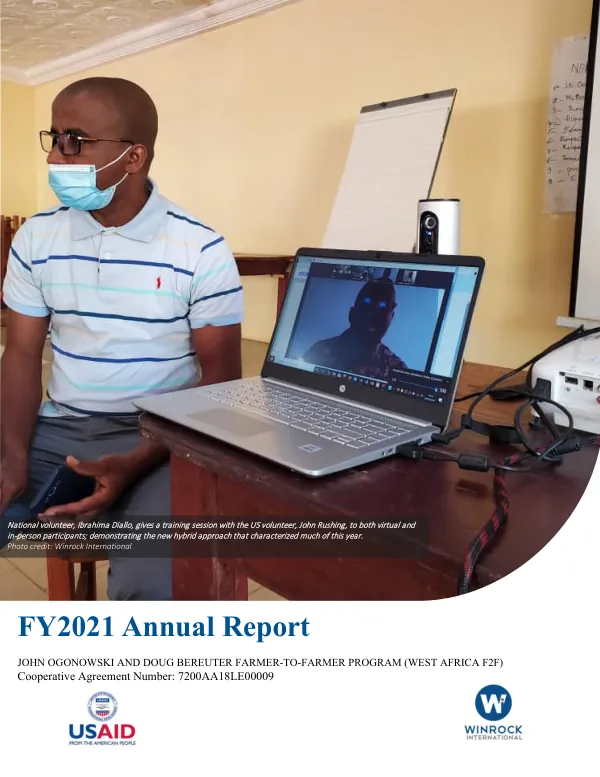
The program operates in five core countries: Ghana, Guinea, Mali, Nigeria, and Senegal. During the first half of the project's FY21 implementation, West Africa F2F completed 44 volunteer assignments, supporting 34 host organizations in the five core countries. The assignments were completed by 39 remote US volunteers and 5 paired-local volunteers, with 15 of the volunteers being new to the program and 41% being women. The first half of FY21 was marked by the continuation of global travel prohibitions arising from COVID-19. West Africa F2F core countries operated under a mixture of state-mandated curfews, restricted interstate travel, border closures, and oscillating cycles of partial re-openings and lockdowns. As a result, no in-person international travel occurred between Winrock volunteers and host countries in West Africa within this period. Winrock approached the disruption of COVID-19 by focusing on embedding "programmatic resilience" into the implementation of West Africa F2F. Through collaborative dialogues with core country leadership teams, Winrock established a strategic plan to maximize impact and ensure the sustainability of volunteer activities. The program continued its pivot from the traditional model of in-person volunteer assignments. The shift in operations has entailed key tasks that will ultimately result in a more adaptive, dynamic, and resilient program. Building on the success of the remote U.S. volunteer design established in FY20, Winrock invested time and effort in establishing the programmatic foundation for the launch of remote paired U.S. volunteer assignments in early FY21. Through engagement of US and local attorneys, Winrock performed a comprehensive risk and compliance analysis to ensure that appointment of local volunteers meets labor, health, and safety provisions in each core country. In Ghana, the ongoing presence of COVID-19 continued to inhibit in-person international travel. In response, the F2F Ghana team developed and expanded its successful remote U.S. volunteer model. Over the past six months, initial assumptions regarding the viability of remote assignments in Ghana have proven true. F2F Ghana's sectoral focus on postharvest quality, the comparative strength of Ghanaian host organizations' connectivity and access to technological platforms, and prevalence of English-speaking hosts have positioned this country office to transition into virtual engagements with minimal disruption. Building on the success of the purely remote mechanism, F2F Ghana incorporated the inclusion of a local volunteer expert to provide an in-person, on-the-ground, training component for remote paired US volunteer assignments. Early feedback from host organizations, local, and U.S. volunteers has been overwhelmingly positive on this new implementation model.
Related documents