USAID FAMINE EARLY WARNING SYSTEMS NETWORK
SAHEL AND WEST AFRICA Food Security Outlook Update
The West Africa Food Security Outlook Update for January 2011 reports that unrest threatens food security in several countries.
2011 · 3 pages
Sign in to readA free account is required to download.
Abstract
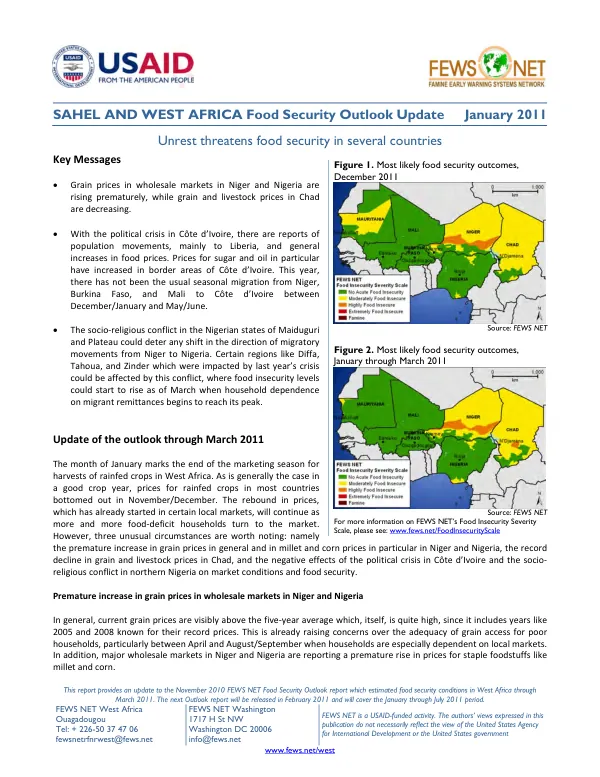
Grain prices in wholesale markets in Niger and Nigeria are rising prematurely, while grain and livestock prices in Chad are decreasing. The socio-religious conflict in the Nigerian states of Maiduguri and Plateau could deter any shift in the direction of migratory movements from Niger to Nigeria. The month of January marks the end of the marketing season for harvests of rainfed crops in West Africa. Prices for rainfed crops in most countries bottomed out in November/December, but a premature increase in grain prices in general and in millet and corn prices in particular in Niger and Nigeria is raising concerns over the adequacy of grain access for poor households. Major wholesale markets in Niger and Nigeria are reporting a premature rise in prices for staple foodstuffs like millet and corn. Wholesale markets are the main sources of supply for local markets in grain-deficit areas beginning as of March in general and particularly during the lean season. If the current premature increase in prices in these markets is due merely to the limited shipments of grain from farmers with the rainy season lasting longer than usual and delaying harvests, conditions could normalize as more and more fresh crops get shipped to wholesale markets. However, if this is not the case, market prices will stay high despite this year's good harvests and contribute to the current moderate to high levels of food insecurity found in market-dependent areas, particularly in the northeastern Sahel which is still grappling with severe food deficits from 2009 and among the urban poor. Ongoing institutional procurements will drive these prices up even further over the next few months since there is no further possibility of any large sales by farmers until after the beginning of the rainy season when they clear out their inventories in preparation for their farming activities. These different circumstances will be investigated by joint annual market and food security assessment missions to each major trading area beginning as of the end of January. The record decline in livestock and grain prices in Chad and cowpea prices in Nigeria is also raising concerns. Chad's ban on livestock exports and capping of prices for local grain crops and livestock at levels 50 percent below the five-year average is driving down their prices. This could translate into high prices as of April, poor food access, and food insecurity in the Sahelian region of Chad, as was the case last year. The low prices of cowpea crops in the Kano wholesale market in Nigeria are raising concerns over the incomes of farmers in Niger once grain prices begin to rise in their main provisioning market at the beginning of the lean season. The political crisis and socio-religious conflict in Côte d'Ivoire and Nigeria are also affecting food insecurity levels in the region. Food insecurity levels, particularly in the at-risk areas referred to above, could be driven up by the conflict in Côte d'Ivoire, which is distorting the projections made in last November's outlook report. The sociopolitical crisis in Côte d'Ivoire has prompted a de facto division of the country into a northern and southern zone, virtually impeding the free movement of persons and goods around the country and cutting off supplies of rice, oil, and wheat from neighboring countries like Mali and Burkina Faso. Central basin countries like Burkina Faso and Mali, which are highly dependent on Côte d'Ivoire for their supplies of food, energy, and other staple commodities, will be most affected. The price of corn and oil is rising across the area, making it difficult for urban households to maintain access to these products. Prices for oil and corn, for which Côte d'Ivoire is one of the region's largest producers, are already up by 10 to 15 percent. If the crisis continues, food prices will keep rising as a result of shortages or increases in shipping costs to Mali and Burkina Faso, heightening food insecurity among the urban poor. The combined effects of market disruptions, the socio-religious conflict in Nigeria, and the dispute between importers in Niger and the port of Cotonou will also aggravate food insecurity problems in Niger. Côte d'Ivoire and Nigeria are the two largest economies in the region, making them the main destination countries for seasonal migration by food-deficit populations, particularly from Niger, Burkina Faso, and Mali. Unfortunately, the current crisis in Côte d'Ivoire has limited the usual seasonal migration taking place at this time of year, which could affect households impacted by last year's crisis and households could be facing heightened levels of food insecurity as of March of this year when their dependence on migrant remittances begins to reach its peak.
Related documents