CARE MALAWI
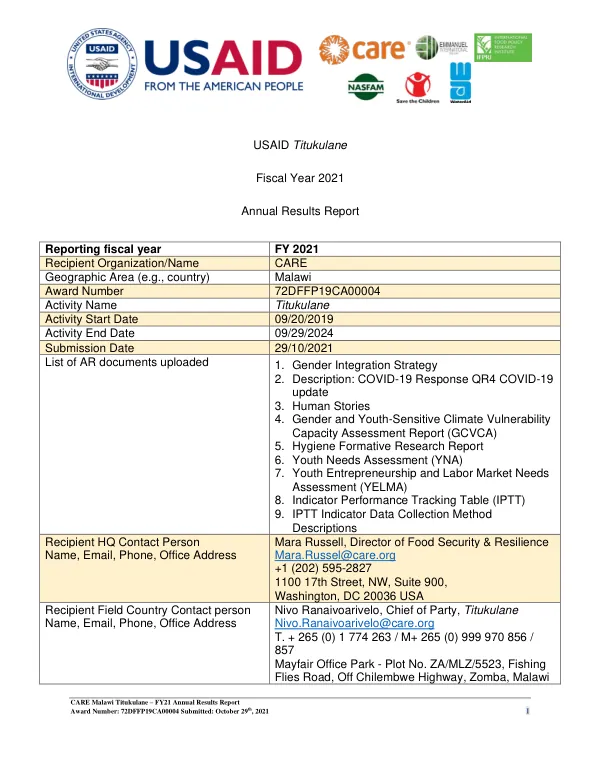
FY24 Q1 Report: USAID Titukulane Activity
The Titukulane Activity is a Resilience Food Security Activity implemented by CARE Malawi in 19 Traditional Authorities of Mangochi and Zomba Districts in Malawi.
2024 · 124 pages
Sign in to readA free account is required to download.
Abstract
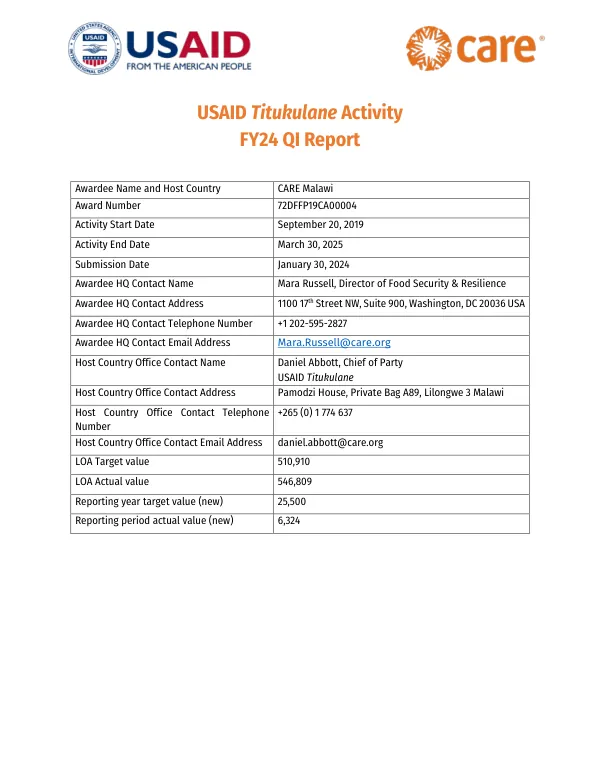
The activity aims to achieve sustainable, equitable, and resilient food and nutrition security for ultra-poor and chronically vulnerable households. It offers an integrated package of interventions focusing on maternal and child health and nutrition, water, sanitation, and hygiene, agriculture sector capacity, youth micro-enterprise productivity, civic participation, and capacity building for disaster preparedness and planning. The activity has delivered strong outcomes in fiscal year 2023 and Quarter 1 of FY24 across its three Purpose Areas, surpassing its Life of Award target by 7%. A total of 546,809 individuals, including 292,828 females and 253,981 males, were reached in 161,967 households, of whom 173,378 were youth. The activity is designed to support the Government of Malawi to implement the National Resilience Strategy at the district level. The 2023/24 rainfall season in Malawi has been marked by erratic patterns aligned with El Niño forecasts, causing moisture stress that adversely affected crops. Many crops faced permanent wilting, compelling farmers to replant, and potentially leading to a decline in agricultural productivity. The dry conditions not only jeopardized crops but also diminished agricultural labor opportunities, impacting vulnerable households heavily reliant on labor for sustenance. According to Rapid Feedback Monitoring System data, Titukulane-supported households reported higher levels of food security as measured by the reduced Coping Strategy Index, as well as greater dietary diversity, compared to others within the districts. However, the transition to lean season still led to stresses on Titukulane-supported households, with food consumption and frequency decreasing due to reported shocks and the transition to the lean season. Economic conditions in Malawi continue to worsen, with soaring inflation and a foreign exchange shortage significantly impeding households' access to essential goods. The 44% devaluation of the Malawi Kwacha in November 2023, coupled with an earlier 25% devaluation in May 2023, intensified the already dire situation, driving up prices of food and basic commodities. This has disproportionately affected the purchasing power of impoverished households, both in rural and urban areas. The activity has made significant progress in achieving its Purpose 1: Increased Diversified, Sustainable, and Equitable Incomes for Ultra-poor, Chronically Vulnerable Households, Women, and Youth. Under Sub-Purpose 1.1: Increased Equitable and Diversified Crop and Livestock Production, Titukulane delivered quality inputs in partnership with Community Finance Limited, a local microfinance institution, bringing agriculture input loans to 854 producer groups. A total of 14,404 farmers accessed input loans, representing an achievement of 144% of the program's target of 10,000 farmers for the 2022/23 cropping season. The activity has also made progress in achieving its other Purpose Areas, including Purpose 2: Nutritional Status Among Children Under Five Years of Age, Adolescent Girls, and Women of Reproductive Age Improved, and Purpose 3: Increased Institutional and Local Capacities to Reduce Risk and Increase Resilience Among Poor and Very Poor Households in Alignment with the National Resilience Strategy. The activity has also made significant progress in its Monitoring and Evaluation, Collaboration, Learning, and Adapting, Cross-Cutting, Sustainability Plan and Exit Strategy, Challenges and Mitigation Measures, Market Analysis, and Planned Interventions – Quarter 2.
Related documents