USAID DEC
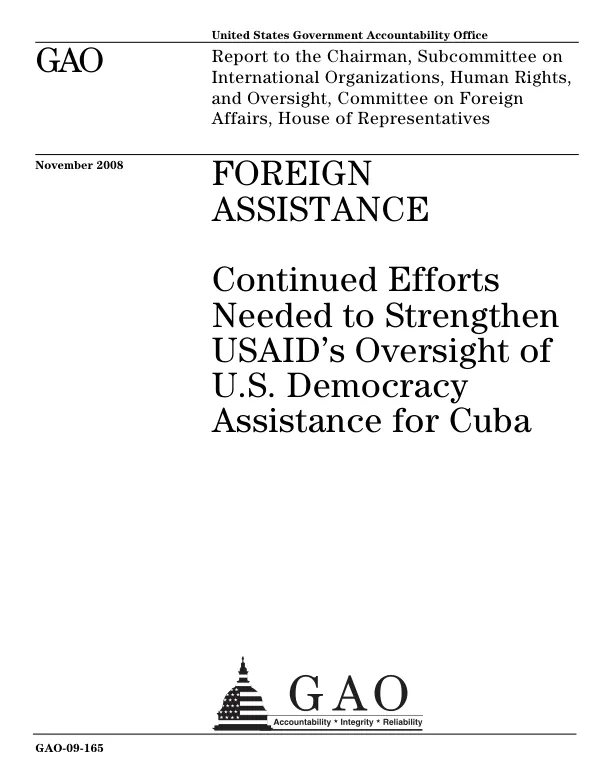
GAO-13-285, CUBA DEMOCRACY ASSISTANCE: USAID's Program Is Improved, but State Could Better Monitor Its Implementing Partners
Sign inU.S. DEPARTMENT OF STATE/OES
GAO-13-285, CUBA DEMOCRACY ASSISTANCE: USAID's Program Is Improved, but State Could Better Monitor Its Implementing Partners
The U.S.
2013 · 58 pages
Sign in to readA free account is required to download.
Abstract
Agency for International Development (USAID) and the Department of State (State) provide democracy assistance for Cuba aimed at developing civil society and promoting freedom of information. Typical program beneficiaries include Cuban community leaders, independent journalists, women, youths, and marginalized groups. USAID receives the majority of funding allocated for this assistance, although State has received 32 percent of funding since 2004. In recent years, both USAID and State have provided more funding for program implementation to for-profit and nongovernmental organizations (NGO) with a worldwide or regional focus than to universities and to NGOs that focus only on Cuba. All types of implementing partners, but worldwide or regional organizations in particular, used subpartners to implement program activities under 21 of the 29 awards and contracts that were reviewed. USAID and State legal officials view the Cuba democracy program's authorizing legislation as allowing the agencies discretion in determining the types of activities that can be funded with program assistance. Agency officials added that the agencies ensure that program activities directly relate to democracy promotion as broadly illustrated in related program legislation. USAID has improved its performance and financial monitoring of implementing partners' use of program funds by implementing new policies and hiring contractors to improve monitoring and evaluation and to conduct financial internal controls reviews. However, GAO found gaps in State's financial monitoring. While GAO found some gaps in implementing partners' performance planning and reporting, both agencies are taking steps to improve performance monitoring. For financial monitoring, USAID performs financial internal controls reviews of its implementing partners with the assistance of an external auditor. Since 2008, USAID has used a risk-based approach to determine the coverage and frequency of the 30 reviews the auditor has conducted, which have identified weaknesses in implementing partners' financial management, procurement, and internal controls. However, because of resource constraints, State did not perform financial internal controls reviews for more than two-thirds of its implementing partners during fiscal years 2010 through 2012. State procured an external financial auditor in September 2012 that plans to review more than half of State's implementing partners, and has taken steps toward implementing a risk-based approach for scheduling these reviews. Federal regulations generally require agencies to approve the use of subpartners. GAO found that USAID issued specific guidance in 2011 to its implementing partners on requirements for subpartner approval. While State told GAO it has similar requirements, State's requirements are not clearly specified in its written guidance. As a result, State was not provided with the information it would have needed to approve at least 91 subawards and subcontracts that were obligated under eight awards. The U.S. Agency for International Development (USAID) and the Department of State (State) provide assistance to increase respect for human rights and fundamental freedoms, strengthen independent Cuban civil society, and foster greater access to independent information on the island. Cubans have lived under an authoritarian regime for more than 50 years; in that time, Cubans have faced continuous restrictions in citizens' rights to organize, express themselves freely, and participate in political life without fear of being harassed and repressed by the Cuban government. Conditions in Cuba pose risks and challenges for the delivery of program assistance on the island, which is largely provided by implementing partners (partners) and their subpartners. In fiscal years 1996 through 2011, Congress appropriated $205 million for Cuba democracy assistance, with about 90 percent of program funding provided since fiscal year 2004. While USAID has received most of this funding, State has also received program funding allocations since fiscal year 2004. The U.S. Agency for International Development (USAID) and the Department of State (State) have provided democracy assistance for Cuba aimed at developing civil society and promoting freedom of information. The agencies have used a variety of implementing partners, including for-profit and nongovernmental organizations (NGO) with a worldwide or regional focus, to deliver program assistance on the island. However, GAO found gaps in State's financial monitoring and in implementing partners' performance planning and reporting. Both agencies are taking steps to improve performance monitoring, including implementing new policies and hiring contractors to improve monitoring and evaluation and to conduct financial internal controls reviews. USAID has used a risk-based approach to determine the coverage and frequency of financial internal controls reviews, while State is taking steps toward implementing a similar approach. Federal regulations generally require agencies to approve the use of subpartners, and USAID has issued specific guidance on requirements for subpartner approval.