GOVERNMENT OF HAITI
Governing Justly and Democratically
The USAID/Haiti's Governing Justly and Democratically initiative aims to advance stable, democratic governance in Haiti by strengthening national and local institutions while engaging citizens in the process of developing their state.
2009 · 3 pages
Sign in to readA free account is required to download.
Abstract
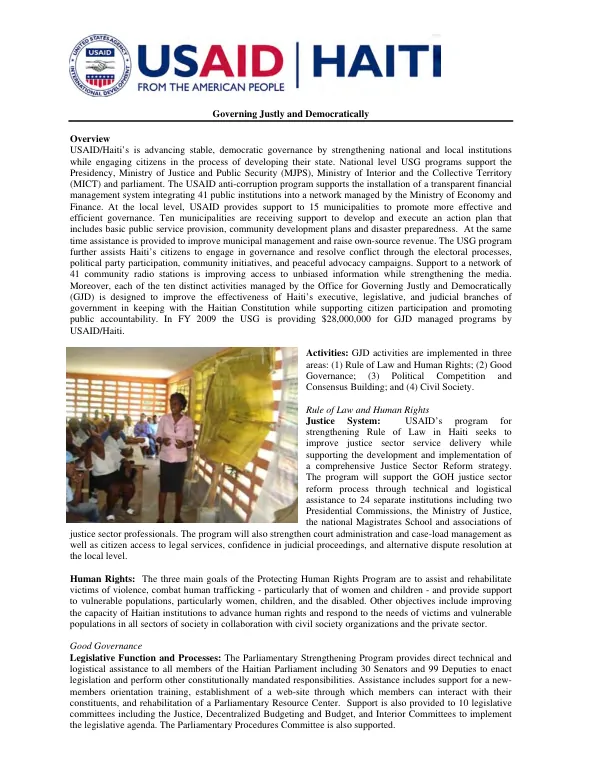
National-level USG programs support the Presidency, Ministry of Justice and Public Security (MJPS), Ministry of Interior and the Collective Territory (MICT), and parliament. The USAID anti-corruption program supports the installation of a transparent financial management system integrating 41 public institutions into a network managed by the Ministry of Economy and Finance. At the local level, USAID provides support to 15 municipalities to promote more effective and efficient governance. Ten municipalities are receiving support to develop and execute an action plan that includes basic public service provision, community development plans, and disaster preparedness. Assistance is also provided to improve municipal management and raise own-source revenue. The USG program further assists Haiti's citizens to engage in governance and resolve conflict through the electoral processes, political party participation, community initiatives, and peaceful advocacy campaigns. Support to a network of 41 community radio stations is improving access to unbiased information while strengthening the media. The initiative is implemented in four areas: Rule of Law and Human Rights, Good Governance, Political Competition and Consensus Building, and Civil Society. The Rule of Law and Human Rights program seeks to improve justice sector service delivery while supporting the development and implementation of a comprehensive Justice Sector Reform strategy. The program will support the GOH justice sector reform process through technical and logistical assistance to 24 separate institutions, including two Presidential Commissions, the Ministry of Justice, and the national Magistrates School. The Human Rights program aims to assist and rehabilitate victims of violence, combat human trafficking, particularly that of women and children, and provide support to vulnerable populations, particularly women, children, and the disabled. Other objectives include improving the capacity of Haitian institutions to advance human rights and respond to the needs of victims and vulnerable populations in all sectors of society in collaboration with civil society organizations and the private sector. The Good Governance program provides direct technical and logistical assistance to all members of the Haitian Parliament, including 30 Senators and 99 Deputies, to enact legislation and perform other constitutionally mandated responsibilities. Assistance includes support for a new-members orientation training, establishment of a website through which members can interact with their constituents, and rehabilitation of a Parliamentary Resource Center. Support is also provided to 10 legislative committees, including the Justice, Decentralized Budgeting and Budget, and Interior Committees, to implement the legislative agenda. The Political Competition and Consensus Building program is designed to strengthen the organizational capacity of the Provisional Electoral Council (CEP) at the national and local levels. Activities support the CEP to improve internal election administration systems and to manage a credible, participatory election process that includes all political parties and expanded grassroots involvement. Support will also be provided for future elections administration in order to contribute to a peaceful transfer of power from one government to another and establish a permanent election management body. The Civil Society program aims to develop a legal framework to protect and promote civil society organizations and their initiatives, increase citizen participation in policy development and oversight of public institutions, improve the viability of civil society organizations combating corruption and achieving public policy reforms, while strengthening democratic political culture and promoting gender equity. Training and equipment are provided to 41 community radio stations and 22 regional journalist associations to increase the relevance, quality, and reach of these stations and journalists' networks. Support is also provided to sustain Haiti's first national association of community radio journalists. In FY 2008, significant results were achieved, including the development and adoption of three seminal laws establishing an independent judiciary, a new national magistrate's school, and defining the roles of key justice sector personnel. Haiti's first integrated Case Registry and Tracking system was developed and launched, and over 345 justice-sector personnel were trained. Additionally, 9,271 citizens had access to mobile courts, and 350 vulnerable women and children were assisted through grants to local organizations. Ten parliamentary commissions were assisted to draft and debate priority legislation, and 180 parliamentarians and their staff were trained.