USAID DEC
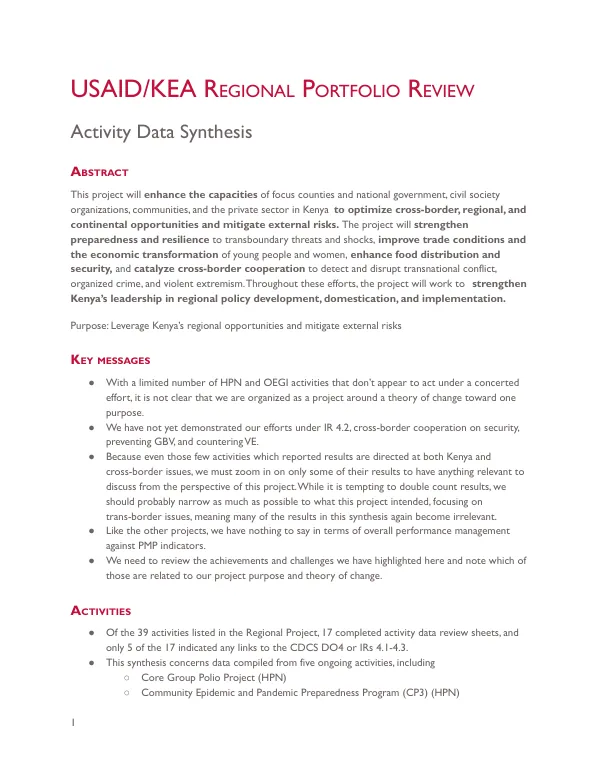
Gap Analysis for Business Process Reengineering (BPR) of Kenya Power and Lighting Company (KPLC)
Sign inRTI INTERNATIONAL
Gap Analysis for Business Process Reengineering (BPR) of Kenya Power and Lighting Company (KPLC)
Kenya Power and Lighting Company (KPLC) Gap Analysis for Business Process Reengineering (BPR) was conducted to identify gaps in the company's processes and develop solutions to address them.
2019 · 94 pages
Sign in to readA free account is required to download.
Abstract
The analysis focused on six key areas: Commercial Cycle, Contract Management, Supply Chain, Supply Chain Processes, Payment Processes, and Meter Lab Management. The Commercial Cycle process involves managing large power users, corporate customers, household customers, revenue protection, quality assurance, customer complaints, debt management, account reconciliation, and meter lab management. The analysis identified several gaps in this process, including the lack of a framework agreement with contractors, which leads to long delays in new connection installations. To address this, KPLC should ensure strong oversight of contractors and establish framework agreements with service level agreements (SLAs). The facilities database (FDB) is not updated in a timely manner, leading to incomplete records. A possible solution is to issue an energization order only after the FDB is updated and the new connection process is completed. KPLC also operates in silos, leading to communication missteps among departments. To address this, the company should design and use a workflow process to share information, documents, and data efficiently. In the Contract Management process, the analysis identified gaps in the management of large power users, corporate customers, and household customers. KPLC should establish a mandatory policy requiring smart meter registration before delivering power to customers. The company should also aim to automate the registration process, but first, undertake a more detailed analysis to understand integration issues. The Supply Chain process involves managing supply chain processes at the headquarters and regions, as well as payment processes. The analysis identified gaps in the management of large power users, corporate customers, and household customers, including the lack of a framework agreement with contractors and the failure to update the FDB in a timely manner. To address these gaps, KPLC should establish framework agreements with contractors and update the FDB after new connections are made. The analysis also identified gaps in the Meter Lab Management process, including the lack of a framework agreement with contractors and the failure to update the FDB in a timely manner. To address these gaps, KPLC should establish framework agreements with contractors and update the FDB after new connections are made. The general objectives of the gap analysis are to improve quality, eliminate waste, reduce time, reduce total costs, and benefit from best practices developed elsewhere. The specific objectives are to accelerate connection times, improve reading efficiency, improve billing quality, reduce the time between service delivery and customer payments, increase first-time payments, reduce token generation errors, and improve revenue collection. The gap analysis is a critical input to the reengineering of KPLC's processes. The company should address each gap to improve its performance and achieve its objectives. The key areas of focus for the gap analysis are organization, process, systems, network, resources, and resources assessment. The analysis identified several gaps in these areas, including the lack of a framework agreement with contractors, the failure to update the FDB in a timely manner, and the lack of a workflow process to share information, documents, and data efficiently. The methodology used for the gap analysis includes scoping, process design and planning, As-Is mapping, road mapping for implementation, workshops and initial assessment, and To-Be mapping. The objectives of the upcoming workshops are to present the gaps identified during the As-Is mapping and discuss ways to bridge those gaps during the To-Be mapping. The gap analysis effort had five key areas of focus, including organization, process, systems, network, and resources. Some additional issues that arose are listed under a sixth category, "Other," when applicable.
Related documents