RTI INTERNATIONAL
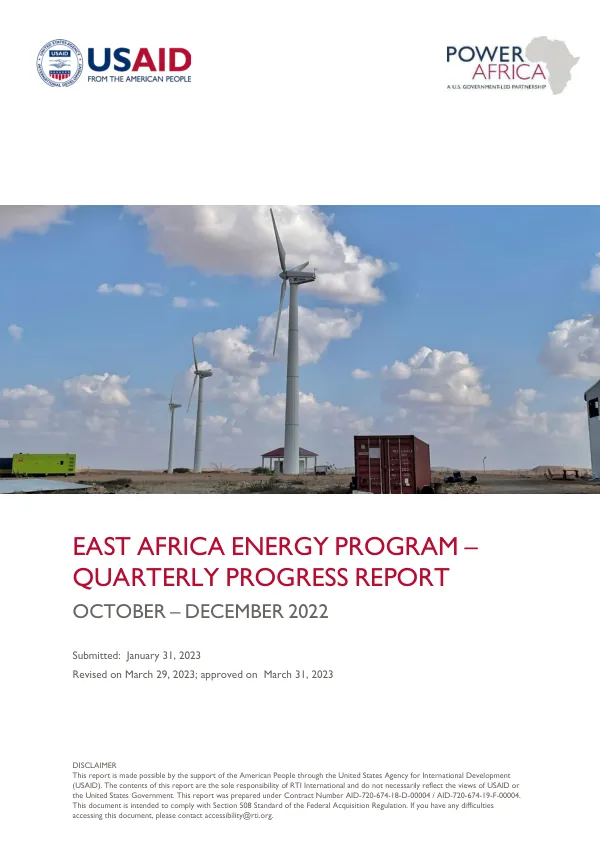
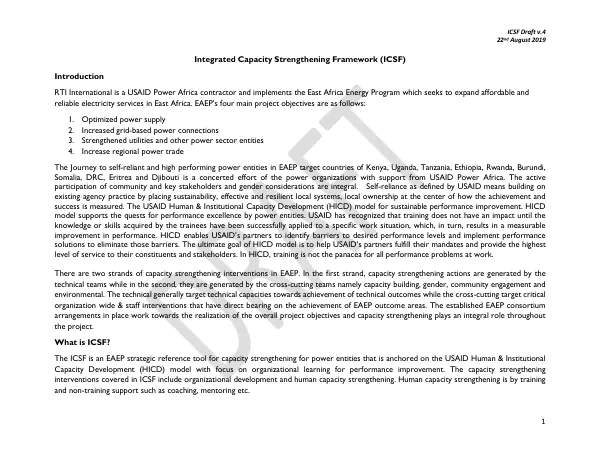
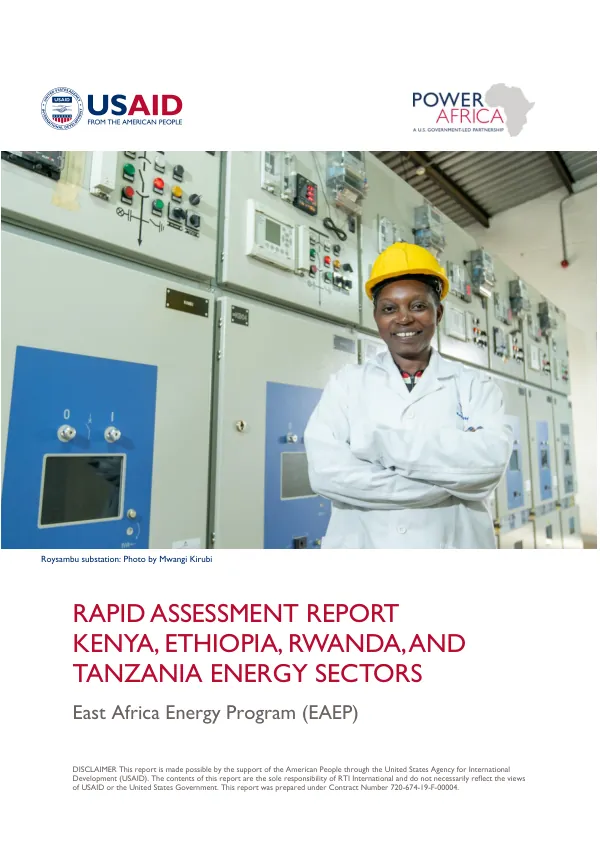
EAEP Rapid Performance Assessment Report
The East Africa Energy Program (EAEP) aims to expand affordable and reliable electricity services in East Africa, fostering inclusive economic growth, security, and improved health and education outcomes.
2019 · 30 pages
Sign in to readA free account is required to download.
Abstract
EAEP seeks to optimize the East African power supply, increase grid-based power connections, strengthen utilities and other power-sector entities, and increase regional power trade. A core mission of EAEP is to improve institutional performance in the East Africa power sector, involving long-term generation, transmission, and investment planning, negotiating and managing power generation and transmission projects, improving regulatory authority, reducing technical and commercial losses, and attracting private-sector funding. EAEP has developed a layered approach to identifying capacity gaps and generating institutional-improvement packages. Senior Institutional Performance Advisor Dr. Francis Kangure carried out qualitative assessments in the four EAEP core countries, Kenya, Ethiopia, Rwanda, and Tanzania. These assessments introduced EAEP's mandate to potential partner power entities, provided an initial list of performance gaps, launched the relationship-building process with key stakeholders, and identified quick-start activities for the EAEP team. The results of this rapid gaps assessment will be integrated into full organizational capacity assessments, which were launched at the end of FY 2019 through the Human and Institutional Capacity Development (HICD) approach. The HICD model supports partner organization training and capacity-building activities, allowing tracking of performance metrics. However, few scientific baseline surveys were conducted before the implementation of capacity-building activities, making it difficult to ascertain actual outcomes or impacts. It is therefore imperative for EAEP to conduct baseline surveys that will guide capacity-building activities from the beginning of the program. The private sector in these countries has received little support from development partners, with some companies struggling to attract and retain talent due to resource scarcity. In Kenya, the power entities struggle with issues that threaten the sustainability of technical interventions. At the project level, several power entities report low capacity to manage public-private partnership processes and financial and legal frameworks. There is also a pattern of underperformance in succession planning, project finance, leadership, and managerial skills, employee training, accountability mechanisms, and governance. The Kenya Electricity Stakeholders include Kenya Power and Lighting Company (KPLC), Kenya Electricity Generating Company (KenGen), Kenya Electricity Transmission Company (KETRACO), Rural Electrification and Renewable Energy Corporation (REREC), Energy and Petroleum Regulatory Agency (EPRA), and Geothermal Development Company. The rapid gaps assessment in Kenya identified several performance gaps, including low capacity to manage public-private partnership processes and financial and legal frameworks. The assessment also highlighted the need for improved regulatory authority, reduced technical and commercial losses, and increased revenues. The EAEP team has identified quick-start activities to address these gaps, including training and capacity-building programs for power entities. The HICD model will support these activities, allowing tracking of performance metrics and ensuring sustainable performance improvement in host-country institutions. In Rwanda, the power entities also struggle with issues that threaten the sustainability of technical interventions. At the project level, several power entities report low capacity to manage public-private partnership processes and financial and legal frameworks. There is also a pattern of underperformance in succession planning, project finance, leadership, and managerial skills, employee training, accountability mechanisms, and governance. The Rwanda Electricity Stakeholders include Rwanda Energy Group (REG), Rwanda Utilities Regulatory Authority (RURA), and Energy Private Developers Association (EPD). In Ethiopia, the power entities struggle with issues that threaten the sustainability of technical interventions. At the project level, several power entities report low capacity to manage public-private partnership processes and financial and legal frameworks. There is also a pattern of underperformance in succession planning, project finance, leadership, and managerial skills, employee training, accountability mechanisms, and governance. The Ethiopia Electricity Authority (EEA), Ethiopian Electric Power (EEP), and Ethiopian Electric Utility (EEU) are among the power entities in Ethiopia. In Tanzania, the power entities struggle with issues that threaten the sustainability of technical interventions. At the project level, several power entities report low capacity to manage public-private partnership processes and financial and legal frameworks. There is also a pattern of underperformance in succession planning, project finance