USAID DEC
GEM 2011 National Summary Sheet: Bangladesh
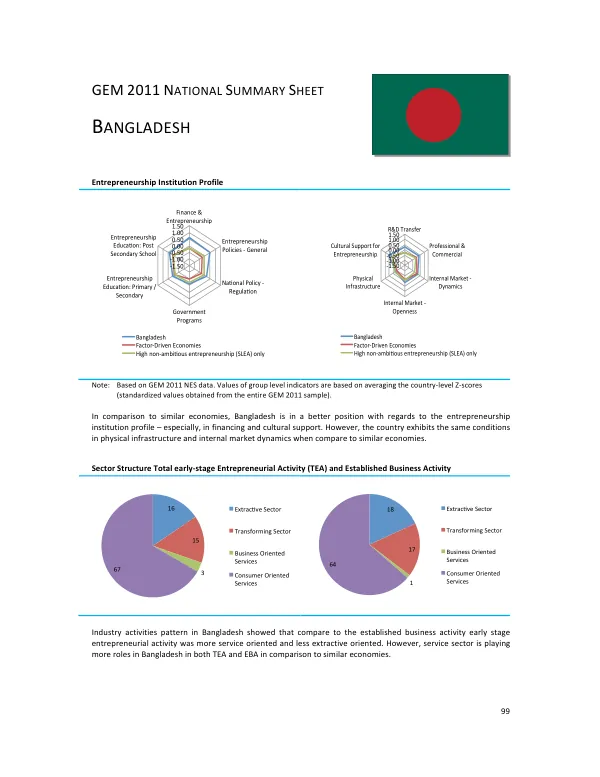
Bangladesh's entrepreneurship institution profile is in a better position compared to similar economies, particularly in financing and cultural support.
2011 · 1 pages
Sign in to readA free account is required to download.
Abstract
However, the country exhibits the same conditions in physical infrastructure and internal market dynamics when compared to similar economies. The sector structure in Bangladesh shows that early-stage entrepreneurial activity is more service-oriented and less extractive-oriented compared to established business activity. The service sector plays a more significant role in Bangladesh in both total early-stage entrepreneurial activity and established business activity compared to similar economies. The country's finance and entrepreneurship policies are generally supportive, with a national policy framework in place. However, regulatory frameworks and government programs require improvement to foster entrepreneurship. Education systems, including primary and secondary education, are not specifically designed to promote entrepreneurship, and post-secondary education institutions do not have a strong focus on entrepreneurship. Bangladesh is classified as a factor-driven economy, with high non-ambitious entrepreneurship, as indicated by the Small and Large Enterprise Activity (SLEA) score. The country's research and development (R&D) transfer and commercialization processes are not well-developed, and internal market dynamics are not conducive to entrepreneurship. Physical infrastructure and cultural support for entrepreneurship are also lacking. The country's sector structure is dominated by the transforming sector, which accounts for 67% of the total early-stage entrepreneurial activity and 64% of the established business activity. The business-oriented services sector is the second-largest sector, accounting for 18% of the total early-stage entrepreneurial activity and 17% of the established business activity. The consumer-oriented services sector is the smallest sector, accounting for 1% of the total early-stage entrepreneurial activity and 3% of the established business activity.