USAID DEC
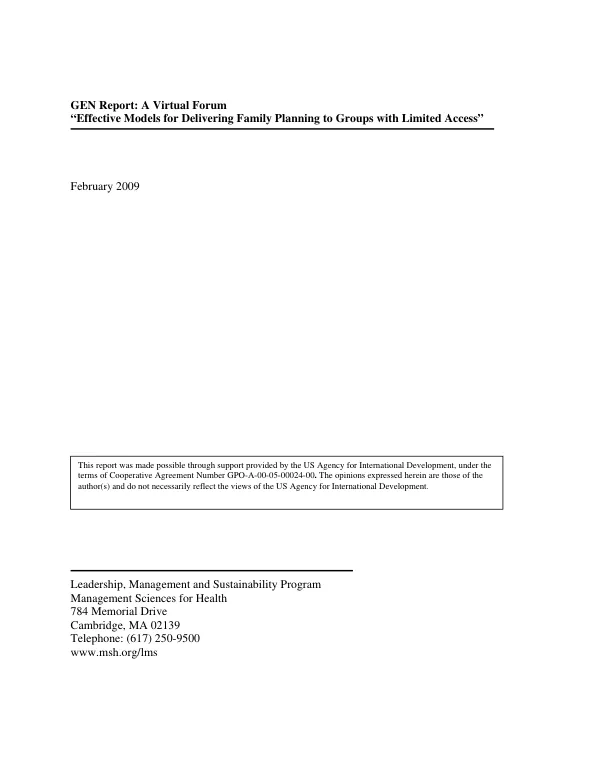
GEN Report: A Virtual Forum Effective Models for Delivering Family Planning to Groups with Limited Access
Sign inMANAGEMENT SCIENCES FOR HEALTH
GEN Report: A Virtual Forum Effective Models for Delivering Family Planning to Groups with Limited Access
The Global Exchange Network for Reproductive Health (GEN) hosted a virtual seminar entitled "Effective Models for Delivering Family Planning to Groups with Limited Access" in February 2009.
2009 · 6 pages
Sign in to readA free account is required to download.
Abstract
The forum was facilitated by Hector Colindres and Meghann Lindholm from Management Sciences for Health (MSH) and was funded by the United States Agency for International Development (USAID). The seminar was the third in a series of forums held during FY09 to address topics related to reproductive health and family planning. The forum focused on case studies of effective models for increasing access to reproductive health and family planning services for vulnerable groups. The case studies presented included the Healthy Images of Masculinity project in Tanzania, the Religious Leaders RH/FP Program in Kenya, the Expanding Contraceptive Use project in Afghanistan, the Expanding Coverage of Family Planning Services in Kigoma, Tanzania, and the Reducing Fertility in Bangladesh project. More than 2,000 GEN members from NGOs, health ministries, universities, and other organizations participated in the forum. A total of 227 people from 53 different countries visited the GEN site, and 62 people posted 156 comments to the discussion during the forum. The participating countries included Afghanistan, Ghana, Nepal, Australia, Guatemala, Nicaragua, and others. Thirty-eight participants completed the forum evaluation, and 37 indicated that they had gained skills and/or knowledge from the forum that they would use in their work. The participants found the discussions and documents presented in the forum to be very useful for their work, and 36 participants acquired skills or knowledge that they could apply in their work. The forum discussion threads focused on factors that contributed to success in the case studies presented and practical approaches participants could use to expand reproductive health and family planning service coverage. The discussion concluded that support from political, traditional, and religious leaders, community participation, alignment with religious and family values, motivation of health workers, and strong links between communities and service providers are critical factors for success. The participants also discussed obstacles and strategies for overcoming them. The obstacles included lack of funding, weak health infrastructure, lack of resources for transportation and logistics, insufficient medicines, lack of trained personnel, particularly in rural areas, and limited understanding of reproductive health and family planning. The participants agreed that information, education, and communications outreach, which expands on the traditional medical model, is a key strategy to overcome obstacles and expand coverage. The participants concluded that successful interventions include joint participation of men and women, peer counseling and reproductive health workers, participation of community, religious, and political leaders, respecting local culture and traditional values, counseling provided by women inside their own communities, in-depth needs assessments, and partnerships with the public sector-NGO coalition.