CHECCHI AND COMPANY, CONSULTING, INC.
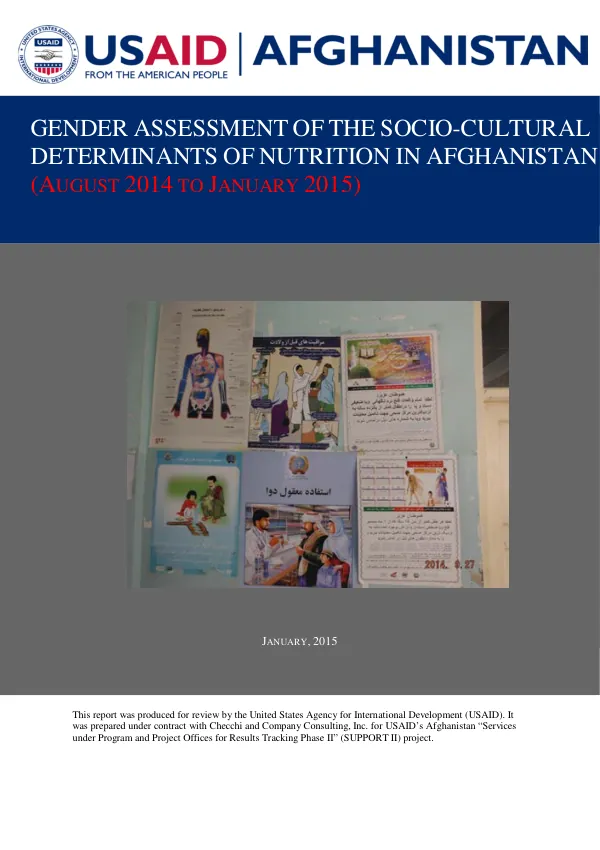
Gender Assessment of the Socio-Cultural Determinants of Nutrition in Afghanistan
The gender assessment of socio-cultural determinants of nutrition in Afghanistan was conducted from August 2014 to January 2015.
2015 · 119 pages
Sign in to readA free account is required to download.
Abstract
The assessment aimed to identify the cultural, social, and economic factors influencing nutrition outcomes in Afghanistan. The study focused on the family, religion, power dynamics, dietary diversity, healthcare, nutrition programs, agriculture, education, water, sanitation, and hygiene (WASH), and media. Cultural traditions play a significant role in shaping nutrition outcomes in Afghanistan. The family is the primary unit of social organization, and women's roles within the family are often limited to domestic duties. Religion also influences nutrition practices, with Islamic dietary laws dictating food choices. Power dynamics within the family and community can impact women's access to nutrition information and resources. Dietary diversity is a critical factor in nutrition outcomes, particularly for women of reproductive age and infants. The assessment found that women's diets are often limited to staple foods such as bread, rice, and tea, with inadequate access to fruits, vegetables, and animal-source foods. Infants and young children also face challenges in accessing nutritious foods, with many relying on breast milk or inadequate complementary foods. Healthcare and nutrition programs are essential in addressing nutrition outcomes in Afghanistan. The assessment found that healthcare services are often inaccessible, particularly in rural areas, and that nutrition programs are often fragmented and lack coordination. Agriculture and livestock programs can also impact nutrition outcomes, with many households relying on subsistence farming and livestock production for food. Education is critical in promoting nutrition knowledge and practices, particularly among women. The assessment found that education levels are low, particularly among women, and that many schools lack nutrition education programs. WASH and media also play important roles in promoting nutrition outcomes, with many households lacking access to clean water, sanitation facilities, and hygiene practices. The assessment identified several key findings and recommendations. The study found that cultural traditions, power dynamics, and dietary diversity are critical factors influencing nutrition outcomes in Afghanistan. The assessment also found that healthcare and nutrition programs are often inadequate, and that education, WASH, and media can play important roles in promoting nutrition knowledge and practices. Based on these findings, the assessment recommends several key actions. The report suggests that healthcare and nutrition programs should be strengthened, with a focus on improving access to healthcare services and nutrition information. The assessment also recommends that education programs should be expanded to include nutrition education, and that WASH and media programs should be implemented to promote hygiene practices and nutrition knowledge. The assessment team conducted a series of focus groups and interviews with women and men in various provinces, including Badakhshan, Herat, and Nangarhar. The team also reviewed existing literature and data on nutrition outcomes in Afghanistan. The assessment was conducted under the auspices of the USAID-funded SUPPORT II project, with technical assistance from Checchi and Company Consulting, Inc. The assessment team consisted of several experts, including Dr. Humayoun Ludin, a nutrition specialist with the Ministry of Public Health, and Manizha Wafeq, a gender and M&E project manager. The team also included several other experts, including Mussarat Arif, a gender and M&E specialist, and Kamal Burhan, an M&E specialist. The assessment was funded by USAID under contract number AID-306-C-12-00012. The report was prepared by Checchi and Company Consulting, Inc. under the auspices of the SUPPORT II project. The views expressed in the report are those of the authors and do not necessarily reflect the views of USAID, the Government of the Islamic Republic of Afghanistan, or any other organization or person associated with this project.