CHECCHI AND COMPANY, CONSULTING, INC.
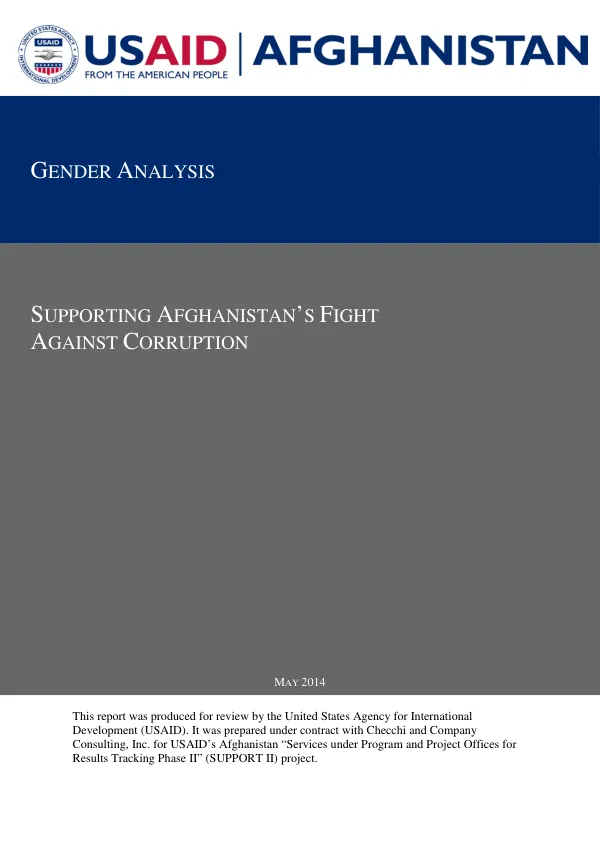
Supporting Afghanistan’s Fight Against Corruption (SAFAC) Gender Analysis
The Supporting Afghanistan's Fight Against Corruption (SAFAC) project is a $30 million, five-year initiative undertaken by the United States Agency for International Development (USAID) to reduce corruption in Afghanistan.
2014 · 37 pages
Sign in to readA free account is required to download.
Abstract
The project aims to work with both the Government of the Islamic Republic of Afghanistan (GIRoA) and civil society stakeholders to identify vulnerabilities in government processes, monitor and advocate for reforms, and strengthen civil society capacity to stimulate civic engagement that can drive change. Empirical evidence links state security and gender equality, and U.S. Policy requires foreign assistance resources to contribute to increasing women's capacity, increasing opportunities for women to influence decision-making, and empowering women to be equal partners. The magnitude of gender-based disparity in Afghanistan calls for explicit identification of how project design, budget, and management will provide women and men with equitable participation in decision-making and in benefiting from SAFAC resources. Gender-based disparities have enormous relevance to SAFAC in terms of the types of corruption that have differential impact on women and men, the dearth of Afghan women in decision-making positions in both government offices and donor-funded projects, and women's generally less active role in civic life. While men have the freedom to choose whether or not to participate in corrupt practices, social norms most often preclude women's participation. Compared to men, few women in Afghanistan are in positions of sufficient power that would enable them to perpetrate corruption. Women's low level of professional involvement in anti-corruption mirrors that of Afghanistan's workforce in general. Within donor projects and counterparts, there are more qualified men who are more accessible and more mobile than women. Recruiting qualified women in Afghanistan takes commitment and frequently, additional time and dedicated resources. Gender inclusiveness has not been a priority in anti-corruption efforts, and the project aims to address this gap by providing women and men with equitable participation in decision-making and in benefiting from SAFAC resources. The project's focus on gender dimensions of anti-corruption is critical in addressing the types of corruption that have differential impact on women and men. The dearth of Afghan women in decision-making positions in both government offices and donor-funded projects is a significant challenge that the project aims to address. Women's generally less active role in civic life also poses a challenge, and the project aims to empower women to be equal partners in decision-making and civic engagement. The project's methodology involves working with both the Government of the Islamic Republic of Afghanistan (GIRoA) and civil society stakeholders to identify vulnerabilities in government processes, monitor and advocate for reforms, and strengthen civil society capacity to stimulate civic engagement that can drive change. The project's focus on gender dimensions of anti-corruption is critical in addressing the types of corruption that have differential impact on women and men, and the project aims to provide women and men with equitable participation in decision-making and in benefiting from SAFAC resources. The project's findings indicate that gender-based disparities have enormous relevance to SAFAC in terms of the types of corruption that have differential impact on women and men, the dearth of Afghan women in decision-making positions in both government offices and donor-funded projects, and women's generally less active role in civic life. The project's recommendations include providing women and men with equitable participation in decision-making and in benefiting from SAFAC resources, addressing the dearth of Afghan women in decision-making positions in both government offices and donor-funded projects, and empowering women to be equal partners in decision-making and civic engagement. The project's conclusions emphasize the importance of addressing gender-based disparities in anti-corruption efforts. The project's recommendations provide a framework for addressing these disparities and promoting equitable participation in decision-making and in benefiting from SAFAC resources. The project's focus on gender dimensions of anti-corruption is critical in addressing the types of corruption that have differential impact on women and men, and the project aims to provide women and men with equitable participation in decision-making and in benefiting from SAFAC resources.