SAVE THE CHILDREN FUND
Gender Digital Divide Risk Mitigation Technical Note
Risk mitigation strategies for the gender digital divide involve collaboration with various stakeholders to address the risks associated with information and communication technology (ICT) for women and girls.
2021 · 5 pages
Sign in to readA free account is required to download.
Abstract
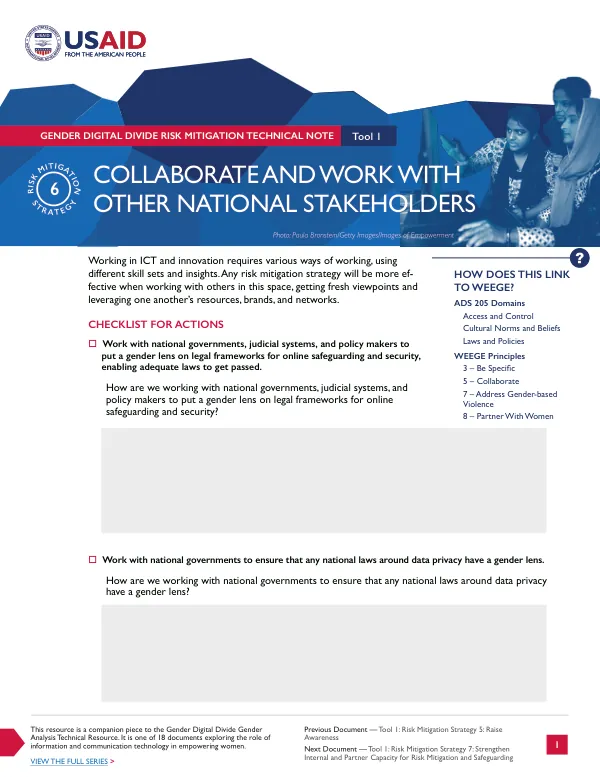
Working with national governments, judicial systems, and policy makers is crucial to put a gender lens on legal frameworks for online safeguarding and security. This includes ensuring that national laws around data privacy have a gender lens. Collaboration with national governments is essential to set up protection systems for women and girls, strengthen law enforcement capacity, and equip them with tools to manage and address technology-facilitated gender-based violence (GBV) and other risks. Additionally, national governments can be worked with to include risk awareness and mitigation strategies in their formal and non-formal digital literacy training and curricula. Forming coalitions with other organizations in-country is also a key strategy to share resources and increase reach. Multi-stakeholder groups, comprising government, academics, non-governmental organizations, the private sector, and women's organizations, can be convened to strengthen responses at the national or system level. These groups can work together on safeguarding national action plans for women and girls or strengthen responses to technology-facilitated GBV within the country. Partnering with national women's organizations is also essential to ensure that women's voices are heard and that they have a say in the decision-making process. Building their organizational and leadership skills is critical to enable them to drive the agenda forward in the future. Furthermore, working with gender and development organizations that have experience in social norms work can help to identify, reuse, and adapt existing digital literacy tools that address risks for women and girls. In-country coalitions have been successful in various countries, such as Save the Children working with organizations like NetHope to run child helplines to report online sexual abuse materials or child abuse activity. Similarly, the IndiaPhones project involves coalitions between academic institutions and state governments in India to deliver ICT outreach and information about taking up government services to rural women. The Gender Digital Divide Risk Mitigation Technical Note provides a framework for understanding the risks of ICT to women and girls and offers practical risk mitigation strategies. These strategies include understanding the context and the risks, investing in digital products and services that mitigate risks, supporting and strengthening ICT outreach and digital literacy initiatives, supporting initiatives that involve gatekeepers, raising awareness, collaborating with national stakeholders, and strengthening internal and partner capacity for risk mitigation and safeguarding.
Related documents