USAID
Gender Equality = Smarter Development
Investing in women and girls can unlock human potential on a transformational scale.
2015 · 2 pages
Sign in to readA free account is required to download.
Abstract
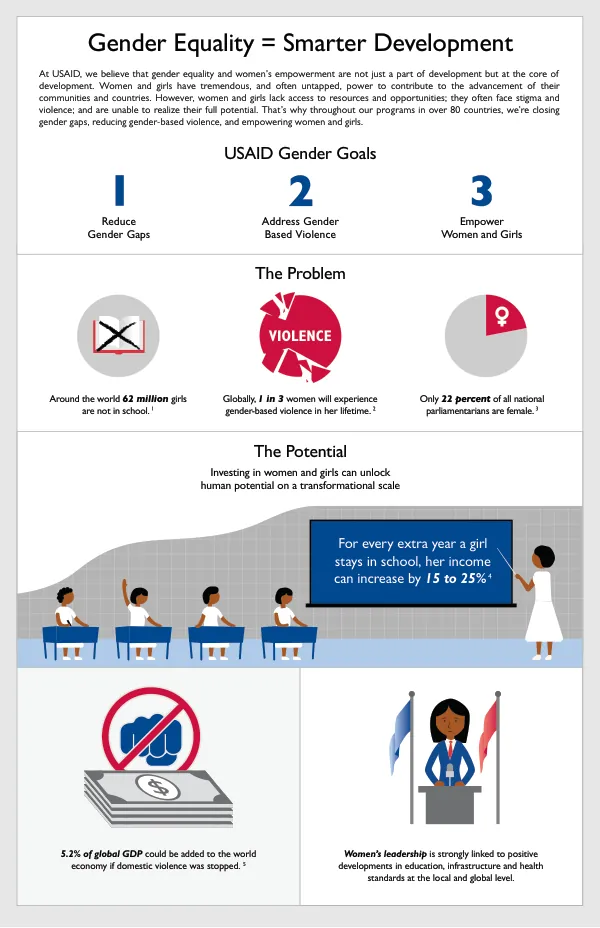
Gender equality and women's empowerment are at the core of development, as women and girls have tremendous power to contribute to the advancement of their communities and countries. However, they lack access to resources and opportunities, face stigma and violence, and are unable to realize their full potential. The lack of access to education is a significant challenge. For every extra year a girl stays in school, her income can increase by 15 to 25%. Despite this, only 22 percent of all national parliamentarians are female, and globally, 1 in 3 women will experience gender-based violence in her lifetime. Additionally, around the world, 62 million girls are not in school. Women's leadership is strongly linked to positive developments in education, infrastructure, and health standards at the local and global level. The economic impact of gender-based violence is substantial. If domestic violence were stopped, 5.2% of global GDP could be added to the world economy. USAID is working to address these challenges through various programs. In Afghanistan, a project is educating, promoting, and training 75,000 Afghan women between 18-30 years of age, strengthening women's rights groups, and boosting female participation in the economy. In Nigeria and Kenya, the Women and the Web Alliance is working to reduce the internet gender gap by bringing more than 600,000 young women online. The project is providing digital literacy training, relevant content, policy work, and online social networks to transform the lives and livelihoods of girls and women in Africa. In Zambia, the Boys to Men Project is promoting positive, non-violent male development to reduce social acceptance and the occurrence of gender-based violence. In Guatemala, the Lifelong Learning Project is improving access to quality education for 10,000 adolescent girls by training teachers to improve classroom learning environments and engaging parents and communities on student learning. In Ethiopia, the Addressing Violence Project is addressing the high prevalence of child marriage through increasing the capacity of law enforcement agencies to investigate, prosecute, and adjudicate child marriage and female genital mutilation. In the Democratic Republic of Congo, the Empowering Women in Kivu Project is encouraging women's inclusion in leadership positions in peace committees and other community structures.
Related documents