TETRA TECH
Gender Smart Energy Services
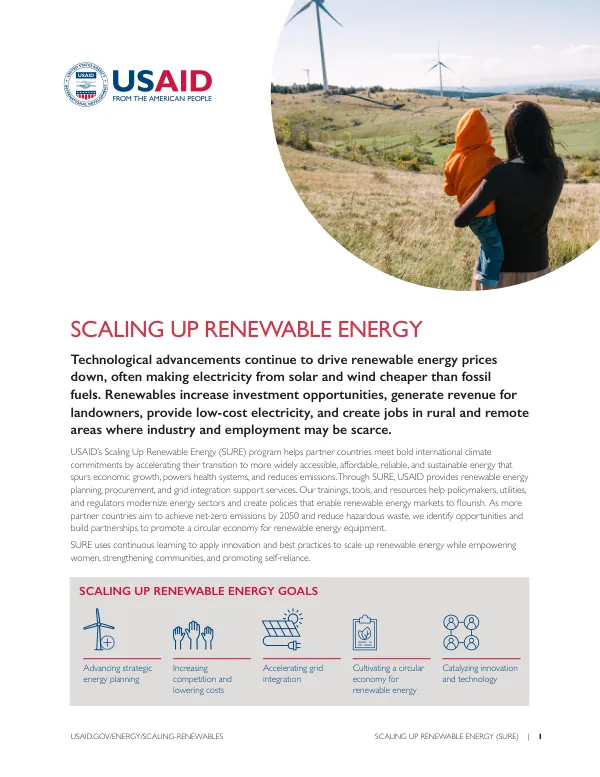
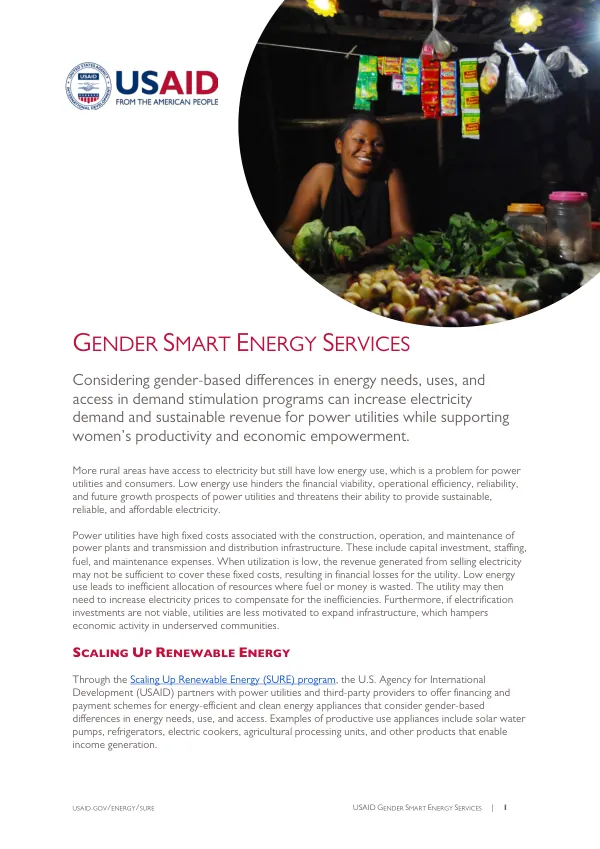
The USAID Gender Smart Energy Services initiative aims to increase electricity demand and sustainable revenue for power utilities while supporting women's productivity and economic empowerment.
2 pages
Sign in to readA free account is required to download.
Abstract
This is achieved by considering gender-based differences in energy needs, uses, and access in demand stimulation programs. Rural areas with access to electricity still exhibit low energy use, posing a problem for power utilities and consumers. Low energy use hinders the financial viability, operational efficiency, reliability, and future growth prospects of power utilities, threatening their ability to provide sustainable, reliable, and affordable electricity. Power utilities face high fixed costs associated with the construction, operation, and maintenance of power plants and transmission and distribution infrastructure. When utilization is low, the revenue generated from selling electricity may not be sufficient to cover these fixed costs, resulting in financial losses for the utility. Low energy use leads to inefficient allocation of resources, where fuel or money is wasted. Utilities may then need to increase electricity prices to compensate for the inefficiencies, which can have a negative impact on consumers. Furthermore, if electrification investments are not viable, utilities are less motivated to expand infrastructure, hampering economic activity in underserved communities. The Scaling Up Renewable Energy (SURE) program, implemented by USAID, partners with power utilities and third-party providers to offer financing and payment schemes for energy-efficient and clean energy appliances that consider gender-based differences in energy needs, use, and access. Examples of productive use appliances include solar water pumps, refrigerators, electric cookers, agricultural processing units, and other products that enable income generation. SURE experts analyze utilities' qualitative and quantitative data to map out electrification infrastructure, consumption patterns, payment behaviors, and other factors that affect the financial viability of electrification efforts. A gender-sensitive demand-stimulation program can engage a larger customer base and increase electricity use. Women represent half of power utilities' customers yet their needs are often underserved. Understanding women's energy needs, use, and access and providing financing for clean energy and energy-efficient appliances helps power utilities better serve women and, in turn, increase their use of electricity. Careful consideration of women as decision makers, buyers, and consumers can result in a larger group of potential customers who are interested in a wider range of electrical applications and ultimately more success in stimulating electricity demand. Electricity demand-stimulation activities make electrification efforts financially viable, increasing the utilities' customer base and revenue from new electricity connections, which can be used to invest in upgrades and recover costs associated with electrification infrastructure. Programs that are gender sensitive enable women and girls to reap the full benefits of electricity while increased use of clean energy and energy-efficient appliances expands energy utilization, optimizes power utility operations, increases power utilities' revenue, and supports a sustainable electricity supply. More women save time and money performing tasks like pumping water, cooking, and washing clothes by using solar-powered water pumps, electric cookers, and energy-efficient washing machines. This allows them to pursue education, participate in the workforce, or start businesses. Women's productivity at home and in businesses increases and in turn contributes to economic growth.
Related documents