INTERNATIONAL LABOR ORGANIZATION
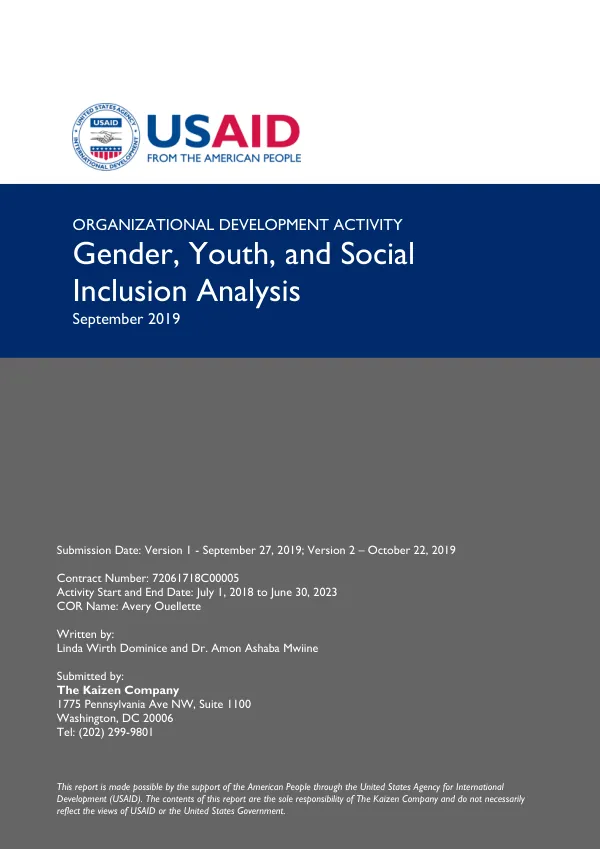
Gender, Youth, and Social Inclusion Analysis for USAID/Uganda ODA
The USAID/Uganda Mission has a long history of collaboration with the government and people of Uganda, dating back to the country's independence in 1962.
2019 · 32 pages
Sign in to readA free account is required to download.
Abstract
The Mission's investment has focused on areas such as health, governance, agriculture, and education, which continue to be the benchmarks of its present-day work. Recently, U.S. bilateral and multilateral assistance to Uganda has emphasized investing in people through education programs, healthcare, and HIV/AIDS; peace and security; economic growth; humanitarian and refugee assistance; and good governance and democracy. The Mission's overall development objective, as enshrined in the Country Development Cooperation Strategy (CDCS 2016-2021), is to ensure Uganda-led, inclusive, and sustainable development in 25 years. To achieve this goal, USAID/Uganda support is geared towards promoting systems that deliver outcomes addressing the needs of all Ugandans, regardless of age, gender, disability, or sexual preferences. These systems are also required to absorb population growth. The CDCS's guiding principles prioritize harnessing youth-appropriate approaches to promote inclusion and participation and addressing issues of the youth in all Mission programs. Additionally, the guiding principles emphasize infusing and prioritizing inclusive development, including but not limited to gender empowerment, throughout the Mission portfolios. The USAID/Uganda Mission has volunteered to undergo an assessment on how it integrates gender, youth, and social inclusion (GYSI) into its internal systems, practices, and staff relations. The analysis evaluates staff capacity for gender and inclusion analysis and the degree to which GYSI is mainstreamed in the overall organizational culture. The GYSI analysis was informed by the International Labor Organization (ILO) Participatory Gender Audit Methodology, adapted to include issues of youth and social inclusion. The assessment used participatory methods, including group discussions with Mission staff in their respective offices, individual interviews, staff surveys, and analysis of key policies and strategic documents in the Mission. Exercises and conversations focused on mapping out institutional commitments in promoting GYSI, institutional culture, and its implication for GYSI. The GYSI analysis covered the following aspects: staff survey, document review, group meetings, individual interviews, and consultations with staff members. The staff survey received 36 responses, with 31% men and 69% women from all Offices. The survey included good practices and recommendations. A total of 50 documents were reviewed, including the CDCS, Gender and social inclusion analysis: Uganda (2017), Project Appraisal Documents (PADs), USAID policies, and Mission Orders (MOs). The team conducted 12 group meetings and 6 individual interviews, and consulted with 78 staff members, including 24 men and 54 women. The assessment aimed to evaluate the Mission's institutional commitments to promoting GYSI, its institutional culture, and its implication for GYSI. The analysis will inform the development of strategies to strengthen the Mission's capacity for GYSI and promote inclusive development throughout its portfolios.