DT GLOBAL
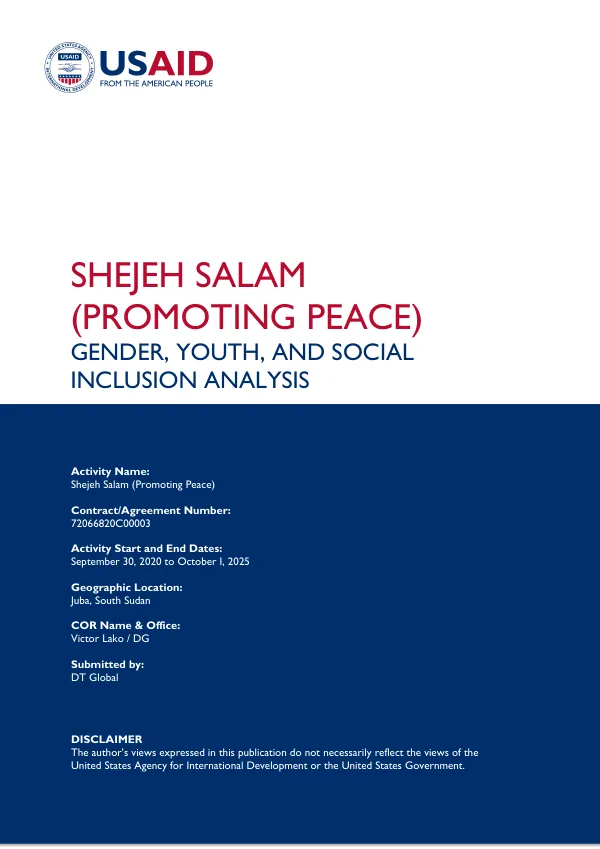
Gender, Youth, and Social Inclusion Analysis: Shejeh Salam (Promoting Peace)
Shejeh Salam, a peace-promoting initiative, was launched in September 2020 and is set to conclude in October 2025.
2021 · 44 pages
Sign in to readA free account is required to download.
Abstract
The activity is focused on promoting peace, civil society, trauma awareness, and media in South Sudan, with a specific emphasis on gender, youth, and social inclusion. The initiative is being implemented in four priority counties: Akobo, Budi, Jur River, and Wau. The study conducted by Shejeh Salam involved over 90 interviews with a diverse range of respondents, including men and women, youth and adults, and individuals from different ethnic and socioeconomic backgrounds. The interviews were conducted using a semi-structured methodology, which allowed for the collection of "life story narratives" that shed light on the intersectional factors contributing to inclusion or exclusion in each location. The study identified several unique situations in each of the four counties. In Akobo County, women are denied equal education opportunities and are treated as property to be sold for dowry, leading to their exclusion from decision-making processes. Insecurity due to revenge killing also makes it difficult for young men to travel in search of economic activity. In Budi County, increased insecurity due to cattle raiding and revenge killing has led to greater food insecurity, with women shouldering the burden of feeding their households. In Wau and Jur River Counties, insecurity is driving poverty and economic exclusion, which in turn leads to reduced political and social inclusion. Despite the differences in each location, several cross-cutting themes emerged that affect inclusion and exclusion across the study areas. These themes include gender disparities, with differences in education opportunities for males and females, as well as gender-based violence, under-age marriage, and regressive cultural practices disadvantaging women. Youth are also often left out of communal processes, particularly those living in cattle camps. Insecurity is driving poverty in all locations, leading to exclusion in social and political realms, as well as economic. Urban/rural divides also exist, with proximity to centers of power and opportunity leading to increased inclusion, while rural populations have limited opportunities for inclusion. The study also highlighted the importance of addressing traditional authorities, who are often wealthy and engaged in communal issues, but may also perpetuate regressive cultural practices. Alternative coping mechanisms, such as family networks and access to refugee camps or other countries, are also being used to cope with food insecurity. The situation in South Sudan is deteriorating, with high levels of violence and food insecurity, and populations are traumatized by the loss of loved ones, personal displacement, and constant fear of violence. The final section of the report outlines programmatic implications and recommendations for addressing social inclusion and exclusion. Shejeh Salam proposes addressing different locations with unique solutions of clustered, layered, and sequenced activities to best address unique situations and distinct patterns of inclusion and exclusion. Targeted activities for marginalized groups, engaging with traditional authorities on gender matters, addressing issues such as pastoralist lifestyles, violence, and food insecurity, and trauma awareness are also recommended. Barriers to education must also be addressed both directly and indirectly. Shejeh Salam has developed a list of initial commitments for addressing social inclusion and exclusion in all of its programming, including refocusing the activity clearance form to more explicitly address social inclusion and developing specific regional social inclusion plans. Medium-term goals include developing a checklist to assist in thinking through social inclusion issues, identifying key roles in conflict and peacebuilding for all groups in targeted counties, and developing specific training materials to address social inclusion with grantees and beneficiaries.