DEPARTMENT FOR INTERNATIONAL DEVELOPMENT
Lessons on Gender, Youth, and Social Inclusion in Zambézia Province, Mozambique
The Integrated Land and Resource Governance (ILRG) program in Mozambique is working to improve land tenure security for women and youth as part of broad-based economic empowerment.
2021 · 15 pages
Sign in to readA free account is required to download.
Abstract
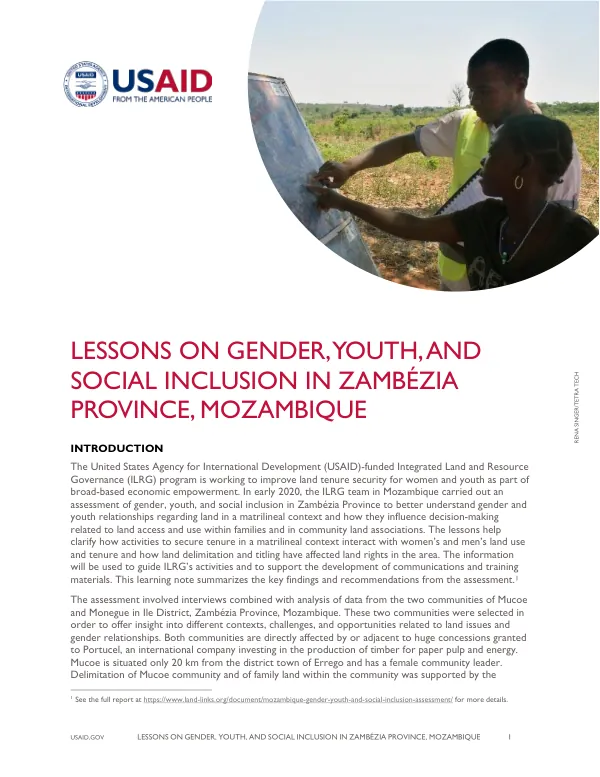
The program is focused on Zambézia Province, where a matrilineal context influences decision-making related to land access and use within families and in community land associations. The ILRG team conducted an assessment of gender, youth, and social inclusion in the province to better understand these relationships and how they interact with land use and tenure. The assessment involved interviews with 71 women, men, and youth in two communities, Mucoe and Monegue, as well as eight interviews with the district government and other local stakeholders. The report compares information from the qualitative interviews with quantitative data from all 25 communities and 13,000 family land parcels involved in the LEGEND and ILRG projects. The assessment aimed to clarify how activities to secure tenure in a matrilineal context interact with women's and men's land use and tenure and how land delimitation and titling have affected land rights in the area. Mozambique's land policy context was established in the 1990 Constitution and built upon in the National Land Policy of 1995 and the Land Law of 1997. The law states that land belongs to the state and cannot be sold, alienated, or mortgaged, but that Mozambican nationals can acquire land rights through inheritance, peaceful occupation, and application to the state. Foreign entities can acquire rights to implement land-based projects, and the state is obliged to consult all interested parties, including local communities, in the process of land rights allocations. In practice, the most important day-to-day land administration activities in rural areas are undertaken by communities and traditional leaders. Most rural residents acquire their land rights through occupation based on customary norms and practices or by good faith occupation for at least 10 years. Traditional leaders are vital to the initial allocation of land to families and in the resolution of conflicts or disputes over land. The traditional leaders are usually older men, with some exceptions, such as in the case of Mucoe, where a female community leader is present. The ILRG program supported the establishment and capacity building of community land associations as legal entities that represent all community members on land and natural resource management. ORAM, a Mozambican organization, implemented two projects in Ile District to identify rights holders and publicly map out the boundaries of the land. The projects facilitated delimitation of community boundaries, resulting in declarations of land rights emitted by the associations, formally identifying land parcels and holders of the land rights. The LEGEND project, financed by the DFID LEGEND Challenge Fund from 2016 through 2019, worked with 20 communities affected by or adjacent to land concessions granted to the paper and pulp company Portucel. This project delimited over 66,000 hectares of community land, including Mucoe, and provided declarations to titleholders. The USAID-funded ILRG program supported five additional communities in Ile District, including delimitation of 13,000 hectares of community land and the systematic mapping of nearly 3,000 family land parcels covering 6,600 hectares. The community land associations provided a declaration of land rights to titleholders for each family land parcel, including details of the parcels, titleholders, witnesses, and community leaders, as well as satellite imagery locating the plots. Together, the two projects helped 25 community associations to provide written declarations of land rights for over 13,000 family and individual parcels, with 70 percent solely in the names of women and a further six percent co-titled to a man and a woman.