USAID DEC
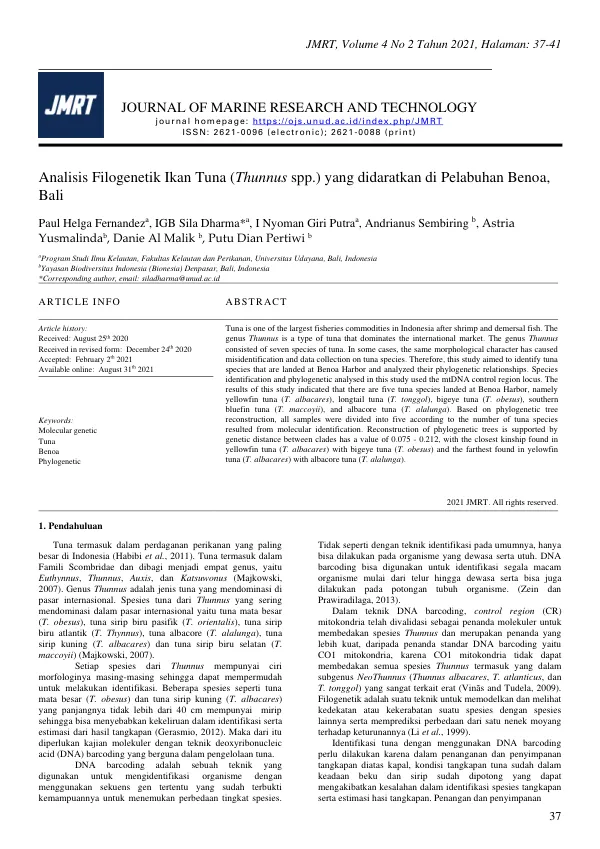
Genetic Diversity of Enhalus acoroides (L.) Royle from Coastal Waters of Pramuka Island, Lembongan Island, and Waigeo Island, Indonesia, Based on Microsatellite DNA
Sign inHUAZHONG AGRICULTURAL UNIVERSITY
Genetic Diversity of Enhalus acoroides (L.) Royle from Coastal Waters of Pramuka Island, Lembongan Island, and Waigeo Island, Indonesia, Based on Microsatellite DNA
Enhalus acoroides is a sea grass species found in most Indonesian marine waters.
2015 · 4 pages
Sign in to readA free account is required to download.
Abstract
It is characterized by its larger size, wider and longer leaves, and high productivity in intertidal zones as a food source for marine biota and carbon sequestration. The species is distributed throughout Indonesia, including Java, Bali, Kalimantan, Sumatra, Papua, Nusa Tenggara, Sulawesi, Ambon, and Papua. In the Seribu archipelago, located off Jakarta's Northern Coast, E. acoroides is reported as one of the common sea grass species. A study was conducted to analyze the genetic diversity of E. acoroides collected from waters of Pramuka Island, Lembongan Island, and Waigeo Island, Indonesia, using microsatellite DNA markers. The study aimed to analyze the genetic diversity and relationships of E. acoroides from these locations. Microsatellite DNA markers have been widely used in genetic diversity and molecular ecology studies, offering several advantages, including high mutation rates and high polymorphism. The study collected samples from the shoreline up to a perpendicular distance of 100 m-200 m during low tide. Young leaf blades of E. acoroides were taken from individuals separated at least 5 m apart. The samples were then transferred to the laboratory for further analysis. DNA was extracted from 0.1 g leaf using Qiagen Plant Mini kit, and PCR was conducted using five primer pairs (Eaco1, Eaco9, Eaco19, Eaco51, Eaco55). The PCR reaction consisted of 1×PCR buffer, 2.5 mm MgCl, 200 μm dNTP, 1U taq polymerase, 0.75 μm each forward and reverse primers, 50 ng template DNA, and sterile water to make up 20 μl PCR reaction. The analysis of heterozygosity showed that E. acoroides from Pramuka Island had the highest value of observed heterozygosity, which was 0.767. Observed heterozygosity at the population at Nusa Lembongan was 0.436, which was slightly lower than that in Waigeo, which was 0.582. The high levels of observed heterozygosity at the waters of Pramuka Island may be due to scattered individual distribution of E. acoroides. A dendrogram using UPGMA based on Euclidean distance showed genetic relationships of a total of 51 E. acoroides samples from waters of Pramuka, Lembongan, and Waigeo Islands. The dendrogram divided all samples into four groups, which were group A, B, C, and D. There is no previous study on genetic relationships of E. acoroides from Indonesian waters, making this the first report on its genetic relationships from three locations in Indonesia. In general, the samples were grouped into their growing locations, although there are some exceptions. Several individuals from Lembongan Island water were grouped with E. acoroides from Waigeo water (Group A). Group C consisted of individuals from waters of Pramuka, Lembongan, and Waigeo Islands. The genetic structure of marine species in Indonesia is also affected by oceanic factors such as ocean current of Indonesian through-flow current that conveys water from the Pacific to the Indian Oceans. This may facilitate gene flow of E. acoroides between locations. The study suggests that there is a possibility of gene flow between the three sampling areas, and more samples and microsatellite primers are needed to further confirm E. acoroides connectivity.