HUAZHONG AGRICULTURAL UNIVERSITY
Genetic variations of Lansium domesticum Corr
The Coral Triangle region, specifically the Bird Seascape of West Papua, is home to a diverse array of molluscs, including the herbivorous gastropod species Turbo sparverius and Turbo bruneus.
2016 · 10 pages
Sign in to readA free account is required to download.
Abstract
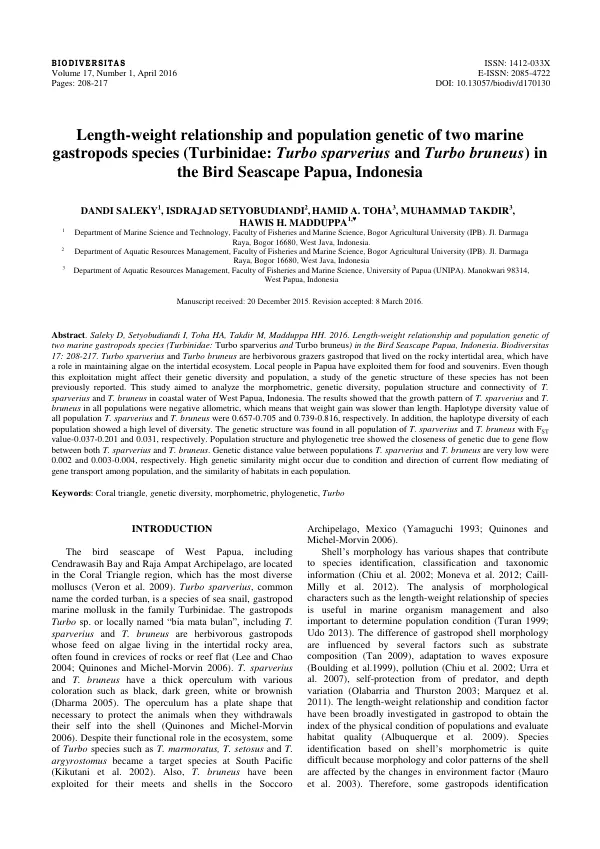
These species, also known as corded turban and brown dwarf turban, respectively, are found in the rocky intertidal area and play a crucial role in maintaining algae on the intertidal ecosystem. Local people in Papua have exploited these species for food and souvenirs, which may affect their genetic diversity and population. The growth pattern of T. sparverius and T. bruneus in all populations was found to be negative allometric, meaning that weight gain was slower than length. Haplotype diversity values for all populations of T. sparverius and T. bruneus ranged from 0.657 to 0.705 and 0.739 to 0.816, respectively. The genetic structure of both species was found to be similar, with FST values ranging from -0.037 to 0.201 and 0.031, respectively. Population structure and phylogenetic tree analysis revealed a high level of genetic similarity between the two species, which may be due to gene flow between them. Genetic distance values between populations of T. sparverius and T. bruneus were found to be very low, ranging from 0.002 to 0.004. This high genetic similarity may be due to the condition and direction of current flow, which mediates gene transport among populations, as well as the similarity of habitats in each population. The study of morphometric, genetic diversity, population structure, and connectivity of T. sparverius and T. bruneus in West Papua has not been previously reported, and this study aimed to analyze these aspects of the species. A total of 179 specimens from four localities throughout West Papua were collected for the study. Turbo sparverius were collected from Manokwari, Teluk Wondama, Sorong, and T. bruneus were collected from Raja Ampat and Manokwari. The samples were collected from the rocky intertidal area during low tide, and the total length and total weight of gastropod shells were measured for each sampled individual. Foot muscle tissues from T. sparverius and T. bruneus were collected and preserved in 96% ethanol for subsequent analysis. Genomic DNA for each sample was extracted using an extraction kit or Chelex, and amplified and sequenced using PCR and Sanger sequencing. The results of the study provide valuable information on the morphometric, genetic diversity, population structure, and connectivity of T. sparverius and T. bruneus in West Papua, which is essential for marine management and conservation. The study highlights the importance of genetic diversity in maintaining the health and resilience of populations, and the need for conservation efforts to protect these species and their habitats. The analysis of population structure aims to examine the dynamics of natural populations, and life history traits and gene flow are strongly affected by population structure. Genetic connectivity plays a central role in conservation, as it helps maintain population and restoration from damages. The study of morphometric, genetic diversity, population structure, and connectivity of T. sparverius and T. bruneus in West Papua provides a comprehensive understanding of the species and their habitats, which is essential for effective conservation and management strategies.
Related documents